AI-Powered Workforce Analytics: Driving Smarter HR Decisions and Talent Growth
The global workforce faces a projected talent shortage of 85 million by 2030, creating significant challenges for organisational productivity and growth. Traditional HR practices, often reactive and subjective, are insufficient to address the dynamic demands of modern talent management. Artificial i
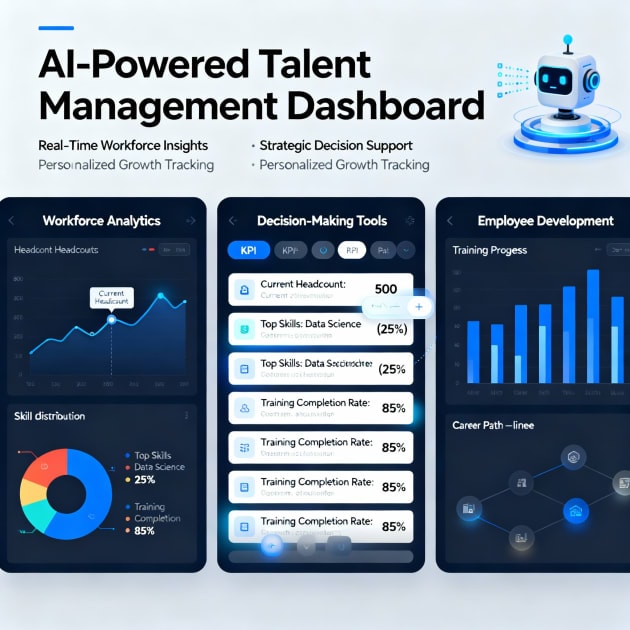
AI for Talent Management: Enhancing Workforce Analytics, Decision-Making, and Employee Development
Dr. Rubvita Chadha
Introduction
By 2030, the global talent shortage is expected to reach 85 million people, threatening productivity and growth across industries (Korn Ferry, 2018). This looming challenge highlights the urgent need for organisations to rethink their approaches to attracting, developing, and retaining talent. Traditional human resource management practices—often reactive, biased, and inefficient—are proving insufficient to meet the demands of a rapidly evolving workforce landscape. One powerful solution lies in adopting artificial intelligence (AI) within talent management.
AI offers organisations the ability to improve workforce analytics, streamline hiring, reduce bias, and enhance decision-making. Rather than replacing HR professionals, AI complements human judgment by delivering data-driven insights and automating repetitive tasks. This article explores how AI can be strategically applied across end-to-end talent management—specifically in workforce planning, recruitment, performance management, succession planning, and employee engagement—while addressing key challenges in talent strategies.
AI’s Role in Talent Management
AI extends beyond automation to bring speed, accuracy, and predictive power to talent processes. Its ability to process large datasets, identify hidden patterns, and provide real-time insights helps HR leaders transition from reactive to proactive workforce planning (Tambe, Cappelli, & Yakubovich, 2019).
Key advantages include:
Scalable analytics: AI can analyse workforce data alongside external labor market trends, helping organisations predict skills shortages and future hiring needs (Huang & Rust, 2021).
Data-driven decision-making: By eliminating subjectivity, AI ensures more consistent and equitable hiring and promotion practices (Raisch & Krakowski, 2021).
Automation of routine HR tasks: From resume screening to employee survey analysis, AI reduces manual work, allowing HR professionals to focus on strategic initiatives (Bersin, 2018).
Personalisation: AI can create adaptive learning and career development pathways, enhancing employee engagement and retention (Black & van Esch, 2021).
Addressing Key Challenges in Talent Management with AI
1. Outdated Hiring Practices
Traditional hiring often emphasises job titles and qualifications instead of skills. AI helps overcome this by enabling skills-based hiring through predictive matching algorithms that evaluate candidates on competencies and potential. AI-powered resume screening tools, for example, filter applicants objectively and speed up recruitment. Hilton Hotels successfully implemented an AI recruitment platform to evaluate larger candidate pools more efficiently, improving both hiring speed and quality (SHRM, 2020).
2. Bias and Subjectivity in Talent Decisions
Bias in promotions and hiring remains a pervasive issue. AI-powered assessment tools help reduce these problems by standardizing evaluation processes. Moreover, bias-detection algorithms analyse historical HR data to identify patterns of unconscious discrimination. Unilever, for example, adopted AI-driven assessments during recruitment, which helped evaluate candidates through objective skill tests, leading to more equitable hiring outcomes (Upadhyay & Khandelwal, 2018).
3. Reactive Workforce Planning and Skills Gaps
Organizations that rely on reactive workforce planning often struggle with unfilled roles and rushed recruitment. AI-enabled predictive analytics forecast turnover, detect future skills gaps, and recommend targeted upskilling interventions. This proactive approach enhances organisational agility and resilience (Bughin et al., 2018).
Applications of AI in Talent Management
1. AI-Driven Talent Identification and Hiring
AI-powered screening tools prioritise candidates based on competencies rather than pedigree.
Talent marketplaces leverage machine learning to match employees to roles dynamically, fostering internal mobility.
Predictive algorithms identify external candidates proactively, creating robust talent pipelines.
2. Objective Decision-Making
AI-based assessments objectively evaluate candidate skills and cultural fit.
Diversity, equity, and inclusion (DEI) analytics track organisational fairness in hiring and promotions.
Bias detection algorithms highlight inequities in pay, promotion, and workforce representation.
3. Personalised Employee Development
AI enables tailored career paths and adaptive training programs, ensuring employees receive the right learning opportunities at the right time. Personalised recommendations for skill development not only improve employee engagement but also align with organisational talent needs (Jarrahi, 2018).
4. Workforce Planning and Succession Management
By integrating workforce analytics with predictive modelling, AI supports succession planning by identifying high-potential employees and forecasting future leadership needs. This reduces leadership gaps and ensures continuity (Minbaeva, 2021).
Balancing AI and Human Judgment
Despite its advantages, AI should not replace human judgment in HR. While AI enhances efficiency and objectivity, HR professionals remain essential in interpreting results, maintaining empathy, and ensuring fairness. Overreliance on algorithms risks reinforcing existing biases if not carefully monitored (Caliskan, Bryson, & Narayanan, 2017). Thus, the ideal model is a human-AI partnership where technology provides insights and HR leaders contextualise them to support people-first strategies.
Conclusion
AI is reshaping workforce analytics and talent management by enabling organizations to address outdated hiring practices, reduce bias, and adopt proactive workforce planning. Its applications in recruitment, performance management, succession planning, and employee engagement provide organisations with tools to build agile, future-ready workforces. However, organisations must adopt AI responsibly, ensuring transparency, ethical use, and alignment with human judgment.
As the global talent shortage intensifies, AI is no longer a “nice-to-have” but a critical enabler of sustainable talent strategies. By strategically embedding AI into HR, organisations can create data-driven, unbiased, and forward-thinking approaches to workforce management—strengthening their resilience and competitiveness in the digital age.
References
Bersin, J. (2018). AI in HR: A Real Killer App. Deloitte Insights.
Black, J. S., & van Esch, P. (2021). AI-enabled recruiting: What is it and how should a manager use it? Business Horizons, 64(1), 49-59.
Bughin, J., Seong, J., Manyika, J., Chui, M., & Joshi, R. (2018). Notes from the AI frontier: Modeling the impact of AI on the world economy. McKinsey Global Institute.
Caliskan, A., Bryson, J. J., & Narayanan, A. (2017). Semantics derived automatically from language corpora contain human-like biases. Science, 356(6334), 183-186.
Huang, M.-H., & Rust, R. T. (2021). Artificial intelligence in service. Journal of Service Research, 24(1), 3-20.
Jarrahi, M. H. (2018). Artificial intelligence and the future of work: Human-AI symbiosis in organisational decision making. Business Horizons, 61(4), 577-586.
Korn Ferry. (2018). Future of work: The global talent crunch. Korn Ferry Institute.
Minbaeva, D. (2021). The role of HRM in the digital age: Why HRM’s role is more important than ever. Human Resource Management Review, 31(2), 100744.
Raisch, S., & Krakowski, S. (2021). Artificial intelligence and management: The automation–augmentation paradox. Academy of Management Review, 46(1), 192-210.
SHRM. (2020). Hilton Uses AI to Enhance Recruitment Process. Society for Human Resource Management.
Tambe, P., Cappelli, P., & Yakubovich, V. (2019). Artificial intelligence in human resources management: Challenges and a path forward. California Management Review, 61(4), 15-42.
Upadhyay, A. K., & Khandelwal, K. (2018). Applying artificial intelligence: Implications for recruitment. Strategic HR Review, 17(5), 255-258.