Empowering the Marginalized: How Green Jobs Can Serve as a Sustainable Pathway Out of Poverty in Emerging Economies
This paper examines how green employment can reduce poverty and promote sustainable development in developing economies. It explores theories, evidence, and models showing how well-designed green jobs can empower marginalized groups and strengthen economic and environmental resilience.
Introduction:
The ILO defines green jobs as work that improves environmental quality by reducing energy, material, and water use, cutting emissions, and minimizing waste. These jobs are increasingly viewed as a means to alleviate poverty and support sustainable growth. As environmental degradation worsens poverty in developing nations, expanding green employment offers a vital opportunity to link environmental sustainability with inclusive economic development (Bradley, Whittard, Green, Brooks, & Hanna, 2025; Gehrke & Hartwig, 2015; Shackleton et al., 2024).
Literature Review
Some Selected Seminal Empirical and Conceptual Works:
The research highlights that green jobs are vital for combining environmental protection with poverty reduction. The UNDP’s Working for Water programme in South Africa showed how nature-based employment can enhance livelihoods (Shackleton et al., 2024). Studies by the ILO (2023) and others indicate that jobs in renewables, sustainable agriculture, and waste management boost income, skills, and rights, especially in the Global South (Gehrke & Hartwig, 2015; Van der Ree, 2022). Systematic reviews stress the need for coherent policies to ensure green sector growth translates into quality, inclusive employment (Barford, 2024; Hochstetler, 2025; Tiba, 2019). Additionally, urban green infrastructure and circular economy approaches have proven effective in reducing multidimensional poverty and strengthening community resilience resilience (Sovacool, Kim, & Yang, 2021; Van der Ree, 2019). The studies agree that green jobs reduce poverty most effectively when paired with policies supporting training, social protection, finance access, and local entrepreneurship (Hochstetler, 2025; Shackleton et al., 2024).
Theoretical Framework:
The study draws on three key frameworks: the Sustainable Livelihoods Approach, which emphasizes building skills, resources, and resilience for marginalized groups; Green Growth Theory, which promotes economic progress alongside environmental protection and social inclusion; and Environmental Justice, which ensures fair distribution of environmental benefits and burdens. Together, these frameworks show how targeted green job initiatives can reduce poverty through skill development, equity, and sustainable economic structures (Gehrke & Hartwig, 2015).
Proposed Conceptual Model
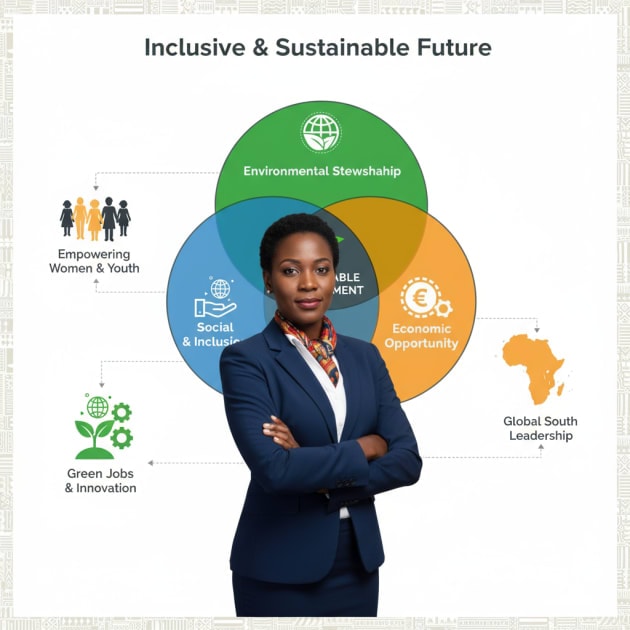
The proposed model links green economy principles, poverty reduction mechanisms, and social inclusion. It shows how policies promoting access to green jobs enhance skills, entrepreneurship, and equity - creating feedback loops that empower marginalized groups and drive sustainable development.
Pathways Out of Poverty
Researchers equally agree that green jobs help reduce poverty by building long-term skills in sustainable sectors, ensuring decent working conditions that promote equality and safety, and enhancing economic resilience through diversified, climate-resistant income sources (Ahmed, Gui, Qi, & Liu, 2022; Hochstetler, 2025 Shackleton et al., 2024; Van der Ree, 2019).
Policy Analysis:
National and international policies support green job creation through coordinated incentives and programs. For instance, in India, subsidies, tax breaks, and training initiatives - such as rooftop solar and electric vehicle programs, they have expanded green employment (Ahmed et al., 2022; Hochstetler, 2025). Globally, the ILO’s just transition guidelines and the UN’s PAGE initiative link skills training, entrepreneurship, and public investment to align poverty reduction with sustainable economic and environmental goals (Hochstetler, 2025; Shackleton et al., 2024).
Challenges and Limitations
Key challenges to green job expansion include a skills gap among disadvantaged groups, limited access to finance for small enterprises, policy fragmentation that hinders coordination, and insufficient social protection for workers transitioning from fossil fuel sectors (Ahmed et al., 2022; Hochstetler, 2025; Shackleton et al., 2024).
Conclusion and Recommendations
When included in broad development plans, green employment is a very promising approach to help poor communities in emerging nations get out of poverty. To have the most effect, governments and civil society should work together on policies that help people learn new skills, fill up the gaps in financing for the poor, make sure that workers' rights are protected, and make green jobs a part of larger social protection and industrial initiatives. For long-term poverty reduction and a fair transition in the years to come, it is important to invest in green employment programs that are inclusive and well-designed.
References:
Ahmed, Z., Gui, D., Qi, Z., & Liu, Y. J. I. D. (2022). Poverty reduction through water interventions: A review of approaches in sub‐Saharan Africa and South Asia. 71(3), 539-558.
Barford, A. (2024). Avoiding the decent work deficits of the circular economy. In Rethinking Economic Transformation for Sustainable and Inclusive Development (pp. 103-122): Edward Elgar Publishing.
Bradley, P., Whittard, D., Green, E., Brooks, I., & Hanna, R. J. S. F. (2025). Empirical research on green jobs: A review and reflection with practitioners. 9, 100527.
Gehrke, E., & Hartwig, R. (2015). How can public works programmes create sustainable employment? : Discussion Paper.
Hochstetler. (2025). The green economy and the Global South. 19(2), 515-519.
Lima, M. G. B. J. F. P. (2022). Just transition towards a bioeconomy: Four dimensions in Brazil, India and Indonesia. 136, 102684.
Shackleton, C. M., Brom, P., Gwedla, N., Matamanda, A. R., Sardeshpande, M., & Kumar-Nair, S. J. C. (2024). Embedding opportunities for poverty alleviation in urban green infrastructure design and management using South Africa as a case example. 155, 105442.
Sovacool, B. K., Kim, J., & Yang, M. J. E. R. (2021). The hidden costs of energy and mobility: A global meta-analysis and research synthesis of electricity and transport externalities. 72, 101885.
Tiba, S. (2019). A non-linear assessment of the urbanization and climate change nexus: the African context. 26(31), 32311-32321.
Van der Ree, K. (2019). Promoting green jobs: Decent work in the transition to low-carbon, green economies. In The ILO@ 100 (pp. 248-272): Brill Nijhoff.
Van der Ree, K. (2022). Green jobs recovery through employment policies: guidelines for shaping employment policies that support a green recovery and a just transition: ILO.