How Netflix, Google, and Amazon Use AI to Keep You Coming Back
In this article learn how Netflix, Google, and Amazon utilize AI to make their services more personalized to improve user experiences, meet their demands, and keep them coming back. Discover how Netflix's smart suggestions, Amazon's proactive service, and Google's adaptive technologies keep millions
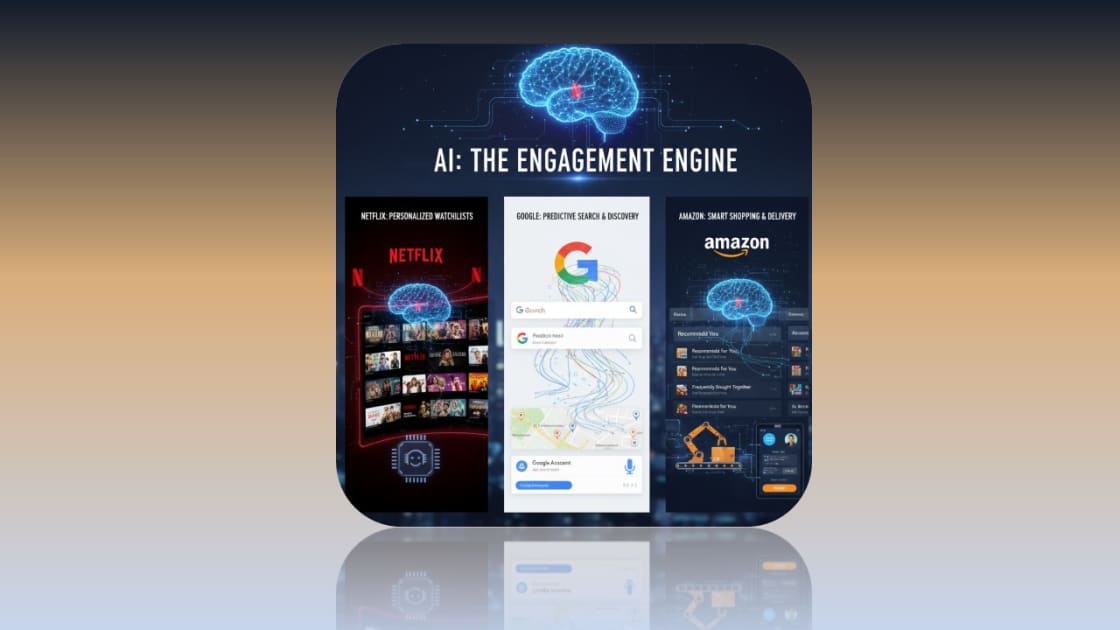
How Netflix, Google, and Amazon Use AI to Keep You Coming Back
AI as the Unseen Customer Whisperer
Have you ever thought about how Netflix seems to know exactly what show you want to watch next? Or how Amazon suggests things you didn't even know you needed? Or how Google keeps Gmail and YouTube running smoothly for billions of people around the world?
The key is AI, or artificial intelligence. AI systems are not futuristic robots; they are already a part of our daily lives, working behind the scenes to anticipate our needs, stop problems before they happen, and give us experiences that are very personal.
AI has changed the game in marketing and getting people to interact with your business. Businesses don't wait for customers to complain, leave, or get frustrated anymore. Instead, they're using AI to find problems before they happen and give customers proactive solutions that make them happy.
Netflix, Google, and Amazon are three of the biggest companies in the world that are leading the way in this area. This article goes into great detail about how they use AI to keep you coming back.
Why Predictive AI is imperative for Customer Experience
Customers call customer service when they have a problem and wait for help. This is how regular customer service works. This model has worked for decades, but it often makes customers unhappy .
AI turns this model on its head by making service proactive:
• It can tell when customers are unhappy and stop it from getting worse.
• It finds technical problems before they affect millions of people.
• It personalizes solutions, helping customers feel valued.
This service is like a friend who knows you well and is always one step ahead of you in making your life easier.
According to a report from McKinsey (2021), businesses that utilize AI-driven personalization have customers who are 10–20% happier and generate up to 15% more revenue than those that do not.
Netflix: Personalization That Feels Like Magic

One of the best AI recommendation systems in the world is Netflix's. Gomez-Uribe and Hunt (2016) report that algorithms suggest more than 80% of what people watch on Netflix.
This is how it works:
• The AI checks your viewing history, like what you watched, paused, or gave up on.
• The AI examines your viewing habits and compares them to those of millions of other people who watch similar content, then it guesses what you will watch next and displays it on your home screen.
This system isn't just for types of music. For instance, Netflix's AI will notice and change if you like thrillers with strong female leads or comedies that are less than 30 minutes long.
Spotting At-Risk Users
Netflix also uses predictive AI to detect signs of churn (customers canceling subscriptions). If you haven’t logged in for weeks, the system knows you may be losing interest. To re-engage you, Netflix might:
Send you an email highlighting the new release.
Showcase trending shows in your country.
Offer tailored suggestions to get you hooked again.
This approach ensures customers feel valued and keeps churn rates low.
Google: AI as the Guardian of Seamless Service
AI-Powered Outage Detection
With billions of users throughout the world, Google operates enormous platforms, including Gmail, YouTube, and Google Drive. Suppose that a single system error affected 1% of users, or tens of millions.
It uses AI systems that keep an eye on performance all the time to prevent things from getting out of control. These systems look for sudden drops in activity, login issues, or unusual spikes in error rates. AI alerts engineers so they know right away if it sees something strange, often before users even notice
For instance, AI systems will identify the problem and report it for a quick fix if Gmail logins stop working in a specific city. Often, engineers resolve the issue before it impacts the majority of users.
Smart User Experience Enhancements
Beyond outages, AI also makes Google products smarter in everyday use:
Gmail’s Smart Reply suggests short responses based on your writing style.
Google Photos automatically organizes pictures and creates albums.
YouTube recommendations adapt to your viewing habits, keeping you engaged longer.
These features are subtle but powerful. By removing friction and predicting user needs, Google keeps billions of people loyal to its ecosystem.
Amazon: AI That Anticipates Your Shopping Needs
Personalized Shopping Journeys
The AI-powered recommendation engine at Amazon makes up 35% of the company's total revenue (McKinsey, 2021). The system looks at your browsing and purchase history every time you shop.
• It keeps track of the items you've added to your cart and those you've left behind.
Similar products bought by other users.
It uses this information to predict which product you'll buy next and puts it right in front of you. That's why you often see sections like "Customers who bought this also bought..." or "Recommended.”
Proactive Problem Solving
Amazon prioritizes customer satisfaction by simplifying processes and incorporating small gestures to demonstrate their concern.
Delays in shipping: If your package is late, AI systems automatically send you an apology email, explain why it is late, and sometimes even offer you a credit before you contact support.
Payments that didn't go through: Instead of shutting down your account, AI gives you a simple link to change your payment information.
Confusion among customers: If users have trouble with a new feature, AI can automatically send them tutorials or chat support suggestions.
Amazon makes customers feel cared for by cutting down on their frustration and integrating personal touches.
AI in Marketing and Retention
Tech titans like Netflix, Google, and Amazon are not the only ones doing this. An increasing number of companies are using predictive AI in their marketing strategies. Retailers use artificial intelligence (AI) to identify when customers empty their shopping carts and send personalized discounts.
Travel agencies forecast cancellations and provide flexible solutions ahead of time; banks use AI to identify suspicious activity and stop fraud in real time.
AI-powered advertising is starting to become mainstream. 73% of customers believe that experiences that leverage personal data to produce more relevant interactions are "critical" in fostering brand loyalty, according to PwC (2022).
AI as the Future of Customer Loyalty
The strategies used by Netflix, Google, and Amazon reveal a clear truth: AI is no longer just a buzzword- it's the most important part of the user experience.
By analyzing behavior, predicting problems, and offering timely solutions, AI makes interactions feel personal, seamless, and proactive.
For businesses, the message is clear:
• Don't only respond to customers; think forward about what they might require.
• Use AI to make things less frustrating, tailor experiences to each person, and establish loyalty.
• Understand that retaining existing customers is often more important than acquiring new ones in a competitive industry.
And what about us, the customers? This means we experience less time spent waiting, reduced stress, and a feeling that the companies we interact with genuinely care about us.
AI may not be able to read minds, but it is coming very close. This is why businesses like Netflix, Google, and Amazon will continue to attract us.
References
Dean, J. (2019). The Deep Learning Revolution at Google: An Inside Look. Google Research Blog.
Gomez-Uribe, C. A., & Hunt, N. (2016). The Netflix Recommender System: Algorithms, Business Value, and Innovation. ACM Transactions on Management Information Systems (TMIS), 6(4), 13.
McKinsey & Company. (2021). The State of AI in 2021. McKinsey Global Survey.
PwC. (2022). Customer Loyalty Survey 2022: What Matters Most to Today’s Consumers. PwC Research.