India's Online Gaming Industry Crisis: A Comprehensive Case Study on Employee Impact and Career Disruption
India's 2025 gaming ban eliminated ₹25,000 crore investments, displacing 2 lakh workers. The crisis reveals regulatory risks in digital sectors and the critical need for skill diversification.
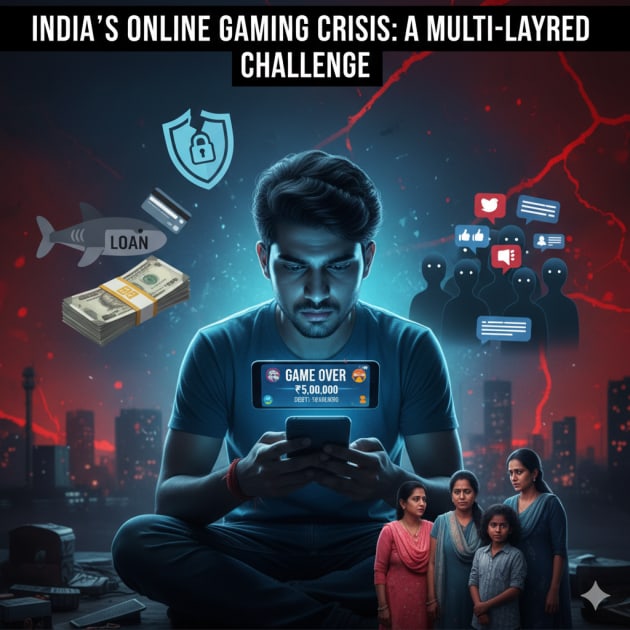
India's Online Gaming Industry Crisis: A Comprehensive Case Study on Employee Impact and Career Disruption
Abstract
India's Promotion and Regulation of Online Gaming Bill 2025 created an unprecedented industry crisis, forcing major platforms, including Dream11, MPL, and Zupee, to suspend all real-money gaming operations. This case study examines the cascading effects on approximately 2 lakh employees across 4 lakh companies, with ₹25,000 crore in investments at risk. The analysis reveals differential impacts based on role transferability: technical professionals face better transition prospects while gaming-specific roles experience significant career disruption. Key findings highlight the critical importance of regulatory risk management, skill diversification, and adaptive career planning in volatile digital industries. The study provides a strategic framework for employee career transition, organizational crisis management, and industry transformation. Through examination of immediate displacement effects, long-term career implications, and emerging opportunities in eSports and social gaming, this research offers practical guidance for navigating sudden regulatory shifts that can instantly transform entire industry ecosystems.
INTRODUCTION
The Perfect Storm: From Boom to Ban
The Indian online gaming industry's meteoric rise came to an abrupt halt in August 2025 when Parliament passed the Promotion and Regulation of Online Gaming Bill 2025, creating what industry insiders describe as a "regulatory earthquake." This legislation didn't emerge in isolation but was the culmination of mounting concerns about gambling addiction, youth participation in real-money games, and several high-profile cases of financial distress linked to excessive gaming.
The bill's passage marked the end of a golden era for Indian gaming startups. Companies like Dream11 had grown from ambitious startups to unicorn valuations, riding the wave of India's cricket obsession and smartphone penetration. MPL had successfully positioned itself as the "Olympics of mobile gaming," while platforms like Zupee had carved niches in quick-play cash games. These companies had collectively raised billions in funding, hired thousands of employees, and created an ecosystem that many believed would define India's digital entertainment future.
The Legislative Avalanche
The Promotion and Regulation of Online Gaming Bill 2025 banned all real-money online gaming, including fantasy sports, poker, rummy, and skill-based competitions. It treated all cash-based contests as gambling, without differentiating between skill and chance. Supporters claimed it was essential for protecting vulnerable populations, while critics argued it would stifle innovation and eliminate legitimate business models. The bill's immediate implementation required companies to suspend all real-money operations within 48 hours of approval, leaving no time for adaptation or exit strategies. While the legislation encouraged eSports and social gaming platforms without monetary transactions, companies reliant on transaction fees faced a fundamental shift in their business models rather than a simple transition.
The Domino Effect Across India's Gaming Giants
The recent approval of new parliamentary legislation marks a crucial moment for India's gaming industry, prompting major players to adapt. Dream11, valued at $8 billion and with over 180 million users, has suspended all cash contests to comply with the law. The CEO stated this difficult decision reflects their commitment to legal operation. Mobile Premier League (MPL), previously valued at $2.3 billion, has restructured its workforce, reducing it by 60%, while continuing to offer free games and seeking new revenue opportunities beyond cash tournaments. Other platforms like Zupee, PokerBaazi, My11Circle, and WinZO have also paused cash-related activities, causing a ripple effect that impacts marketing agencies and esports organizations reliant on these companies. Though these changes present challenges, they also create opportunities for innovation as the industry adapts to the new legal landscape.
The Human Cost: A Workforce in Transition
The ban on real-money gaming in India has triggered immediate mass layoffs, led to skill obsolescence, and placed thousands of highly specialized professionals into a career crisis, most severely impacting tech hubs like Bangalore and Mumbai.
Impact on Human Resources
Massive layoffs: Companies including MPL have laid off up to 60–100% of their Indian workforce, with industry estimates suggesting more than 200,000 direct job losses and up to 300,000 affected if outsourced roles are considered.
Obsolescence of skills: Many roles—especially in marketing, user acquisition, game design, fraud detection, and data analytics—have become largely obsolete domestically, making it hard for workers to transfer their expertise to other sectors, especially for non-engineering roles.
Geographical concentration: The crisis is most acute in tech cities like Bangalore, Mumbai, and Hyderabad, flooding local job markets with highly skilled—but niche—talent, intensifying competition for roles while the broader tech sector slows.
Wider economic and sectoral effects: The fallout extends to advertising, fintech, content creation, and payment gateways, affecting professionals in adjacent industries due to the interconnected nature of these business models.
Psychological and Financial Consequences
Workers in their 30s and 40s, with mortgages and young families, now face both financial strain and serious career insecurity after investing years in a now-vaporized sector.
The abruptness—with the ban enacted in just days—removed safety nets, leaving many without severance or transition support unless voluntarily provided by companies.
The Path Forward
Pivot and upskilling challenges: Tech professionals with transferable skills (software engineering, AI) may pivot to broader tech, but less tech-focused roles (e.g., digital marketing tailored to real-money gaming) have limited alternatives and require retraining.
Shift to other verticals: Some companies are exploring pivots to free-to-play and esports, but these models may not absorb anywhere near the same workforce size or skill sets.
Government support: The government has acknowledged the crisis and assured support, but as of now has not provided concrete retraining or transition measures, making future prospects highly uncertain for many workers.
Risk of talent and capital flight: Major gaming platforms and entrepreneurs are exiting India, relocating teams and investment to the US and other markets, risking a long-term loss of talent and digital innovation from India.
Key Human Resource Consequences
Severe disruption in workforce stability, with thousands of employees applying for jobs in a saturated market.
Uncertainty in career trajectories for specialized talent, many of whom had moved to gaming from other corporates for better prospects.
Potential contagion effect on adjacent sectors dependent on gaming, such as fintech and advertising, eroding business sentiment and investor confidence.
The ban’s human resource ramifications are profound, risking not only direct job losses but also broader professional destabilization, industry exodus, and diminished prospects for highly skilled workers in India’s tech economy.
Market Dynamics and Investment Implications
The recent regulatory changes present an opportunity for re-evaluating financial strategies within the gaming sector, influencing market dynamics and investment patterns. Valuations of leading gaming companies like Dream11 ($8 billion) and MPL ($2.3 billion) are under review, which allows venture capital firms to recalibrate their investment approaches in a shifting landscape. Although some planned funding rounds have been put on hold, this situation encourages businesses to refine their strategies and focus on long-term viability. This policy shift also invites a discussion about India’s digital policy environment, which, while perceived as more uncertain, could prompt improvements that enhance transparency and reliability for foreign investors. Addressing these concerns has the potential to strengthen India's position in attracting future investments across various tech sectors. Moreover, the postponement of international gaming companies entering the Indian market could lead to increased innovation and competition within the domestic landscape. In response, several Indian companies are taking proactive steps towards international expansion, opening up new avenues for growth and creating exciting international career opportunities for employees willing to explore these paths.
Conclusion and Future Outlook
The Online Gaming Bill 2025 marks a turning point for India’s digital entertainment industry, demonstrating how regulatory changes can rapidly transform sectors and careers. While the immediate impact presents challenges for employees and companies, it also creates opportunities for innovation and international expansion. This situation underscores the importance of effective regulatory risk management, skill diversification, and strategic career planning in the digital industry. Companies that successfully navigate this transition will strengthen their business models and build more adaptable workforces. For affected individuals, this period offers a chance to broaden their career paths and enhance resilience against future shifts. The gaming sector's technical talent remains a crucial asset for India's technology ecosystem. The key challenge is for the industry, government, and educational institutions to collaborate effectively, ensuring that the skills developed in gaming are applied across various sectors while fostering balanced regulatory frameworks for the future.
Further Reading
1. Agarwal, S., & Kumar, R. (2024). Regulatory uncertainty in emerging digital markets: A framework for business resilience. Journal of Indian Business Strategy, 15(3), 245-267.
2. Chopra, M. (2025). The rise and fall of India's fantasy sports industry: Policy implications and market dynamics. Economic and Political Weekly, 60(8), 34-42.
3. Das, P., & Sharma, A. (2024). Digital entrepreneurship and regulatory risk: Lessons from India's startup ecosystem. Harvard Business Review India, 12(4), 78-89.
4. Ernst & Young. (2025). India gaming report 2025: Navigating regulatory challenges and market transformation. EY Publications.
5. Gupta, N., Singh, K., & Patel, V. (2024). Career transitions in disrupted industries: A study of skill transferability and professional adaptation. Academy of Management Perspectives, 38(2), 156-174.
6. International Association of Gaming Regulators. (2024). Global trends in online gaming regulation: Comparative policy analysis. IAGR Press.
7. Jain, R. (2025). From unicorns to uncertainty: The regulatory reckoning of India's digital economy. Business Standard Management, 18(1), 12-19.
8. McKinsey & Company. (2024). The future of work in regulated industries: Preparing for policy-driven disruption. McKinsey Global Institute.
9. Nair, L., & Reddy, S. (2025). Employee welfare and corporate responsibility during industry crises: Case studies from India's tech sector. Indian Journal of Industrial Relations, 60(3), 423-441.
10. Verma, A., & Krishnan, P. (2024). Policy advocacy and industry associations: Building resilience in volatile regulatory environments. Sage Publications India.
References
2. https://www.sae.edu/gbr/insights/how-game-development-skills-transfer-to-other-tech-fields/
4. https://insightsoftware.com/blog/10-video-game-skills-that-make-you-a-better-employee/
5. https://www.reddit.com/r/gamedev/comments/1h5x3i6/how_transferable_are_game_dev_skills/