Problem-Based Learning (PBL) in Organizational Behaviour and Human Resources
Problem-Based Learning (PBL) represents a transformative pedagogical approach that fundamentally shifts educational focus from traditional knowledge transmission to active learning through real-world problem solving. In the interconnected fields of Organizational Behaviour and Human Res
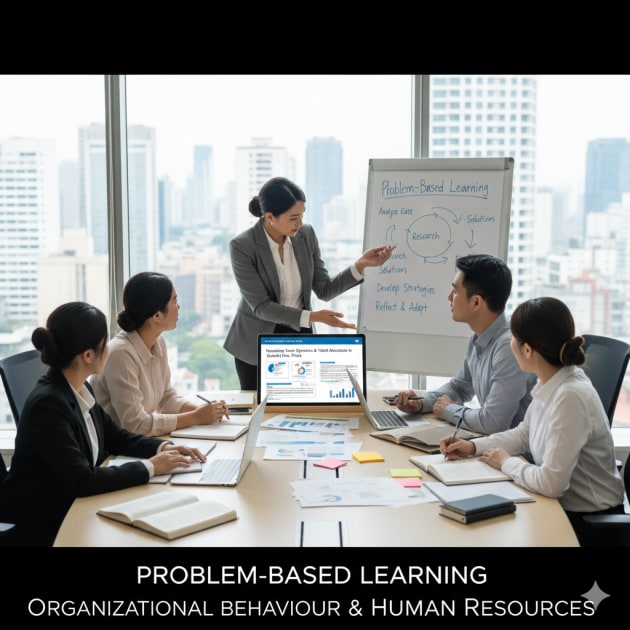
Problem-Based Learning (PBL) in Organizational Behaviour and Human
Resources
Introduction
Problem-Based Learning (PBL) represents a transformative pedagogical approach that
fundamentally shifts educational focus from traditional knowledge transmission to active
learning through real-world problem solving. In the interconnected fields of Organizational
Behaviour and Human Resources, this methodology proves particularly valuable as it mirrors
the complex, ambiguous challenges professionals face daily in workplace environments.
Unlike conventional educational approaches that emphasize memorization and theoretical
understanding, PBL engages students with multifaceted scenarios requiring synthesis of
knowledge from multiple disciplines. This learner-centered methodology empowers students
to conduct independent research, integrate theoretical frameworks with practical applications,
and develop viable solutions to complex organizational challenges.
Theoretical Foundations and Origins
The conceptual roots of PBL trace back to the 1960s at McMaster University's medical school,
where educators sought more effective ways to prepare students for real-world practice. The
approach draws from several influential pedagogical theories, including John Dewey's
emphasis on intrinsic interest and learning through experience, Jerome Bruner's "learning by
discovery" principle, and Harvard Business School's pioneering case-based methodology.
Constructivist learning theory provides the primary theoretical foundation for PBL, positing
that learners actively construct knowledge through experience rather than passively receiving
information. This aligns with the understanding that meaningful learning occurs when students
interact with their environment, reflect on these interactions, and build understanding through
collaborative problem-solving processes.
The methodology operates on four core elements: engagement with ill-structured problems
that mirror real-world complexity, substantive content engagement that requires deep
understanding, student apprenticeship in professional thinking, and self-directed learning that
develops autonomous learning capabilities.
Application in Organizational Behaviour Education
Within Organizational Behaviour curricula, PBL creates immersive learning environments
where students confront complex organizational dilemmas reflecting authentic workplace
scenarios. Students engage with challenges involving group dynamics, leadership conflicts,
organizational culture transformation, and change management initiatives that require
sophisticated analytical and interpersonal skills.
This experiential approach enables students to develop nuanced understanding of human
behavior within organizational contexts. They learn to conduct diagnostic analyses of
workplace situations, design targeted interventions, and implement strategic solutions while
considering multiple stakeholder perspectives. Through collaborative problem-solving,
students cultivate essential competencies including complex reasoning, strategic thinking,
empathetic engagement, and adaptive leadership.
The interdisciplinary nature of organizational behavior, drawing from psychology, sociology,
and anthropology, provides rich foundations for PBL exercises. Students must synthesize
knowledge across these domains to address intricate human and organizational challenges,
developing transferable skills that extend beyond academic settings into professional practice.
Implementation in Human Resources Education
Human Resources education particularly benefits from PBL given the field's inherently
practical and interpersonal nature. HR professionals must regularly address complex scenarios
involving talent acquisition, employee relations, performance management, organizational
development, and compliance issues that require both technical knowledge and sophisticated
interpersonal skills.
PBL in HR education immerses students in realistic dilemmas that bridge the gap between
academic theory and workplace realities. Students engage with scenarios involving diverse
challenges such as designing inclusive recruitment strategies, managing cross-cultural team
dynamics, addressing workplace conflicts, implementing organizational change initiatives,
and developing comprehensive talent management systems.
This methodology facilitates development of essential soft skills including communication,
collaboration, ethical reasoning, and cultural competency. Students learn to analyze intricate
situations from multiple perspectives, devise innovative solutions, and implement them
effectively within organizational constraints and stakeholder expectations.
Benefits and Learning Outcomes
Research demonstrates that PBL produces several significant educational benefits compared
to traditional instructional methods. Students develop enhanced critical thinking capabilities,
improved problem-solving skills, and increased motivation for learning through engagement
with meaningful, relevant challenges.
The methodology particularly strengthens self-directed learning abilities, as students must
identify knowledge gaps, locate appropriate resources, and evaluate information credibility
independently. This skill proves essential for lifelong learning in rapidly evolving professional
fields where continuous adaptation is necessary.
PBL also cultivates crucial process skills including research methodology, negotiation
techniques, teamwork dynamics, and professional communication. These competencies
directly translate to workplace effectiveness, as employers consistently identify such skills as
more critical than narrow academic specialization when making hiring decisions.
Implementation Challenges and Considerations
Despite its considerable advantages, PBL implementation presents notable challenges
requiring careful consideration. The approach demands significant time investment from both
instructors and students, potentially creating stress and logistical complexities within
traditional academic structures.
Effective PBL requires specialized educator training to ensure problems are appropriately
structured to trigger deep learning while facilitating acquisition of both domain-specific
knowledge and transferable skills. Curriculum design must carefully balance challenge level
with student capabilities to maintain engagement without overwhelming learners.
Assessment presents additional complexity, as traditional evaluation methods may
inadequately capture the diverse cognitive and competency developments fostered through
PBL. Educators must develop innovative assessment strategies that recognize both individual
contributions and collaborative achievements while measuring both knowledge acquisition
and skill development.
Conclusion
Problem-Based Learning offers a powerful pedagogical framework for Organizational
Behaviour and Human Resources education, effectively preparing students for the complex
realities of contemporary workplace challenges. By engaging with authentic, ill-structured
problems, students develop not only theoretical understanding but also practical skills essential
for professional success.
The methodology's emphasis on active learning, collaborative problem-solving, and self-
directed inquiry aligns perfectly with the demands of HR and OB fields, where professionals
must navigate ambiguous situations, integrate diverse perspectives, and develop innovative
solutions. While implementation challenges exist, the long-term benefits of enhanced critical
thinking, improved problem-solving capabilities, and stronger professional competencies
make PBL an invaluable approach for developing effective organizational leaders and HR
professionals.