Strategic Tools Every MBA Must Master
Here are the ten high-voltage tools that, once internalised, let you diagnose any firm’s performance in under ten minutes
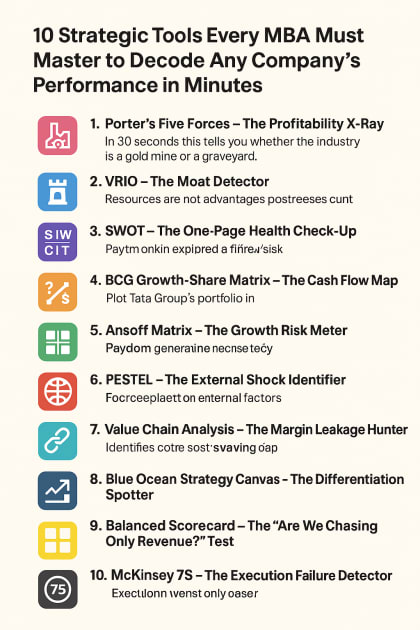
10 Strategic Tools Every MBA Must Master to Decode Any Company’s Performance in Minutes
Most MBA students graduate knowing 50 frameworks but can’t use even five under pressure. Recruiters at McKinsey, BCG, Amazon, Flipkart, Tata, Aditya Birla and even start-ups don’t care how many models you can name — they want to know if you can look at a company and instantly tell why it is winning or bleeding.
Here are the ten high-voltage tools that, once internalised, let you diagnose any firm’s performance in under ten minutes. I have used these exact tools in consulting projects, equity research reports, boardrooms and MBA classrooms — and they never fail.
Porter’s Five Forces – The Profitability X-Ray In 30 seconds this tells you whether the industry itself is a gold mine or graveyard. Example: Apply it to Indian airlines (2025). Buyer power = High (price comparison apps), Supplier power = High (Airbus/Boeing + ATF), Rivalry = Brutal (IndiGo vs Air India vs Akasa), Threat of new entrants = Low (capital + slots), Substitutes = Medium (high-speed trains). Result? The industry is structurally unattractive — only the lowest-cost player (IndiGo) makes money. Everyone else loses cash even when planes are full.
VRIO – The Moat Detector Resources are not advantages until they pass the VRIO test (Valuable, Rare, Imitable, Organized). Zomato’s network of dark stores in 2025 is Valuable and Rare, extremely costly to Imitate overnight, and Zomato is superbly Organized to exploit it — hence a clear sustainable advantage over Swiggy Instamart.
SWOT – The One-Page Health Check-Up Never start a case discussion without quickly scribbling a 2×2 SWOT. When Byju’s crashed in 2023–24, the SWOT was brutally clear: Strength = Brand, Weakness = Negative cash flow & governance, Opportunity = Edtech recovery, Threat = Unacademy, PhysicsWallah eating market share + investor lawsuits. The threats and weaknesses overwhelmed the strengths — bankruptcy followed.
BCG Growth-Share Matrix – The Cash Flow Map Plot Tata Group’s portfolio in 2024: Tata Motors EV (Star), TCS (Cash Cow), Tata Consumer (Question Mark after the BigBasket/1mg acquisitions), and old steel plants (Dog). The matrix instantly shows why Ratan Tata’s successor is milking TCS to fund EV and consumer bets.
Ansoff Matrix – The Growth Risk Meter When boAt wanted to grow from ₹3000 cr to ₹10000 cr, the safest path was Market Penetration (more ads, more offline stores) and Product Development (smartwatches, TWS with ANC). Diversification into completely new categories would have been suicidal — and many lifestyle brands that tried it (Noise, Boult) are now struggling.
PESTEL – The External Shock Identifier Paytm’s 2024 nightmare came from one letter in PESTEL: “R” for Regulatory. The RBI banned Paytm Payments Bank — overnight the entire business model collapsed. A five-minute PESTEL scan in 2022 would have shown the regulatory risk was “Extreme”.
Value Chain Analysis – The Margin Leakage Hunter Draw the chain for Mamaearth vs Minimalist (2025). Mamaearth spends heavily on celebrity marketing (Support Activity → Marketing & Sales) while Minimalist spends on R&D and dermatologist networks. Result? Minimalist enjoys 38–42% gross margins while Mamaearth hovers at 18–22% despite higher revenue.
Blue Ocean Strategy Canvas – The Differentiation Spotter Plot quick-commerce players on delivery time, assortment, price, customer service and dark-store density. Zepto and Blinkit are fighting tooth-and-nail on the same factors (Red Ocean). If a new player eliminates physical stores entirely and does 5-minute drone delivery (Raise speed, Eliminate dark-store cost), it creates a Blue Ocean.
Balanced Scorecard – The “Are We Chasing Only Revenue?” Test Many Indian start-ups in 2021–22 had fantastic Financial metrics but zero focus on Internal Processes and Learning & Growth. When money dried up in 2023, they had no operational excellence to fall back on. Companies that tracked all four perspectives (Nykaa, Zerodha, Zomato post-2022) survived and thrived.
McKinsey 7S – The Execution Failure Detector Reliance Retail grows at 40%+ year-on-year not just because of Strategy, but because Structure (separate verticals), Systems (JioMart integration), Skills (data analytics), Staff, Style (Aggressive Mukesh Ambani leadership), Shared Values (“growth at all costs”) and Strategy are perfectly aligned. Most family-business failures in India happen because Strategy changes but Structure, Style and Shared Values stay stuck in 1990.