The Great Indian Silver Squeeze: Analysing the Backwardation of the MCX Futures Market and its Impact on the Indian Economy
The article examines the sharp backwardation in India’s silver futures market, where spot prices exceed futures due to severe supply shortages and surging demand. It highlights impacts on MCX, industry costs, inflation, imports, and financial risks, urging tighter regulation and risk management.
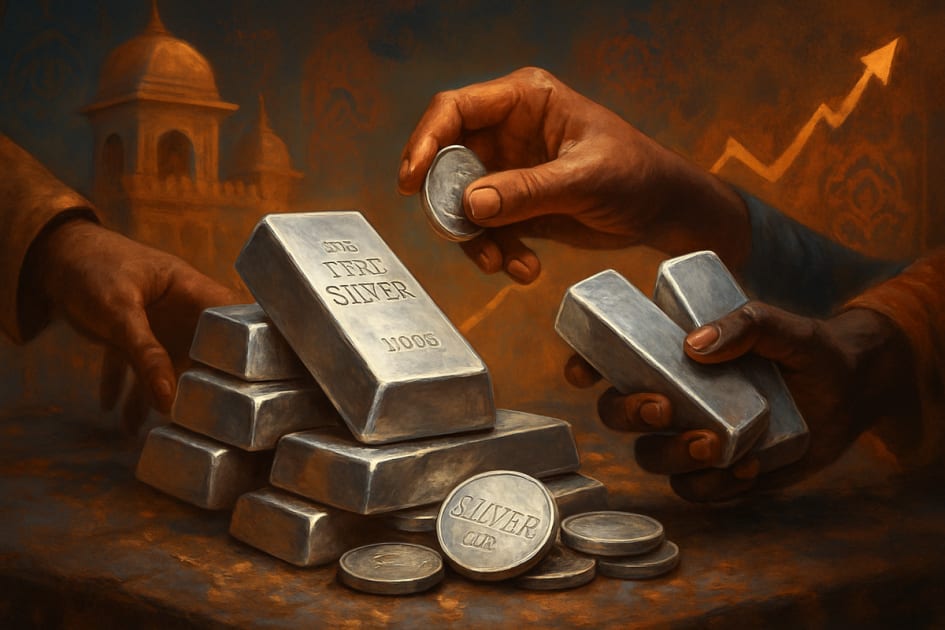
The Great Indian Silver Squeeze: Analysing the Backwardation of the MCX Futures Market and its Impact on the Indian Economy
The Indian silver market is currently witnessing one of its most unusual and intense episodes in recent memory: a phenomenon known as backwardation in the futures curve of silver, with significant implications for the domestic commodities market and the broader economy.
What’s going on with silver?
Under normal conditions, futures prices for a commodity exceed spot prices to factor in costs of storage, insurance and financing — this is known as contango. Upstox - Online Stock and Share Trading+2metalsedge.com+2 Backwardation flips that: the spot price rises above futures, signalling that buyers are willing to pay a premium for immediate delivery rather than wait. metalsedge.com+1
In the global silver market, this inversion is becoming pronounced. According to one analysis, “the spot price is above the futures price … a clear sign that buyers are desperate to get their hands on silver now.” Investing.com+1 Similarly in India, domestic data show that the spot-futures relationship for silver is inverted: domestic spot prices are trading at a premium to futures contracts. DSPIM+1
For instance, in India’s Multi Commodity Exchange (MCX) market, there is growing evidence of a large spread between spot and futures silver prices. One article describes how dealers are “quoting at ₹1.70 lakh / kg and still can’t deliver” even while futures prices lag. gata.org+1
In fact, the MCX itself has responded by raising margin requirements for silver futures — a sign of elevated risk and market stress. Business Standard+1
Why is it happening?
Several interlinked factors are driving this backwardation:
Physical supply constraints: Producers and dealers report tight inventories in India — dealers say they are unable to deliver even at elevated prices. The Economic Times+1 Globally, silver has a structural deficit: industrial demand (for electronics, solar, etc) plus investor demand are outpacing mine output. Investing.com+1
Escalating immediate demand: Both industrial users (who cannot wait for future delivery) and retail/investment buyers are chasing silver today. For India specifically, the festival and wedding season surge in jewellery and physical metal buying adds to pressure. The Economic Times+1
3. The Industrial Engine: At the heart of this deficit is silver’s dual role, particularly its irreplaceable function as an industrial commodity. Today, over 59% of global silver demand comes from manufacturing, driven overwhelmingly by the "green transition." Solar photovoltaics (PV), electric vehicles (EVs), and advanced electronics like semiconductors and chips rely on silver’s superior conductivity. This industrial demand is inelastic—factories need the metal to operate, regardless of price—forcing industrial buyers into a scramble to secure supply. Because silver is mostly a by-product of mining for other metals (like copper and zinc), global mine output has remained stagnated cannot be quickly ramped up to meet this surging, non-negotiable demand. Visible inventories in major global vaults have been draining to multi-year lows, removing the traditional market buffer. Kotak Securities
Worldwide logistical / lease pressures: In global markets, lease rates for silver have spiked (e.g., London lease rates reaching 30%–40%), meaning physical metal is scarce or costly to borrow. Investing.com+1
Paper-versus-physical disconnect: While futures and ETFs represent promises of delivery, physical supply is constrained — so spot demand drives up immediate pricing. Indian ETF flows show anomalous behaviour, with premiums on ETF NAVs expanding, while domestic futures and physical markets diverge. The Economic Times
All of this creates the perfect storm for backwardation: spot > near-futures, which implies a premium for immediate delivery and significant stress on the futures/physical delivery mechanism.
Impact on Indian commodities market
The backwardation in silver is not just a curious technical anomaly — it is having real and material effects in India’s commodities market:
Price distortions: Domestic spot silver prices have surged to new highs, at times reported at ₹1.62 lakh/kg or more, while futures contracts are significantly lower, causing spreads of ₹20,000-30,000/kg in some cases. The Economic Times+1
Delivery risk in futures: The divergence means that futures contracts may not reliably lead to physical delivery; risk of “meltdown” or delivery-squeeze has been flagged by commentators. BusinessWorld+1
Margin and risk-control measures: MCX’s decision to hike margins — silver contract initial margin up to ~11.5% and short option margin similarly increased — reflects increased prudential risk. Zerodha+1
ETF / physical mismatch: Indian silver ETF and silver FoF schemes are facing premium compression and subscription halts, because underlying physical procurement is hampered. The Economic Times
Industrial / jewellery supply chain stress: Jewellery and silver-ware makers are reportedly finding it difficult to replenish stock; this can ripple into the supply chain for silver goods, impacting production and margins. The Economic Times
In short: the Indian trading infrastructure for silver is under strain, with futures, spot, physical, and ETF markets showing uneven and elevated risk.
Broader implications for the Indian economy
Beyond commodity price sets, this backwardation in silver raises macro considerations:
Inflationary pressure and cost pass-through: A surge in physical silver pricing raises costs for industries using silver (electronics, solar panels, consumer goods) and jewellery manufacturing. That could feed into higher prices for end-products or squeeze margins.
Investor behaviour and market risk: The abnormal spread and physical scarcity may attract speculation, increasing volatility in the commodities/exchange market. Risk of a sharp correction exists if supply normalises.
Impact on retail demand and consumption: Silver is used widely in jewellery and small savings in India. When spot premiums rise sharply, smaller buyers may be priced out, altering consumption patterns in festivals/weddings.
Balance of trade and import dependence: India imports a large portion of its precious metal needs. Tight global supply and high spot premiums may increase import cost, affecting trade and rupee dynamics.
Financial system risk in commodities derivative markets: Narrow spreads and delivery risk raise the risk of margin calls, defaults, or forced liquidation in commodity exchanges — which could spill into broader financial markets if unchecked.
What lies ahead?
Given the current state of silver backwardation, several possible scenarios emerge for India:
If backwardation persists — i.e., physical supply remains tight while immediate demand stays strong — then spot prices may continue to climb, creating further stress on futures and physical markets. Some analysts see this as a potential precursor to a “triple-digit” silver price in USD terms. Investing.com+1
Alternatively, if supply normalises (through increased imports, mine output, relaxing of delivery bottlenecks) or if demand eases (post-festival season, jewellery demand slowdown), the spread could collapse, leading to price corrections. Indeed, some market participants believe the premium is partly driven by seasonal demand and may ease after Diwali. The Economic Times
The implication for Indian commodity markets is that risk management (for traders, brokers, jewellery businesses) becomes more critical. Increased margins, delivery vigilance, and hedging of jewellery/industrial off-take become more necessary.
For policymakers and regulators, the episode underscores the need for transparency in the physical delivery chain and coherence between futures, spot, and physical markets — especially in a smaller, less liquid market like silver in India.
Conclusion
The current backwardation in silver futures in India is a warning signal — not just for silver traders, but for the wider commodities and industrial ecosystem. The unusual price structure — with spot premiums, futures discounts, delivery risk and elevated margins — reflects a tightening of physical supply alongside surging demand.
For India, this means potential inflationary pressure, stressed jewellery and industrial supply chains, elevated risk in commodity trading, and a need for vigilance by regulators and market participants alike. Whether the episode resolves smoothly through supply response or triggers a sharper correction remains to be seen — but the market is certainly signalling that silver is far from “business as usual”.