Trending Areas in Brain Computer Interfaces: The Neuroscience Frontier
Brain–Computer Interfaces (BCIs) have emerged as one of the most transformative frontiers in neuroscience, enabling direct communication between the brain and external devices. They hold immense promise for medical rehabilitation, cognitive enhancement, and even human–AI symbiosis.
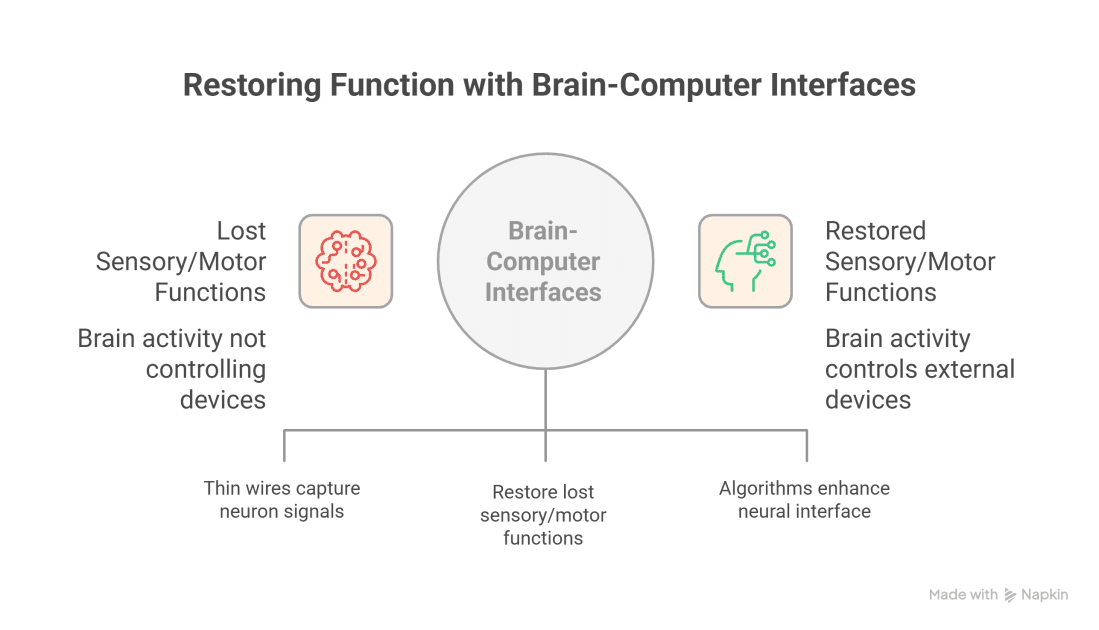
The human brain is still one of the most intricate and least understood systems in nature. Brain Computer Interfaces (BCIs) have in recent years become one of the most exciting frontiers of neuroscience, with the promise of directly linking neural activity to external devices. BCIs facilitate two-way communication between the brain and computers with promises of medical rehabilitation, cognitive enhancement, and even human–AI symbiosis. A well-known example of this vision is Elon Musk’s company Neuralink, which has attracted global attention by merging cutting-edge neuroscience with advanced microelectronics. By examining this case and other parallel developments, we can better understand the trending areas of BCI and their implications for the future of neuroscience.
Elon Musk’s Neuralink exemplifies the ambition to push neuroscience into practical, large-scale applications. The firm has come up with super-thin, flexible wires that can be inserted into the brain with a robotic surgeon. The wires capture electrical signals from thousands of neurons at once, a much higher number than the standard electrode arrays. Neuralink's initial interest is in medical treatments like restoring ability to move for patients with spinal cord damage or allowing paralysis sufferers to control computers with their minds. In 2024, Neuralink performed its first human implant, a milestone for BCIs from theory to practice. Aside from clinical applications, Musk's long-term vision includes "symbiosis with artificial intelligence," which sparks both scientific and ethical controversies among the neuroscience community.
Among the most far-reaching applications of BCI is medical rehabilitation. BCIs are being more extensively utilized in creating neuroprosthetics equipment that restores lost sensory or motor functions. For instance, patients with stroke can be helped using BCIs that decode brain activity into robotic arm movement so that intensive neurofeedback training can be used to drive faster recovery. Likewise, cochlear implants for deafness and retinal implants for visual restoration are previous examples of neural interfaces that are now being further developed using AI-based decoding algorithms. While business players such as Neuralink are speeding up precision implants, neuroscience research is revealing how neuroplasticity can be leveraged for adaptive control of them.
Beyond therapy, BCIs also promise to improve cognitive abilities as well as communication. For locked-in syndrome patients, BCIs can offer avenues of communication through the decoding of intended speech or movement directly from neural activity. Research teams across the globe are creating algorithms that translate neural action into text or even real-time synthesized speech. This follows Musk's proposal that BCIs might one day enable "telepathic communication," although present neuroscience is more focused on the technological challenges of deciphering complicated patterns of language. Cognitive enhancement is a hot area, with research investigating whether BCIs might enhance memory, attention, or decision-making by stimulating targeted areas of the brain.
While Neuralink's efforts are targeting invasive implants, non-invasive BCIs like electroencephalography (EEG) and functional near-infrared spectroscopy (fNIRS) are on the rise for consumer and research markets. EEG-based headbands are already available for gaming, meditation, and attention training. Improvements in machine learning enable these devices to decode noisy neural signals more accurately, making them viable for adaptive user interfaces, smart environments, and learning tools. For neuroscience, non-invasive BCIs provide a scalable platform for observing brain dynamics in naturalistic contexts without the threats of surgery.
The fast development of BCI technology poses urgent ethical challenges that neuroscience cannot avoid. Questions of mental privacy, cognitive liberty, and identity figure prominently in the discussion. If BCIs can read or even control neural activity, what protection is needed to safeguard individuals? The provocative assertions made by Elon Musk regarding human–AI integration underscore the need to build responsible innovation frameworks. Neuroscientists and ethicists are increasingly working together so that BCI technologies are designed with transparency, fairness, and well-informed consent. The marriage of neuroscience and ethics is a popular area of research in itself.
Artificial intelligence has a key role to play in taking BCIs forward. Neural impulses are extremely intricate and need advanced decoding algorithms to decode them into useful outputs. Deep learning algorithms are now being taught to identify patterns in neural activity with unprecedented precision, making possible more seamless prosthetic control or control of digital devices. On the other hand, AI can be used to maximize stimulation protocols for therapeutic BCIs, such as during deep brain stimulation for depression or Parkinson's disease. Neuralink and other projects are gambling on the collaboration of AI and neuroscience as the source of the next generation of BCIs.
Further in the future, one of the most futuristic BCI trends is brain–cloud interfaces. This vision foresees direct linking of human brains to computational resources in the cloud, greatly enhancing memory and processing power. Although extremely speculative, these concepts are pushing neuroscience toward philosophical territory regarding human identity, thought, and what lies at the limits of biological versus artificial intelligence. The rhetoric of Musk regarding avoiding humans becoming obsolete in the new AI era is thus appealing to the same vision even though contemporary neuroscience remains several decades from achieving it.
Conclusion
Brain Computer Interfaces is on the intersection of neuroscience, engineering, and ethics. From Neuralink's invasive implants to non-invasive EEG headsets, from neuroprosthetics aimed at rehabilitation to hypothetical brain–cloud futures, BCIs are one of the most rapidly evolving fields of scientific inquiry presently. Elon Musk's entry has certainly galvanized public consciousness, but the actual drivers are the consistent breakthroughs in neuroscience decoding neural activity, comprehending plasticity, and creating ethical paradigms for its proper utilization. As BCIs advance, they have the potential not only to change the way we treat neurological disorders but also the way we understand human cognition in a rapidly AI-saturated world. The next decade promises to witness neuroscience leaving the lab and entering mainstream life, with BCIs serving as the bridge between the mind and technology.
.png)