Why Students Are Losing Interest—and What Indian Universities Must Do About It
Students attend college for compulsory attendance, not learning. Education feels irrelevant. Make learning practical, personal, and meaningful so students care to show up.
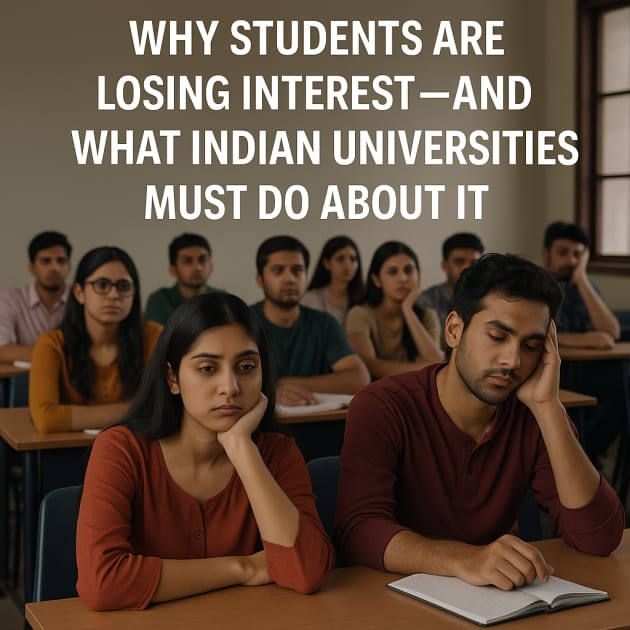
Walk into any college classroom in India and you’ll notice the same scene playing out: a few attentive faces in the front rows, some indifferent ones scrolling through their phones at the back, and a large middle ground of students physically present but mentally elsewhere. It isn’t that they dislike learning; rather, they no longer see meaning in it.
The usual reforms—interactive teaching, blended learning, gamified assignments, and industry talks—have all been tried. Yet, the needle barely moves. Attendance is still enforced by rule, not desire. When universities wonder why nothing works, they are really confronting a deeper truth: the system continues to teach without purpose.
For most students, higher education is a compulsory passage, not a chosen journey. A degree still serves as a safety net for parents’ aspirations, not as a tool for self-discovery. By the time a student enters university, curiosity has already been replaced by caution. Years of rote schooling teach them to avoid mistakes, not to ask questions. So, when we ask them to engage, to debate, or to think differently, they look puzzled—no one has ever rewarded them for doing so.
The disinterest runs deeper than pedagogy. It’s cultural. In many Indian families, education is measured in outcomes—marks, placements, job security. The process itself holds little emotional or intellectual value. The system, too, mirrors that thinking. UGC mandates attendance, exams define progress, and faculty are expected to deliver “syllabus completion.” When everything revolves around compliance, the spark of learning is inevitably lost.
And yet, universities cannot give up. They must reimagine the classroom as a space where relevance replaces regulation. The problem is not that students are lazy; it’s that they no longer recognize education as something that belongs to them. To make them care, universities must stop behaving like administrators and start behaving like collaborators.
One way is to reduce the gap between what students study and what they live. Marketing, for instance, should not remain a set of frameworks—it can become a lived experience through campus-based ventures, digital storytelling, or community projects. A student who sees his idea reach people feels a kind of pride that no grade can match. Real engagement doesn’t come from attendance sheets; it comes from moments of personal investment.
Another way is to rebuild trust between faculty and students. The relationship has become transactional: you teach, I attend. The most inspiring teachers are not always the most knowledgeable but the most authentic. When faculty speak honestly about their struggles, failures, or professional doubts, students listen. Vulnerability, not authority, opens the door to genuine learning.
Universities also need to rethink what they reward. Instead of measuring obedience—attendance, submission, decorum—they could recognize initiative, curiosity, or creative risk-taking. A simple public acknowledgment of effort, a space for students to showcase their interests, or the freedom to choose one’s mode of learning can go a long way. These gestures might seem small, but they signal that the institution sees the student as a partner, not a number.
Perhaps the most radical step is to slow down. The current academic calendar leaves no space for reflection. Classes rush from topic to topic, as though speed were a measure of efficiency. But learning requires digestion. Students today are overloaded—with content, choices, and distractions. Sometimes, the most meaningful educational act is to pause and let them think.
Still, it would be naive to assume that enthusiasm can be engineered overnight. A generation raised in hyper-connected, instant-feedback environments will not suddenly find joy in textbooks. But universities can create moments of resonance—places where knowledge feels alive, not imposed. This might mean bringing popular culture into the classroom, discussing management through cricket leagues or brand fandoms. It might mean allowing students to express understanding through art, video, or social commentary.
Mandatory attendance will remain, because regulation moves slower than reality. But the spirit of engagement can still evolve. We can mark presence on paper while cultivating presence of mind.
The real task before Indian universities is not to teach more effectively, but to help students rediscover why learning matters. Once that connection is restored, attendance will take care of itself. The challenge is not administrative; it is emotional and cultural. Students don’t need better classrooms—they need reasons to show up.