Wins, Fails, and Lessons: A Gentle Year-End Review for a Stronger 2026
The article encourages a thoughtful year-end self-review built around three pillars: Wins, Fails, and Lessons. It highlights the importance of celebrating accomplishments big or small to reinforce positive habits and identify what contributed to success. Readers are urged to acknowledge growth not j
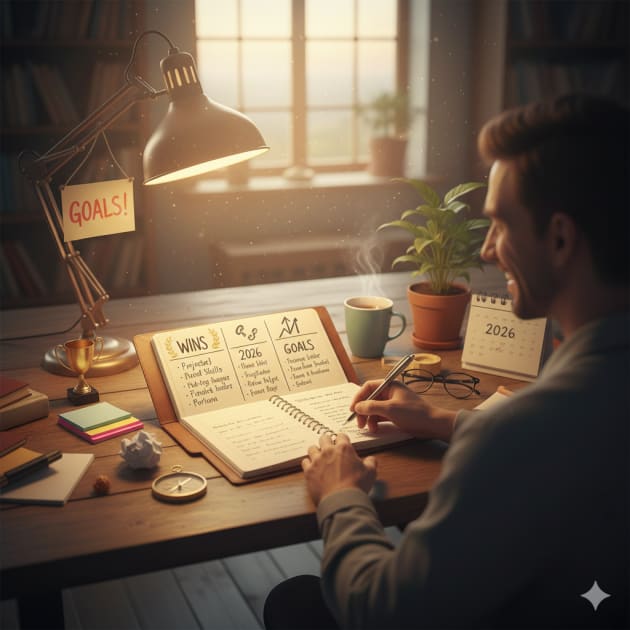
Wins, Fails, and Lessons: A Gentle Year-End Review for a Stronger 2026
There’s something quietly powerful about sitting with your own year not the curated version that appears on social media, but the honest, unpolished record of what you attempted, achieved, stumbled through, and ultimately learned. It is a ritual older than our productivity apps and more human than our checklists: the habit of pausing, looking back, and accepting the story we lived.
Every year, I ask my students and colleagues to do this reflection. Not because it is fashionable, but because the brain needs closure before it can open new chapters. A year-end review is not a summary; it is a conversation with yourself. One part celebration, one part reckoning, and one part quiet wisdom-keeping.
Let’s walk through these three essential pillars Wins, Fails, and Lessons like seasoned travellers who have seen enough of life to smile at its contradictions.
Wins: Honouring the Accomplishments That Built Your Year
Celebrating your wins is not vanity. It is psychology at its elegant best. The human mind remembers failures with surprising loyalty but forgets accomplishments unless we anchor them intentionally. The act of listing what went well reinforces habits that deserve a longer life.
Begin with a tender question: What goals did you actually achieve this year?
Don’t rush to the “big” ones first. There’s a strange cultural pressure to only acknowledge achievements that could impress a stranger. Ignore that. Think instead of the goal you set quietly waking up ten minutes earlier, walking more often, managing anger better, eating mindfully, reading one meaningful book. These are the small hinges that open big doors.
And then ask yourself: How did you celebrate these wins? Most people don’t. They simply move the goalpost forward. Celebration is not indulgence; it is closure. It signals to the brain: “This behaviour is desirable, keep repeating it.” In a sense, celebration is a growth strategy disguised as joy.
Now, explore the mechanics of your success. What specifically helped you achieve these goals?
Perhaps it was a disciplined routine, a supportive friend, a new tool, or even a shift in environment. Identifying these success-drivers is like mapping the routes that took you to your best self. If you know the roads, you can travel them again.
And don’t limit your wins to competence alone. Growth is not always about mastery it often hides in less glamorous corners: consistency, connection, and confidence. Maybe you spoke up in meetings more often. Maybe you reached out to someone you had drifted from. Maybe you trusted yourself in situations where earlier you would have shrunk.
Write down the key moments that brought joy or pushed you outside the comfortable borders of your personality. That moment you said “yes” to a new role. That moment you said “no” when you finally learned to protect your boundaries. These moments are the milestones of inner evolution.
Wins remind you of what is possible. They pull your future forward.
Fails: Reframing Setbacks with Courage and Compassion
The word “fail” has such dramatic marketing around it that people hesitate to inspect their own setbacks. Failure is rarely catastrophic; more often it is a whisper, a nudge, a signal that something in our internal system needs tuning.
When you review the year, be honest about what did not unfold as planned. Not in a self-critical voice, but in the tone a scientist uses when observing data. Something happened; now we understand why.
Ask yourself the inconvenient but necessary questions. Did you spend too much time on low-value activities?
Aimless scrolling, unnecessary obligations, indecision that stretched into months these are not moral flaws; they are attention leaks. A simple time audit often reveals that we weren’t “too busy” we were simply unintentionally busy.
Next, identify roadblocks. What specifically stood between you and your goals?
Maybe it was unclear priorities, maybe a mismatched environment, maybe your energy levels were mismanaged. Often the issue isn’t that we failed; it’s that our systems weren’t designed for success. Workflow inefficiencies, distractions disguised as responsibilities, or unrealistic planning can derail even the most committed individual.
And here comes the part people often skip: Practice self-forgiveness.
Forgiveness is not about excusing your choices; it’s about releasing the emotional fog that prevents you from seeing your path clearly. You forgive your past self not because they were perfect, but because they were trying.
Failures are not opposites of success they are the raw material from which success is sculpted.
Lessons: Turning Experience into a Blueprint for 2026
Lessons are the alchemy of reflection. They turn experience into guidance. Without reflection, experiences remain inert; with reflection, they become wisdom.
When you examine your year, avoid simply listing “what went wrong.” Instead, write down what you learned from what went wrong. That shift in phrasing transforms regret into insight.
Perhaps a setback taught you that you need clearer boundaries. Perhaps a conflict taught you the importance of listening without defending. Perhaps a missed opportunity taught you that preparation is kinder than procrastination.
These lessons become the building blocks of the next year’s strategy.
Also note your mindset shifts. Every year gifts us a few quiet revelations those lines we underline in a book or those thoughts that rearrange our internal architecture. Maybe you discovered that discipline beats motivation, or that prioritizing your well-being is an act of strength, not selfishness.
Capture these shifts. They redefine your operating system.
Next, reflect on how these lessons can shape your 2026. Wisdom without application is like a tool left unused in a drawer. Decide deliberately which learnings you will carry forward. Maybe you’ll start working in deep-focus blocks. Maybe you’ll say “yes” more often to opportunities that challenge you. Maybe you’ll give yourself permission to pause when needed.
And remember, not everything will go according to Plan A.
It rarely does.
Life, in its mischievous way, delights in rearranging our maps.
Plan B and Plan C exist not because we are weak, but because we are adaptable. When the unexpected arrives and it will you won’t panic; you’ll pivot.
Where This All Leads: Purposeful Goal Setting for 2026
A good review is like a well-tuned compass. It doesn’t magically create a path, but it tells you where you stand and how to move with intention.
Your wins remind you of your strengths. Your setbacks reveal your blind spots. Your lessons become the strategies that will carry you forward.
Together, they prepare you to set goals for 2026 that are aligned not with pressure or comparison, but with your personal evolution. Goals grounded in clarity, energy, and values tend to survive the storms of the year far better than goals chosen out of impulse or imitation.
Approach the coming year not as a blank page, but as a continuation a new chapter informed by the wisdom of the previous ones. The story of 2026 will be written by the version of you who understands your own journey a little better.
This reflection is not the end of the year; it is the beginning of a more intentional you.