AI-Generated Dark Patterns in E Commerce: Legal & Policy Implications
Dark patterns are deceptive user-interface designs that steer consumers toward decisions they would not otherwise make. In e-commerce, these techniques exploit cognitive biasesto increase sales or data collection.This article explores the various legal and policy implications of dark pattern.
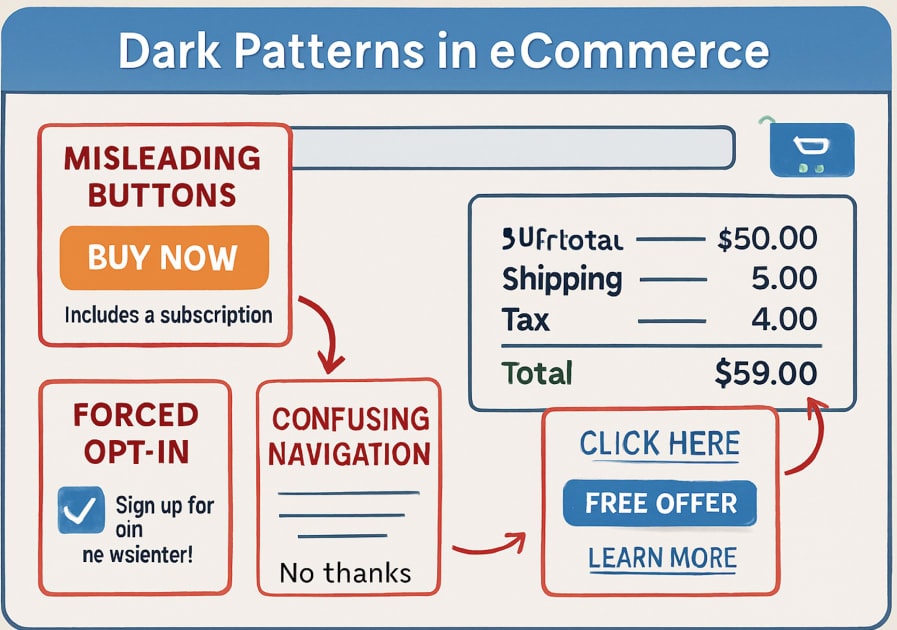
Dark patterns are deceptive user-interface designs that steer consumers toward decisions they would not otherwise make. In e-commerce, these techniques exploit cognitive biases (low-stock alerts, fake discounts, etc.) to increase sales or data collection. Today’s generative AI and machine-learning tools make it easy to automate and personalize such manipulations. For example, generative-design systems (Figma, Wix ADI, ChatGPT/DALL·E, etc.) can produce entire web layouts or text prompts in seconds. AI can adapt interface elements in real time – adjusting colours, wording, or prompts to individual users based on their browsing behavior. An AI-powered site can continuously A/B-test design variants in real time, learning which “dark” layout or wording best triggers each user. For instance, if a shopper lingers on a checkout page, an AI might immediately insert a fake countdown timer (“Only 5 minutes left!”) or a low-stock warning (“Only 2 left in inventory”) to increase urgency for that user. Similarly, AI chatbots can adapt conversational style or emote empathy in real time to upsell add‑ons or subscriptions (“Our records show this plan is right for someone like you”). In short, by mining user data and exploiting psychological biases at scale, AI boosts classic dark-pattern tactics that are difficult to detect.
Global Legal and Regulatory Landscape
The Unfair Commercial Practices Directive (UCPD) and the GDPR regulations in the European Union, prohibit misleading or aggressive practices and demand informed consent, though they did not explicitly name “Dark Patterns”. The new Digital Services Act (DSA, effective 2024) closes that gap by defining dark patterns as interface designs that “materially distort or impairs, autonomous and informed choices” and explicitly bans them on online platforms. But DSA’s ban does not override overlapping rules like the UCPD or GDPR. For example, if a dark pattern is used to obtain consent for data use, it is assessed under GDPR rather than the DSA.
In the United States, the Federal Trade Commission (FTC) has led enforcement. The 2022 FTC staff report “Bringing Dark Patterns to Light” documented myriad schemes in e-commerce: disguised ads, fake countdowns, hard-to-cancel subscriptions, hidden fees, and data-harvesting traps. For example, the FTC sued platforms that lured consumers into multi-year subscriptions with “Easy Cancellation” buttons that in reality require navigating through many misleading pages. The Congress has proposed bills (the bipartisan DETOUR Act) to ban online interface tricks, and California’s privacy agency already forbids “UX that subverts or impairs consumers’ autonomy” under the CCPA. The California advisory makes clear that even lack of “intent” does not excuse an interface that confuses or misleads users.
The UK and other jurisdictions also confront the issue. In late 2023, the UK’s competition (CMA) and data protection (ICO) authorities jointly labelled dark patterns “harmful online choice architectures”. They highlighted forms like nudges/sludges, confirm-shaming, bundling consent, and pre-ticked defaults. Internationally, consumer agencies in Canada, Australia, and Asia are raising alarms too, echoing OECD work on “AI incidents” in advertising. Global initiatives like the OECD’s AI Principles and ICPEN’s reviews reflect mounting concern that AI‑powered manipulation may require new cross-border coordination.
Implications for Consumers and Regulators
AI-enhanced dark patterns have a strong implication on consumer autonomy, trust, and privacy. Since AI makes these patterns dynamic, these are harder to detect and resist, and users can be nudged into unintended purchases or data-sharing. Repeated exposure may result in frustration and cynicism. Users eventually start avoiding or mistrusting sites they find manipulatively designed. From a societal perspective, widespread AI‑driven manipulation could skew markets and erode the fairness of digital commerce.
Regulators must therefore adapt. The current trend is towards explicit prohibitions, viz. the EU’s Digital Services Act forbids “design, organization or operation” of platforms that distort choice. Data-protection agencies can treat certain consent UIs as unlawful coercion, while competition authorities may ban dominant firms from using manipulative UX to lock in customers. In practice, authorities advise companies to audit their designs and ensure “symmetrical” choice presentation. Industry consortia and UX guidelines may also emerge to codify “fair design” principles.
In the long run, meaningful solutions could include real-time dark-pattern detectors, mandatory AI-disclosure (telling users when UI elements are AI-generated), and design standards rooted in user autonomy. For consumers, vigilance and regulatory advocacy are the key. For companies and designers, the message is clear: AI should be used to serve and empower users, not to trick them. The policy response must ensure that algorithmic innovation in UX is aligned with transparency, accountability, and human-centred values.
Bibliography
“AI Amplifying Deception: Exposing Dark Patterns - Blog - Aug 08, 2024,” n.d. https://www.fairpatterns.com/post/ai-amplifying-deception-exposing-dark-patterns.
Bösch, Christoph, Benjamin Erb, Frank Kargl, Henning Kopp, and Stefan Pfattheicher. "Tales from the dark side: Privacy dark strategies and privacy dark patterns." Proceedings on Privacy Enhancing Technologies (2016).
Brenncke, Martin. "A theory of exploitation for consumer law: Online choice architectures, dark patterns, and autonomy violations." Journal of consumer policy 47, no. 1 (2024): 127-164.
California, State Of. “CPPA Enforcement Advisory Stresses the Importance of Avoiding Dark Patterns,” September 4, 2024. https://cppa.ca.gov/announcements/2024/20240904.html.
Car, Polona, Filippo Cassetti, and Members’ Research Service. “Regulating Dark Patterns in the EU: Towards Digital Fairness.” Report. EPRS | European Parliamentary Research Service. European Union, 2025. https://www.europarl.europa.eu/RegData/etudes/ATAG/2025/767191/EPRS_ATA(2025)767191_EN.pdf.
Conti, Gregory, and Edward Sobiesk. "Malicious interface design: exploiting the user." In Proceedings of the 19th international conference on World wide web, pp. 271-280. 2010.
Covington & Burling LLP. "UK Regulators Target Dark Patterns." Inside Privacy, December 15, 2023. https://www.insideprivacy.com/dark-patterns/uk-regulators-target-dark-patterns/.
Federal Trade Commission. “FTC Report Shows Rise in Sophisticated Dark Patterns Designed to Trick and Trap Consumers,” August 20, 2024. https://www.ftc.gov/news-events/news/press-releases/2022/09/ftc-report-shows-rise-sophisticated-dark-patterns-designed-trick-trap-consumers.
.
Federal Trade Commission. “FTC, ICPEN, GPEN Announce Results of Review of Use of Dark Patterns Affecting Subscription Services, Privacy,” July 10, 2024. https://www.ftc.gov/news-events/news/press-releases/2024/07/ftc-icpen-gpen-announce-results-review-use-dark-patterns-affecting-subscription-services-privacy.
Gray, Colin M., Yubo Kou, Bryan Battles, Joseph Hoggatt, and Austin L. Toombs. "The dark (patterns) side of UX design." In Proceedings of the 2018 CHI conference on human factors in computing systems, pp. 1-14. 2018.
Gray, Colin M., Cristiana Santos, Nataliia Bielova, Michael Toth, and Damian Clifford. "Dark patterns and the legal requirements of consent banners: An interaction criticism perspective." In Proceedings of the 2021 CHI conference on human factors in computing systems, pp. 1-18. 2021.
Hallinan, Dara, Ronald Leenes, Serge Gutwirth, and Paul De Hert, eds. Data Protection and Privacy, Volume 12: Data Protection and Democracy. Bloomsbury Publishing, 2020.
Lacey, Cherie, and Catherine Caudwell. "Cuteness as a ‘dark pattern’in home robots." In 2019 14th ACM/IEEE International Conference on Human-Robot Interaction (HRI), pp. 374-381. IEEE, 2019.
Luguri, Jamie, and Lior Jacob Strahilevitz. "Shining a light on dark patterns." Journal of Legal Analysis 13, no. 1 (2021): 43-109.
Mathur, Arunesh, Mihir Kshirsagar, and Jonathan Mayer. "What makes a dark pattern... dark? Design attributes, normative considerations, and measurement methods." In Proceedings of the 2021 CHI conference on human factors in computing systems, pp. 1-18. 2021.
Nouwens, Midas, Ilaria Liccardi, Michael Veale, David Karger, and Lalana Kagal. "Dark patterns after the GDPR: Scraping consent pop-ups and demonstrating their influence." In Proceedings of the 2020 CHI conference on human factors in computing systems, pp. 1-13. 2020.
Spasovski, Mihail, and Oliver Jönsson. "Automated “Dark Patterns” in User Experience (UX): Exploring AI-Driven Manipulative Design." (2025).
Stewart Townsend - B2B SaaS Channel Sales Consultant. “The Hidden Dangers of Dark Patterns in AI: Protecting User Trust,” September 4, 2024. https://stewarttownsend.com/the-hidden-dangers-of-dark-patterns-in-ai-protecting-user-trust/.
Thaler, Richard H., and Cass R. Sunstein. Nudge: Improving decisions about health, wealth, and happiness. Penguin, 2009
Trzaskowski, Jan. "Persuasion, manipulation, choice architecture and dark patterns." In Research Handbook on EU Internet Law, pp. 309-330. Edward Elgar Publishing, 2023.
Xu, Annelie, and Hiba Al-Mashahedi. "Deceptive by Design: AI-enhanced Dark Patterns in E-Commerce UX." (2025).