Do Environmental Regulations Enhance or Hamper Economic Competitiveness?
Environmental regulation now sits at the centre of economic strategy. Climate risk, air pollution, and resource stress influence investment decisions. Firms face increasing scrutiny from buyers, financiers, and regulators. This shift revives a persistent question.
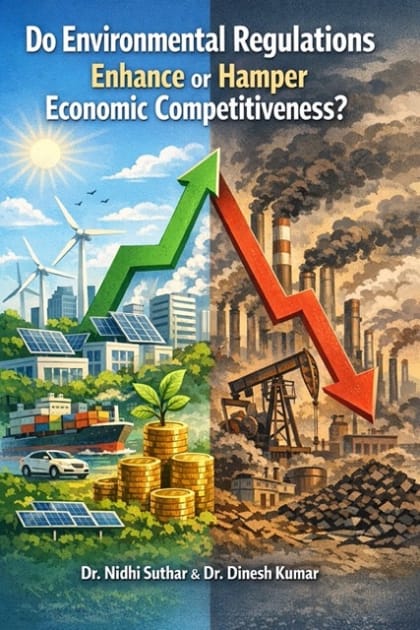
Do Environmental Regulations Enhance or Hamper Economic Competitiveness?
Dr. Nidhi Suthar, Dept. of Entrepreneurship
Dr. Dinesh Kumar, Dept. of Business Analytics
Woxsen University, India
Environmental regulation now sits at the centre of economic strategy. Climate risk, air pollution and resource stress shape investment choices. Firms face rising scrutiny from buyers, financiers and regulators. This shift revives a persistent question. Do environmental rules strengthen competitiveness or weaken it?
A single answer rarely fits. Outcomes depend on policy design, sector conditions and time horizons. They also depend on what we mean by competitiveness. If we mean short-run cost positions, regulation can bite. If we mean productivity, innovation and resilience, regulation can help.
How regulation can strengthen competitiveness
The strongest case rests on induced innovation. Porter’s argument holds that stringent yet flexible rules can push firms to identify waste. It can also shift R&D toward cleaner processes. Evidence often supports this proposition under specific conditions. It appears more likely when firms face credible enforcement and stable policy signals.
The European Union Emissions Trading System illustrates the point. Empirical work links the EU ETS to lower emissions at regulated installations. It also finds limited harm to profits and employment on average. Some studies also report greater low-carbon innovation among regulated firms.
Regulation can also raise efficiency. Energy efficiency saves costs and reduces exposure to volatile fuel prices. Many firms treat these gains as an operational strategy, not compliance. A World Economic Forum analysis on energy transition highlights large potential savings from efficiency measures in major sectors.
A second channel involves market creation. Policy can accelerate demand for renewables, low carbon materials and circular services. This demand supports new entrants and supply chains. It also shifts comparative advantage towards capabilities in design, engineering and systems integration.
A third channel involves macro resilience. Some governments now evaluate growth quality, not only growth speed. The World Economic Forum’s Future of Growth Report 2024 treats sustainability and resilience as core pillars of growth performance. This framing signals changing expectations among investors and policymakers.
How regulation can weaken competitiveness
The counterargument starts with compliance costs. Some regulations require new equipment, monitoring and reporting. These costs can rise quickly in emissions-intensive sectors. They can also fall unevenly across firms.
Small and medium-sized enterprises often face sharper constraints. They have less access to finance and technical staff. They may also struggle with administrative burden. The same regulation can therefore widen gaps between large incumbents and smaller suppliers.
A second concern involves relocation and “pollution haven” dynamics. Firms may shift production when enforcement differs across jurisdictions. Yet the evidence is mixed and context sensitive. Many location decisions reflect wages, infrastructure and market access. Environmental stringency can matter, but it rarely acts alone.
A third concern involves transition risk for regions. Places that rely on coal, heavy industry or legacy manufacturing can face disruptions. If adjustment policy lags, job loss and local decline can follow. These distributional effects often drive political resistance. They also shape the credibility of policy over time.
The real issue at hand is the design of policies, rather than the debate between regulation and no regulation.
Debates often treat regulation as a binary choice. Policy practice rarely works that way. The key issue is whether regulation reduces emissions while supporting capability building.
Several design principles matter.
· Set outcomes, not technologies: Performance-based standards and market instruments can spur experimentation. They let firms choose the least costly pathway.
· Phase in change with credible timelines: Firms invest when policy looks durable. Abrupt shifts raise cost and delay innovation.
· Support SME adjustment: Technical assistance, shared monitoring services and targeted credit lines can reduce the burden. These tools can protect competition in supply chains.
· Use market-based instruments where feasible: Carbon pricing and trading can reduce abatement costs. They also reward early movers when supported by enforcement.
· Manage leakage risks: Border measures, sector agreements and coordinated standards can reduce incentives to offshore emissions.
This is not a call for lax policy. It is a call for policy that recognises industrial dynamics.
What does the evidence suggest overall?
The empirical record does not support simple slogans. Some studies find innovation and productivity gains in regulated settings. Others find modest or neutral aggregate productivity effects. The OECD work on environmental policy stringency reports limited effects on aggregate productivity in OECD countries. It also notes that impacts vary by sector and adjustment horizon.
Evidence also suggests that emissions trading can cut emissions without systematic competitiveness losses. The EU ETS research discussed earlier reports emissions reductions at regulated installations. It also reports no significant average effects on profits and employment.
In India, the energy transition illustrates the mix of opportunity and challenge. Renewables support employment across construction, operations and manufacturing. IRENA reports over one million renewable energy jobs in India in recent estimates. It also provides technology-specific job counts for solar.
India has also attracted foreign investment into non-conventional energy over the long run. Official investment promotion sources report cumulative inflows into the sector on the order of tens of billions of US dollars.
These figures do not prove that regulation alone drives competitiveness. They show that clean energy markets can scale when policy, finance and infrastructure align.
Competitiveness is changing
Environmental regulation can impose real short-run costs. It can also sharpen capabilities that matter in modern markets. The balance depends on predictability, flexibility and support for adjustments.
Competitiveness now includes exposure to climate risk and carbon constraints. It includes access to green finance and low-carbon supply chains. It includes the capacity to innovate under tightening resource limits. Policies that ignore these shifts may preserve old advantages briefly. They may also lock economies into declining pathways.
The question is, therefore, practical. Which regulatory designs raise productivity and cut emissions together? Evidence suggests such an approach is feasible in some sectors and contexts. It also suggests that careless policy can damage firms and regions. A serious strategy treats regulation as industrial policy with environmental intent. It demands rigor, patience and political honesty.
Image Credit: ChatGPT 5.0