From Fragmentation to Foundation: How India’s Four Labour Codes Are Rewriting the Future of Work
India’s implementation of the four Labour Codes marks a historic shift from fragmented, colonial-era labour laws to a simplified, inclusive, and future-ready framework. By consolidating 29 Central labour laws into four comprehensive codes Code on Wages (2019), Industrial Relations Code (2020), Code
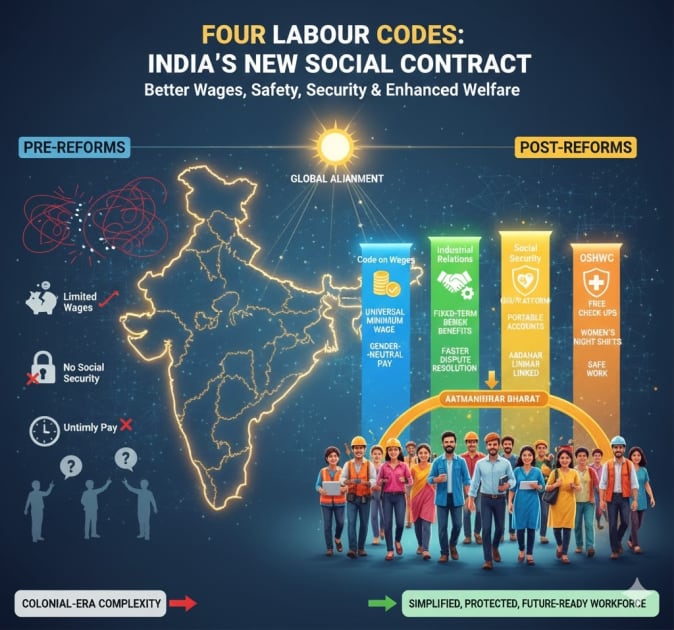
India stands at a pivotal moment in its labour governance journey. With the implementation of the four Labour Codes from November 2025, the Government of India has undertaken one of the most ambitious labour reforms since Independence. By consolidating 29 Central labour laws into four comprehensive codes, India has moved decisively away from a fragmented, compliance-heavy framework toward a simplified, inclusive, and future-oriented labour ecosystem.
This reform is not merely administrative. It is philosophical. It recognises that the nature of work has changed, gig platforms, digital labour, fixed-term employment, migrant workforces, women in non-traditional roles, and MSMEs now define the labour market as much as factories once did. The four Labour Codes attempt to balance worker welfare, employer flexibility, and economic competitiveness, while aligning India with global labour standards.
This article examines the four Labour Codes in detail, their rationale, core provisions, and transformative implications for workers, employers, and the broader economy.
Why Labour Law Reform Was Long Overdue
Most of India’s labour laws were enacted between the 1930s and 1950s, reflecting an industrial economy dominated by large factories and permanent employment. Over time, this resulted in:
Overlapping and sometimes contradictory laws
High compliance burdens for employers
Limited social security coverage for informal and gig workers
Uneven wage protection across sectors
Weak enforcement combined with inspector raj
While other major economies modernised their labour regulations, India continued with a patchwork of outdated statutes. The four Labour Codes address this structural gap by simplifying regulation, expanding coverage, and embedding social justice into the heart of labour governance
4 labour codes
.
The Four Labour Codes: An Overview
The reform architecture rests on four pillars:
Code on Wages, 2019
Industrial Relations Code, 2020
Code on Social Security, 2020
Occupational Safety, Health and Working Conditions Code, 2020 (OSHWC)
Together, they aim to create a protected, productive, and portable workforce suitable for the evolving world of work.
1. Code on Wages, 2019: Ensuring Fair Pay and Timely Earnings
The Code on Wages is a landmark step toward universal wage protection.
Key Transformations
Universal Minimum Wage: Minimum wages now apply to all workers, not just scheduled employments.
National Floor Wage: The Central Government will set a floor wage to ensure a basic standard of living across states.
Timely Payment of Wages: Mandatory timelines for wage disbursement reduce financial insecurity and worker stress.
Gender-Neutral Pay: Equal pay for equal work is explicitly mandated, prohibiting discrimination, including against transgender persons.
Impact
For the first time, India recognises wage security as a statutory right rather than a sectoral privilege. Youth, migrant workers, MSME employees, and informal workers gain a critical layer of financial dignity and predictability.
2. Industrial Relations Code, 2020: Balancing Flexibility and Fairness
The Industrial Relations Code (IRC) modernises the legal framework governing trade unions, dispute resolution, and employment relations.
Key Transformations
Simplified Trade Union Recognition: Clear thresholds for union recognition reduce ambiguity.
Faster Dispute Resolution: Two-member Industrial Tribunals and direct access post-conciliation improve efficiency.
Fixed-Term Employment (FTE): FTEs receive wages, leave, social security, and benefits equal to permanent workers.
Gratuity After One Year: Fixed-term employees become eligible for gratuity after just one year of service.
Impact
The IRC reduces adversarial industrial relations while promoting direct hiring, employment formalisation, and workforce stability, crucial for both industry competitiveness and worker security.
3. Code on Social Security, 2020: Expanding the Safety Net for All
Perhaps the most transformative of the four, the Social Security Code dramatically expands coverage beyond the traditional employer–employee model.
Key Transformations
Inclusion of Gig and Platform Workers: For the first time, gig work, platform work, and aggregators are legally defined.
Aggregator Contributions: Platforms must contribute 1–2% of annual turnover toward worker welfare.
Universal Account Number (UAN): Aadhaar-linked, portable social security accounts ensure benefits across states and jobs.
Expanded ESIC and PF Coverage: Pan-India applicability, including hazardous industries with even one employee.
Impact
India’s social security coverage has expanded from 19% in 2015 to over 64% in 2025, and the Codes aim to push this even further
4 labour codes
. Informal, migrant, and digital workers are now firmly within the ambit of labour protection.
4. OSHWC Code, 2020: Safety, Health, and Humane Working Conditions
The Occupational Safety, Health and Working Conditions Code consolidates 13 laws into a unified framework focused on dignity at work.
Key Transformations
Mandatory Appointment Letters: Written contracts formalise employment and enhance transparency.
Free Annual Health Check-ups: Compulsory for workers above 40 and in hazardous industries.
Standardised Working Hours: 8–12 hours per day, 48 hours per week, with double wages for overtime.
Women in All Occupations: Women can work night shifts and in hazardous roles with consent and safety safeguards.
National OSH Board: Harmonised safety standards across sectors.
Impact
From plantations and mines to IT, media, textiles, docks, and export sectors, the OSHWC Code humanises workplaces while embedding preventive healthcare and safety culture.
Sector-Wise Benefits: A Truly Inclusive Reform
The Codes offer tailored protections across sectors:
Women Workers: Equal pay, night-shift access, grievance redressal committees, expanded family definitions.
Youth Workers: Guaranteed minimum wages, appointment letters, protection against exploitation.
MSME Workers: Simplified compliance, social security coverage, welfare facilities.
Migrant Workers: Wage parity, portability of benefits, PDS access.
Hazardous Industries: Mandatory safety committees, national standards, health monitoring.
This breadth underscores the reform’s inclusive design,no longer limited to organised, urban employment alone
4 labour codes
.
Compliance Reform: From Inspector Raj to Facilitator Model
Equally significant is the shift in enforcement philosophy:
Single Registration, Licence, and Return across India
Inspector-cum-Facilitator System, emphasising guidance over punishment
Higher Applicability Thresholds for small units, reducing regulatory burden
This approach enhances ease of doing business while maintaining worker safeguards.
Strategic Significance for India’s Growth Story
The four Labour Codes support India’s broader aspirations:
Employment Generation through flexible hiring
Formalisation of Work via contracts and social security
Women’s Workforce Participation in high-paying roles
Global Alignment with international labour standards
Aatmanirbhar Bharat through resilient industries and skilled labour
By integrating welfare with competitiveness, the Codes reposition labour as a strategic asset, not a regulatory obstacle.
Conclusion: A New Social Contract for the World of Work
The implementation of the four Labour Codes marks a civilisational shift in India’s labour governance, from fragmentation to foundation, from exclusion to inclusion, from control to collaboration. While effective implementation, rule-making, and stakeholder engagement will determine real-world outcomes, the intent is unmistakable: to place the worker at the centre of economic growth.
For universities, policymakers, employers, and scholars, these reforms offer a rich canvas for research, dialogue, and innovation. More importantly, they offer millions of workers something long overdue, dignity, security, and opportunity in a changing world of work.