Humanity in the Age of Artificial Intelligence: Rediscovering Learning, Thinking, and the Human Spirit
The article explores how AI, like past technologies, can enhance human growth but risks fostering intellectual laziness. It urges reforms in India’s education to promote critical, ethical, and reflective learning.
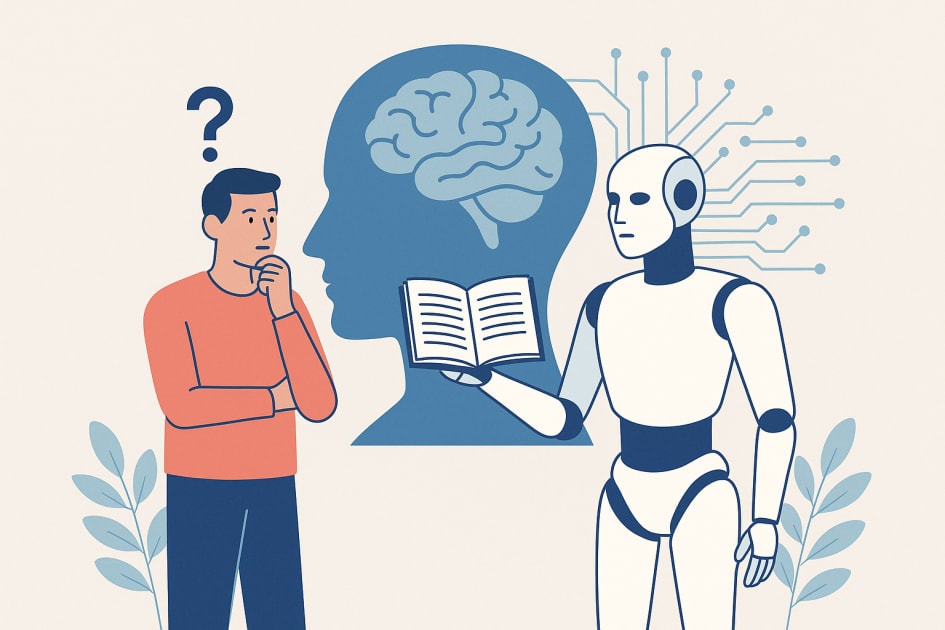
Technological progress has long been both celebrated and feared. From the Industrial Revolution to the Digital Age, every major advancement has brought with it both anxiety and anticipation. Yet history shows that rather than replacing human beings, technology has amplified human capacities, redefining the boundaries of possibility. The invention of the printing press, for instance, democratised knowledge, enabling mass literacy and transforming education and communication (Eisenstein, 1979). Similarly, the Industrial Revolution mechanised labour but also led to new professions, scientific breakthroughs, and socio-economic reforms (Mokyr, 2018). The rise of the computer in the twentieth century accelerated data processing and connectivity, spawning entirely new industries and reshaping human interaction (Castells, 1996). Each technological milestone, while initially perceived as a threat to human labour and intellect, ultimately became a catalyst for progress, fostering creativity and innovation.
Artificial Intelligence (AI) stands at a similar crossroads today. Its rapid integration into everyday life has provoked intense debates about its ethical, economic, and cognitive implications. Yet, like its predecessors, AI has the potential to enrich rather than erase human effort. The difference lies in how societies and individuals engage with it. AI systems, from predictive algorithms to large language models, can automate routine processes, assist in data analysis, and enhance decision-making efficiency. In education, they can personalise learning experiences, identify knowledge gaps, and offer instant feedback (Luckin et al., 2016). When used judiciously, AI becomes an empowering tool that augments human learning, encourages creativity, and supports inclusive education. In that sense, technological intervention, including AI, does not diminish humanity—it demands a redefinition of what it means to learn, think, and create in a digital age.
The Paradox of Ease: AI and the Decline of Human Effort
Despite its potential, AI has also ushered in an unsettling paradox. The very convenience that defines AI risks eroding human curiosity, perseverance, and critical engagement. When tasks such as writing, problem-solving, or information retrieval become instantaneous, the process of learning—the struggle, reflection, and revision that build understanding—is often bypassed. This leads to a troubling question: Is AI making human beings lazy?
Educational psychologists have long maintained that cognitive growth stems from the active engagement of the learner. Vygotsky (1978) emphasised the Zone of Proximal Development, where learning occurs through guided struggle. Similarly, Dewey (1938) viewed education as a process of experiential growth rather than passive absorption. Yet, AI tools, particularly those that generate ready-made answers or essays, encourage minimal cognitive effort. In academic contexts, students may rely on AI-generated summaries or paraphrases, thereby weakening their ability to analyse, interpret, and synthesise information. This trend undermines not only intellectual rigour but also originality—the cornerstone of both scholarship and creativity.
Moreover, the psychological consequences are equally concerning. The instant gratification provided by AI reduces the tolerance for uncertainty, error, and delayed reward, all of which are essential to deep learning (Duckworth & Gross, 2014). The challenge, therefore, is not technological but behavioural: the increasing dependence on AI risks diminishing intrinsic motivation and cognitive resilience.
The Indian Educational Paradox: Reading Without Reflection
In India, these concerns intersect with long-standing structural issues in education. Despite being home to one of the largest education systems in the world, the percentage of active readership is dishearteningly low. According to the National Book Trust (2021), only a small fraction of the population engages in regular reading beyond academic requirements. The culture of reading for pleasure, reflection, or independent inquiry remains marginal. This decline in readership affects not only literacy but also imagination and empathy—qualities essential for both citizenship and employability.
The problem is exacerbated by the structure of school education itself. Rooted in colonial legacies and examination-centric paradigms, the Indian education system continues to privilege rote learning over critical thinking (Kumar, 2005). The emphasis on memorisation, particularly in board examinations and competitive tests, leaves little room for curiosity-driven exploration. Students learn to reproduce information rather than question it, often viewing learning as an act of compliance rather than inquiry. Consequently, even higher education becomes an extension of this passive engagement, where analytical and creative thinking are underdeveloped.
Spoken and written communication, vital tools of cognitive and professional expression, are similarly neglected. The lack of emphasis on articulation results in students who struggle with basic academic writing conventions, contextual word use, and syntactic precision. Teachers, burdened by curriculum demands and large class sizes, often prioritise syllabus completion over linguistic competence. As a result, many graduates find themselves underprepared for the communicative and analytical demands of contemporary workplaces.
Rethinking Learning: Insights from Educational Thinkers
The solutions to these challenges lie not merely in policy reforms but in a philosophical reorientation of education itself. Rabindranath Tagore envisioned education as a holistic and creative process that integrated art, nature, and moral reflection (Tagore, 1917). His model at Shantiniketan emphasised dialogue, experiential learning, and the cultivation of curiosity—all of which remain strikingly relevant today. Similarly, Mahatma Gandhi’s Nai Talim (Basic Education) proposed learning through productive work, linking intellectual and manual labour (Gandhi, 1953). Both thinkers saw education as a process of self-realisation rather than credential accumulation.
From a modern perspective, Paulo Freire’s Pedagogy of the Oppressed (1970) resonates with these ideals, critiquing the “banking model” of education where students are treated as passive recipients of knowledge. Freire advocated for dialogic learning—an interactive process that encourages questioning and co-creation of meaning. Applying these insights to the Indian context would require moving away from mechanical learning towards reflective engagement.
Contemporary scholars like Sugata Mitra (2012), through the “Hole in the Wall” experiments, demonstrated that when children are given autonomy and access to technology, they develop self-organised learning capabilities. This suggests that technology, when integrated meaningfully rather than mechanically, can empower rather than impoverish the learner. The key lies in promoting critical digital literacy—the ability to question, interpret, and create rather than merely consume.
Towards Educational Renewal: Institutional Responsibilities
Educational institutions bear the primary responsibility for this renewal. From schools to universities, curricula must evolve to cultivate thinking learners rather than information reproducers. The National Education Policy (NEP) 2020 provides a progressive framework by emphasising holistic, multidisciplinary, and skill-based education. However, implementation requires consistent institutional effort.
Firstly, schools must introduce reading programmes that go beyond textbooks. Sustained reading initiatives, book clubs, and student-led literary projects can rekindle a culture of reflective engagement. Reading should be positioned not as a task but as a dialogue with ideas. Secondly, communication skills—both spoken and written—must be integrated across subjects rather than confined to language classes. Teachers can adopt techniques such as peer discussions, debates, and reflective journals to enhance linguistic confidence and conceptual clarity.
At the higher education level, institutions must focus on writing across the curriculum initiatives, where academic writing is treated as a process of inquiry. Mentorship models, writing centres, and peer-review workshops can train students to write critically and coherently. Furthermore, assessment systems must shift from memory-based examinations to project-based and problem-solving tasks that evaluate comprehension, creativity, and collaboration.
The role of teachers also demands transformation. Educators must be trained not merely as content deliverers but as facilitators of thought. Regular professional development programmes in pedagogy, digital literacy, and critical thinking are essential. As bell hooks (1994) observed, teaching should be a practice of freedom—an act that inspires rather than instructs.
Balancing AI Integration with Human Growth
AI can play a constructive role in this educational transformation, provided it is used ethically and intelligently. Instead of replacing human judgment, AI tools should assist teachers in identifying learning gaps, designing adaptive assessments, and offering differentiated instruction. However, overdependence must be consciously avoided. Institutions should establish clear policies on responsible AI use, ensuring that technology complements rather than compromises intellectual integrity.
Pedagogically, AI can be harnessed to cultivate metacognition—the awareness of one’s own learning processes. For instance, AI-driven feedback systems can help students reflect on their writing patterns, grammar, or argument structure, while still requiring them to revise and justify their choices. In this way, AI becomes a partner in thinking rather than a substitute for it
Moreover, the integration of AI literacy into curricula is essential. Students must be taught how AI systems work, what their limitations are, and how to evaluate information generated by them. This awareness fosters both critical thinking and digital ethics. When learners understand that AI mirrors human data, with its biases and gaps, they are better equipped to question, not simply trust, its outputs.
Conclusion
The story of technology is ultimately the story of humanity—of its adaptability, creativity, and resilience. Artificial Intelligence, despite its unprecedented capabilities, is but the latest chapter in this ongoing narrative. It challenges us not to surrender our intellects but to refine them. The danger lies not in the machine’s intelligence but in our complacency towards our own.
For India, where the foundations of education remain uneven, AI presents both a risk and an opportunity. Without reform, it may deepen passivity; with foresight, it can ignite a renaissance of critical learning. The task, therefore, is not to resist technology but to reclaim the human purpose of education—to think deeply, communicate clearly, and act ethically. Only then can we ensure that in the age of artificial intelligence, humanity remains not obsolete but optimised.
References
Bell hooks. (1994). Teaching to Transgress: Education as the Practice of Freedom.
Routledge.
Castells, M. (1996). The Rise of the Network Society. Blackwell.
Dewey, J. (1938). Experience and Education. Macmillan.
Duckworth, A. L., & Gross, J. J. (2014). Self-control and grit: Related but separable
determinants of success. Current Directions in Psychological Science, 23(5), 319
325. https://doi.org/10.1177/0963721414541462
Eisenstein, E. L. (1979). The Printing Press as an Agent of Change. Cambridge University
Press.
Freire, P. (1970). Pedagogy of the Oppressed. Continuum.
Gandhi, M. K. (1953). Basic Education. Navajivan Publishing House.
Kumar, K. (2005). Political Agenda of Education: A Study of Colonialist and Nationalist
Ideas. Sage.
Luckin, R., Holmes, W., Griffiths, M., & Forcier, L. B. (2016). Intelligence Unleashed: An
Argument for AI in Education. Pearson.
Mitra, S. (2012). Beyond the Hole in the Wall: Discover the Power of Self-Organized
Learning. TED Books.
Mokyr, J. (2018). A Culture of Growth: The Origins of the Modern Economy. Princeton
University Press.
National Book Trust. (2021). India Reading Report. Ministry of Education.
Tagore, R. (1917). Personality. Macmillan.
Vygotsky, L. S. (1978). Mind in Society: The Development of Higher Psychological
Processes. Harvard University Press.