India works at Night
With emergence information technology and enabled services and eventual boom in post economic reforms has attracted massive outsourcing base work.
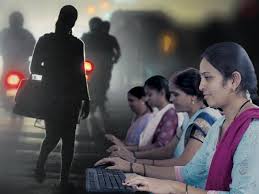
With emergence information technology and enabled services and eventual boom in post economic reforms has attracted massive outsourcing base work. These services where the offshore workers need to be operating at the same hours as US companies, for example customer support / help-desk services, the Indian workers must adapt to working swing-shifts and unsocial hours.
It opened employment options for a huge population, it was one of the most dynamic industry, with rapidly changing work environment, process compliance and above all corporate culture. It became immediate source of earning for middle class youth in metro cities, otherwise was not available. It started a sea change among Indian youth in terms identification of new modernity, culture, night life and materialism. These IT and ITES spaces became platform for social gathering, interaction, socialization and new meaning to life. The improved confidence in the sector created a positive perception across the social-economic hierarchy.
Due to lack of understanding, working in night in India often equated with crime, anti-social activity, alcohol or drug abuse. The initial population at call centers (1996–2005) took the IT and ITES work simply as work but over the year’s subsequent generations, it is about life style, and popular culture. The ITES sector were at the fore front of the new culture. The newly found financial independence, confidence in one-self and exposure to modern elements got the much-acclaimed admiration (or defamation). On the other hand, access to good enough money at young ages lead to drug addition, alcohol addiction, crude relationships and openness that Indian society wasn’t ready at that stage.
The Indian culture is very family and social-centric, and these types of jobs are becoming increasingly less desirable for many workers who go into these jobs initially to enjoy the increased compensation on offer, but are quickly realizing the trade-off with their lifestyle, health and family / social issues. If outsourcing providers are servicing US businesses from India that require a large degree of worker overlap, they are going to be faced with increasing issues of attrition and rising wages to keep workers in these jobs. This is the chief reason why the Latin America region is on the cusp of a major upswing of taking on outsourced jobs that benefit from the time overlap. At the same time, it increases the appeal of UK and European-centric services being run out of India, where the time differences are far less oppressive on the offshore workers.
These health and social issues are very symptomatic of a developing economy like India - and my only surprise is the speed at which they are happening. I believe these issues will only be magnified when work is outsourced from US businesses to China, where the time differentials are even more brutal, and the language issues much tougher. That is one of the principal reasons why China is (and will continue to be) far more successful at taking on services such as engineering and manufacturing, where these worker interaction issues between offshore staff and Western organizations and their customers are less crucial.
Comments (1)
Very well articulated Sazzad... New York is 10.5 hours behind Hyderabad (and most of India) and the UK is 5.5 hours behind --- so this part nails it, besides the "...trade-off with their lifestyle, health and family / social issues," the following statement is instructive: "If outsourcing providers are servicing US businesses from India that require a large degree of worker overlap, they are going to be faced with increasing issues of attrition and rising wages to keep workers in these jobs. This is the chief reason why the Latin America region is on the cusp of a major upswing of taking on outsourced jobs that benefit from the time overlap."