Research Misconduct: A Hidden Crisis in Academia
Within academic institutions, where integrity and rigorous inquiry are expected to guide knowledge creation, a more insidious threat quietly unfolds — research misconduct. While plagiarism and data fabrication dominate headlines, less visible but equally damaging practices continue unchecked.
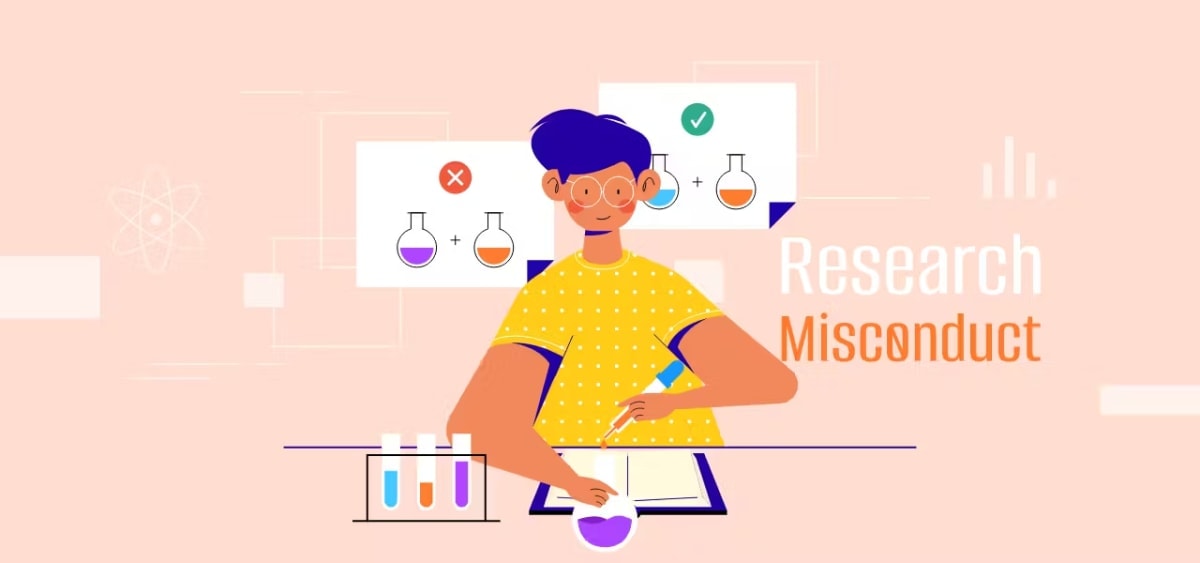
Research Misconduct: A Hidden Crisis in Academia
Prof. Dinesh K. & Dr. Nidhi Suthar
Within academic institutions, where integrity and rigorous inquiry are expected to guide knowledge creation, a more insidious threat quietly unfolds — research misconduct. While plagiarism and data fabrication dominate headlines, less visible but equally damaging practices continue unchecked. These include coercive authorship, falsification of data, and the misuse of academic rank to claim undue intellectual credit. Such behaviors undermine the credibility of science. They also inflict lasting harm on early-career researchers, damaging both their professional progress and personal morale. The consequences are profound and far-reaching.
1. Coercive Authorship: “Put My Name or Else”
Coercive authorship remains one of the most common yet overlooked forms of research misconduct. It involves compelling junior researchers, students, or interns to include senior academics or supervisors as co-authors—regardless of their actual contribution. Often, these individuals have made no meaningful input to the study, patent, or grant.
This practice reflects a clear abuse of academic hierarchy. It is particularly harmful in environments where professional advancement depends heavily on publication metrics. Senior faculty may use their position to inflate their publication records. Ethical standards are sacrificed for personal gain.
The pressure on junior scholars is intense. They may be told—directly or through implication—that omitting a senior’s name could lead to retaliation. Consequences may include delays in thesis approvals, poor evaluations, or withheld recommendations.
International ethical frameworks such as the ICMJE and COPE clearly state that authorship requires substantial intellectual involvement. This includes contributions to a study's conception, design, execution, or interpretation. However, these criteria are frequently disregarded.
The result is a culture of distorted authorship. Credit is misallocated. Power dynamics overshadow merit. Worse, a climate of fear takes hold. Students become reluctant to report violations, fearing academic or professional backlash.
2. Data Fabrication and Falsification: The “Publish or Perish” Fallout
Another serious breach of research ethics is the use of fake or manipulated data. This includes fabrication—the creation of entirely false data—and falsification, which involves altering real data to fit a desired outcome. Both practices fundamentally undermine the principles of empirical science.
Such misconduct often arises from the intense pressure of the “publish or perish” culture. In this environment, academic success is tightly linked to publication quantity and impact. Faced with looming deadlines, funding goals, or career benchmarks, some researchers may resort to dishonest shortcuts. They might fabricate entire datasets. Others may present only favourable results while hiding contradictory evidence.
The consequences are far-reaching. Fabricated data, once published, becomes part of the scientific record. It misleads future studies. It wastes institutional and public resources. In critical fields such as medicine or psychology, it can directly harm patients or vulnerable populations.
The problem is exacerbated by the rise of preprint servers and open-access journals with weak or absent peer review. These platforms, while valuable for fast dissemination, may also allow unverified or fraudulent data to slip through. As a result, the integrity of scientific communication faces growing risk.
3. Intellectual Decoupling: Stealing Credit Under the Guise of Authority
A more subtle, yet equally harmful, form of research misconduct is intellectual decoupling. This refers to senior academics taking credit for ideas, patents, or projects originally developed by junior scholars. It is often disguised as a form of “mentorship” or justified under the need for administrative approval.
In many institutions, faculty authorization is required to move a project forward. This includes signing off on patents, research protocols, or funding applications. Some senior researchers misuse this gatekeeping power. They demand their names be added as inventors or lead authors—despite contributing little or nothing to the intellectual work itself.
This practice constitutes a form of institutionalized intellectual theft. It is especially dangerous because it appears legitimate on the surface. Yet it exploits the structural power imbalance between faculty and students. For early-career researchers, refusal to comply can carry serious consequences. These may include blocked degrees, lost funding, or damaged career prospects.
Because of these risks, many victims remain silent. The result is a deeply unjust system where authority is used not to guide research, but to appropriate the labour and innovation of others.
4. Other Forms of Misconduct Worth Noting
While coercive authorship, data manipulation and intellectual theft are among the most serious violations, other unethical behaviors frequently occur in academia:
Ghostwriting: Having someone else write a paper or thesis but publishing it under one’s own name, often practiced by those in powerful positions with many responsibilities.
Salami slicing: Publishing minimal incremental results across multiple papers to inflate publication count, thus misleading funders and reviewers.
Duplicate publication: Publishing the same data or findings in more than one outlet without proper disclosure, which violates the norms of original contribution.
Manipulation of the peer review process: Suggesting fake reviewers or coercing journal editors to fast-track or approve substandard work.
Retaliation against whistleblowers: Silencing those who raise legitimate concerns about research ethics, either through institutional punishment or academic exclusion.
5. Consequences of Research Misconduct
The consequences of such unethical practices are profound and long-lasting:
Loss of trust in academic institutions and the peer review process
Damaged reputations and legal implications for the involved individuals
Wasted public funding and effort on research that may be later retracted
Demoralization of honest researchers.
Distortion of scientific knowledge particularly when flawed or fake data goes unchallenged
6. The Need for Reform and Vigilance
To combat these abuses, institutions must implement strict authorship guidelines, anonymous reporting systems and mandatory ethics training for faculty and students alike. Journals must demand contribution statements and funding agencies should penalize proven cases of misconduct with bans or fines.
Most importantly, we must shift the culture of academic success from one that glorifies quantity to one that values quality, collaboration and ethical integrity.
Conclusion
Research misconduct is not just an issue of academic dishonesty; it is a systemic failure of accountability, ethics and mentorship. Whether it manifests through forced authorship, falsified data, or exploitative credit-stealing, the harm it causes is far-reaching. Upholding the integrity of science requires not only vigilance but the moral courage to confront unethical practices — even when they come from those in positions of power.
Ethical Statement: AI assistance is taken to refine this content.
About Authors
Prof. Dinesh K is a seasoned professional with extensive expertise in the military, academia, business and charity sectors. He holds a PhD from the Indian Institute of Technology (IIT) Roorkee and made history as the first soldier to secure doctoral admission offers from the prestigious IIT and IIM. He is a former CEO of Pomento and currently the David De Cremer Chair Professor of the Future of Work at Woxsen University, where he also leads the Strategic Enforcement and Technology Intelligence Lab and AI and Analytics Research Cluster. He can be contact at linktr.ee/realdrdj
Dr. Nidhi Suthar is a seasoned academician and a businesswoman. She is a management professor at Woxsen University.