Rethinking Business Strategy in the Age of AI, Sustainability, and Uncertainty
Modern strategy now extends beyond profit to include AI, sustainability, and resilience. Businesses thrive by balancing innovation with responsibility, treating AI as a collaborator, and ensuring growth benefits both the company and society.
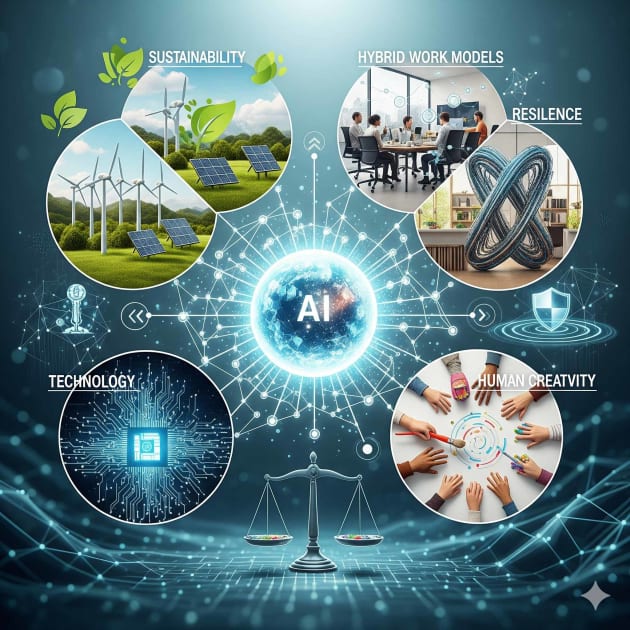
Look at the way strategy is being discussed in boardrooms today. The language has changed. Executives aren’t just talking about market share or quarterly numbers; they’re grappling with AI, sustainability, new models of work, automation, customer trust, and resilience. These aren’t side issues anymore. They’re shaping how firms compete and how societies absorb change.
Artificial intelligence sits at the center of this shift. Generative AI in particular has unsettled both managers and employees. It can write, design, and analyze at extraordinary speed. But here’s the catch: treating it as a cheap replacement for human work is a dead end. The companies that will actually benefit are those that make AI a collaborator, not a substitute. Offload the repetitive tasks, yes—but protect space for judgment, creativity, and ethical reasoning. That’s where people add irreplaceable value. And the wider implications are obvious. Workers need reskilling, education systems need rewiring, and leaders must take responsibility for how transparent and fair these tools are.
Sustainability is following a similar trajectory. It used to be a glossy page in an annual report. Now it’s a board-level discussion about competitiveness. A logistics company that cuts carbon out of its supply chain, or a manufacturer that designs for reuse, is not just doing public relations—it’s setting the terms of the market. The ripple effect is social as much as commercial. Consumers begin to shift habits, regulators raise the bar, and industry norms bend in new directions. Sustainability is no longer about good optics; it’s about survival and influence.
Workplace models have been upended as well. Hybrid work has gone from experiment to expectation. But there’s a danger here: if flexibility is offered without investment in new skills, it simply creates a divide. Some employees thrive; others stagnate. Businesses that take reskilling seriously—teaching digital fluency, data literacy, creative problem-solving—aren’t just protecting their own workforce. They’re narrowing social inequality. That’s a responsibility no serious company can dodge.
Then comes efficiency, which is being redefined by hyper-automation and platform engineering. The idea is to link fragmented systems, cut the drudgery, and let machines take over repetitive tasks. Done well, this creates agility. Done poorly, it strips out human oversight and magnifies mistakes. The lesson is simple: efficiency matters, but accountability matters more. Technology can accelerate processes, but someone has to own the judgment calls.
On the customer side, the expectations are sharper than ever. Personalization has gone from novelty to baseline. AI now makes it possible to deliver tailored experiences at scale. But this, too, has limits. Collecting endless data without consent is not personalization—it’s intrusion. Trust is fragile. Once lost, it rarely returns. The firms that get this right will be the ones that personalize responsibly, balancing relevance with respect for privacy.
And finally, resilience. The shocks of recent years—pandemics, wars, climate events—have shown that strategies built purely for efficiency are brittle. Resilient organizations diversify suppliers, build adaptive systems, and train leaders to live with uncertainty. When they do, they don’t just protect shareholders. They stabilize communities and economies around them. Resilience has become a public good as much as a corporate strength.
What strikes me is how interdependent all these themes are. AI without ethics is exploitation. Sustainability without competitiveness drifts into symbolism. Flexibility without training deepens inequality. Automation without oversight erodes trust. None of these forces can be managed in isolation; they only make sense as part of a larger design.
That design, if handled well, is powerful. A business that treats AI as a co-pilot, embeds sustainability in its core, invests in people, automates with care, respects customer privacy, and prepares for shocks is not only competitive—it’s shaping the society around it. And that, to me, is the real meaning of strategy now. It’s not about chasing the next technology or surviving the next disruption. It’s about making choices that balance profit with purpose, efficiency with empathy, and innovation with responsibility.
These choices are not abstract. They affect workers deciding if they still have a place in the economy. They affect consumers deciding which brands they can trust. They affect communities deciding whether business is a stabilizing force or another source of risk. That’s why the future of strategy is inseparable from the future of society itself.