Role of Micro finance in India
Microfinance in India plays a crucial role in advancing financial inclusion and alleviating poverty. By offering small, collateral-free loans, savings, and insurance, it empowers low-income families and enhances women's socio-economic status.
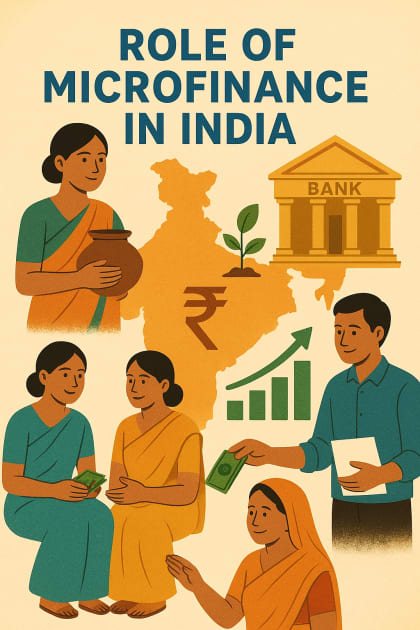
Introduction:
Microfinance refers to the provision of small-scale financial services such as loans, savings, and insurance to individuals who are traditionally excluded from formal banking systems. In India, it has emerged as a powerful tool to enhance financial inclusion, particularly for low-income households and women entrepreneurs. The size of loans usually falls below one lakh rupees, aimed at supporting micro-enterprises and household needs. Over the past two decades, the sector has expanded significantly, with microfinance institutions (MFIs), self-help groups (SHGs), and small finance banks (SFBs) playing a central role in reaching underserved communities. By providing accessible financial services, microfinance not only promotes entrepreneurship but also contributes to poverty reduction and empowerment of marginalised groups (RBI, 2023; NABARD, 2024).
Role of Microfinance
MFIs in India are specifically designed to cater to the needs of low-income groups. These institutions mobilise funds from banks and development agencies and channel them into small, collateral-free loans. Unlike traditional banks, they also provide complementary services such as financial literacy, training, and counselling. This dual support helps borrowers utilise loans productively and improve repayment capacity.
Microfinance operates through diverse channels. Formal institutions include regional rural banks, cooperative societies, and commercial banks. Semi-formal organizations often function as non-governmental organisations (NGOs) registered under various legal frameworks. Informal channels involve small moneylenders and shopkeepers. The sector has also popularised group-based lending models such as Joint Liability Groups (JLGs) and Self-Help Groups (SHGs), which encourage collective responsibility and reduce the risk of default.
Importance of Microfinance in India
Microfinance in India lies in its contribution to both social and economic development:
Ø Microfinance provides low-income individuals with access to affordable loans, enabling them to launch and grow small businesses. This leads to greater financial independence, poverty alleviation, and promotes self-sufficiency in underserved communities.
Ø Organizations offering microfinance services, often in collaboration with NGOs, encourage savings practices among low-income individuals. The savings accumulated, along with microloans from banks, are used to fund loans and advances for members of Self Help Groups (SHGs), effectively channelling resources for community development.
Ø The primary delivery method for microfinance is through Self Help Groups (SHGs), with more than half of these groups composed of women. By gaining access to financial and economic resources, women experience enhanced security and improved economic and social empowerment.
Performance of MFIs
The microfinance industry has witnessed robust growth in recent years. According to the NABARD Status of Microfinance Report (2023–24), MFIs and other institutions together served more than 1409 lakh loan accounts with a gross loan portfolio exceeding ₹4.08 lakh crore by March 2024. The average loan size increased from ₹41,369 in FY 2022–23 to ₹46,636 in FY 2023–24. Loan disbursements also rose significantly, reflecting the sector’s expanding outreach.
The delivery mechanism remains dominated by JLGs, comprising four to ten members, which ensure collective accountability for repayment. Non-Banking Financial Company–MFIs (NBFC-MFIs), regulated by the Reserve Bank of India (RBI), account for the largest share of microfinance lending. Despite challenges such as over-indebtedness and repayment delays in certain regions, the overall performance of the sector has been strong, with repayment rates above 95% (RBI, 2023).
Geographical Outreach
The reach of microfinance has steadily increased across India. By 2024, MFIs were active in 28 states, 8 union territories, and 730 districts. A sharp expansion in geographical coverage has been observed over the past decade, especially in underserved regions of central and eastern India. Larger NBFC-MFIs have diversified their operations across multiple states, while smaller non-profit MFIs continue to operate within one or two states.
This expansion is significant because financial access in rural and semi-urban areas directly supports economic activities such as agriculture, dairy farming, handicrafts, and small trade. It also ensures that communities in remote areas are not left behind in India’s growth story (NABARD, 2024).
Conclusion
Microfinance in India has evolved from a small-scale poverty alleviation initiative into a mainstream component of the financial system. By promoting access to credit, encouraging savings, and supporting entrepreneurship, it has strengthened the foundation of financial inclusion. However, the sector also faces challenges such as borrower over-indebtedness, regulatory concerns, and the need for digital adoption. Addressing these issues through effective policies and responsible lending practices will ensure that microfinance continues to play a transformative role in India’s socio-economic development.
References
· NABARD. (2024). Status of Microfinance in India 2023–24. National Bank for Agriculture and Rural Development.
· RBI. (2023). Report on Trends and Progress of Banking in India. Reserve Bank of India.
· Dr. K. Harika & Dr. S. Praveen (2025) The Role Of Microfinance In India . Iosr Journal Of Economics And Fin