Rupee Under Pressure as USD/INR Breaches 91
Rupee breaches 91/USD amid FII outflows, India-US trade uncertainty, and steady dollar demand. Weak domestic inflation and global dollar strength add pressure, while RBI intervention may temper volatility. Near-term support: 90.60–90.70; resistance: 91.50.
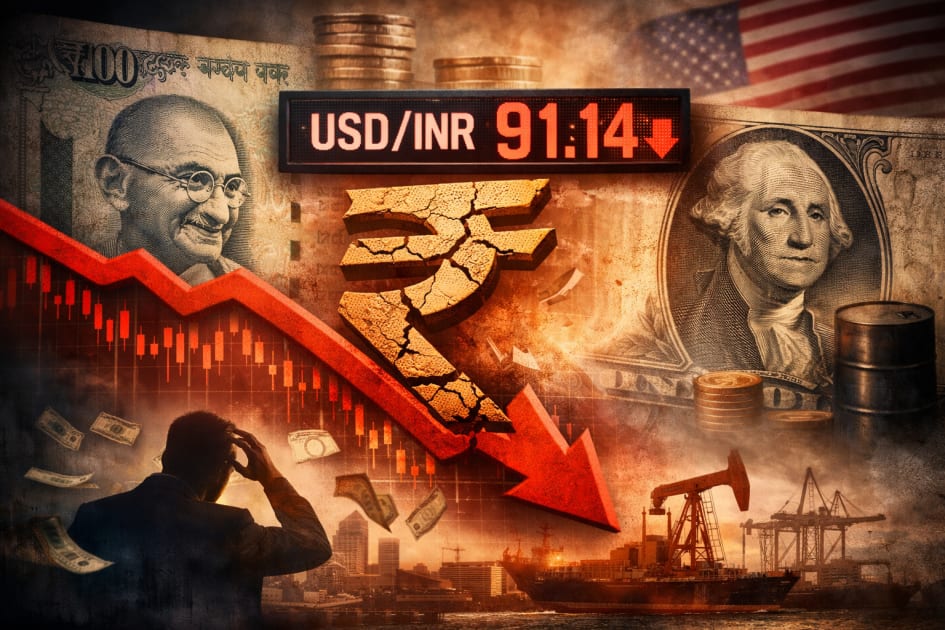
Rupee Under Pressure as USD/INR Breaches 91
The Indian rupee weakened sharply on Tuesday, slipping past the 91-per-dollar level for the first time in intra-day trade, as persistent foreign capital outflows, uncertainty surrounding the India-US trade agreement, and steady demand for the US dollar continued to weigh on sentiment.
The rupee fell by as much as 36 paise to an intra-day low of 91.14, extending its recent slide. The local unit has declined from around ₹90 to ₹91 over the past 10 trading sessions and is down nearly 1% in the last five sessions, reflecting intensifying pressure on the currency.
Table-1 Key Market Drivers Snapshot
Indicator | Latest |
USD/INR (Intra-day Low) | 91.14 |
FII Equity Flow (₹ Cr) | -1,468.32 |
Dollar Index | 98.27 |
Brent Crude ($/bbl) | 60.19 |
WPI Inflation (Nov) | -0.32% |
Rupee Slides to Fresh Record Levels
In the interbank foreign exchange market, the rupee opened weaker at 90.87 against the US dollar and remained under pressure throughout the session. On Monday, the currency had settled at a record closing low of 90.78, down 29 paise from its previous close, according to market data.
Dealers said the near-term bias for the rupee remains negative amid continued dollar buying by importers and foreign investors.
Fig-1: USD/INR Spot Movement (Last 1 Month)

Trade Deal Uncertainty Weighs on Sentiment
Lingering uncertainty over the proposed India-US trade agreement has emerged as a key overhang for the currency, limiting any meaningful recovery.
“The US–India trade deal still appears some distance away. While there are indications that the first phase may be signed before the end of the year, the lack of clarity has clouded recovery in the USD/INR pair, with dollar buying seen on a daily basis,” said Anil Kumar Bhansali, Head of Treasury and Executive Director at Finrex Treasury Advisors LLP.
He added that recent improvements in trade deficit data failed to lend support to the rupee, as capital flow continues to dominate currency movements.
FII Selling Adds to Rupee Pressure
Foreign portfolio flows remain a major drag. According to exchange data, Foreign Institutional Investors (FIIs) sold Indian equities worth ₹1,468.32 crore on Monday, extending a trend of net outflows that has pressured both the rupee and domestic equities.
Market participants note that sustained FII selling typically increases dollar demand in the onshore market, amplifying pressure on the domestic currency.
Inflation Data Offers Little Support
Domestic macroeconomic data did little to arrest the rupee’s decline. Wholesale Price Index (WPI)-based inflation remained in negative territory for the second straight month, contracting 0.32% in November, following a 1.21% contraction in October, according to government data. WPI inflation stood at 2.16% in November last year.
While food items such as pulses and vegetables recorded a month-on-month increase, broader deflationary trends limited any supportive impact on the currency.
Global Factors Provide Limited Relief
Globally, the US dollar index, which measures the greenback against a basket of six major currencies, was marginally lower at 98.27, offering little respite to emerging market currencies. The dollar has remained firm amid expectations that US interest rates could stay higher for longer.
Meanwhile, Brent crude oil, a critical input for India’s import bill, declined 0.61% to $60.19 per barrel in futures trade. Although softer oil prices are generally supportive for the rupee, the impact was outweighed by capital outflows and risk aversion.
Equities Track Currency Weakness
Domestic equity benchmarks traded lower in early deals, mirroring weak global cues and foreign selling pressure. The Sensex fell 363.92 points to 84,849.44, while the Nifty 50 declined 106.65 points to 25,920.65.
Analysts said export-oriented sectors such as IT and pharmaceuticals may benefit from a weaker rupee, while import-dependent sectors including aviation, oil marketing companies, and capital goods face rising cost pressures.
RBI in Focus as Volatility Rises
Attention has now shifted to the Reserve Bank of India (RBI). The central bank has historically intervened to curb excessive volatility rather than defend a specific exchange rate. With India holding comfortable foreign exchange reserves, the RBI has scope to smooth sharp currency moves, though market participants expect policymakers to tolerate gradual depreciation aligned with global trends.
Outlook: Volatility Likely to Continue
In the near term, the rupee is expected to remain volatile, with traders closely watching:
· Foreign portfolio flows
· Movements in the US dollar index
· Crude oil prices
· Signals of RBI intervention
· Developments in India–US trade talks
From a technical perspective, dealers said a sustained move above 91 could open the door toward 91.50, while any pullback may find support around the 90.60 - 90.70 zone.
For now, the breach of the 91 level highlights growing vulnerability in the rupee, as global uncertainty and capital flows continue to dictate currency dynamics.