The Efficacy of In-Game Banner Advertising Among Indonesian and Indian Young Adults
This objective is achieved by investigating mobile and portable gamers’ attitudes and intentions towards mobile in-game banner advertising (IGBA).
The Efficacy of In-Game Banner Advertising Among Indonesian and Indian Young Adults
Introduction
In 2020, the swift evolution of those who engage in video gaming profoundly transformed the virtual entertainment sector. The outcomes of exceptional income reaching billions of dollars emerged as one of the most evident repercussions. Consequently, several opportunities were generated for diverse stakeholders, including developers, publishers, merchants, and other market suppliers. Notably, the year 2020 will henceforth be recognized as the year of the "pandemic," a period during which we all confronted significant challenges to endure and preserve our financial stability. While the Covid-19 pandemic has severely impacted other business sectors, the video gaming industry has undergone a contrasting phase of growth. The simplicity and practicality of playing games anywhere while engaging in essential daily chores sufficiently elucidate the tremendous appeal of mobile games. The target market for mobile games in underdeveloped nations is expanding annually.
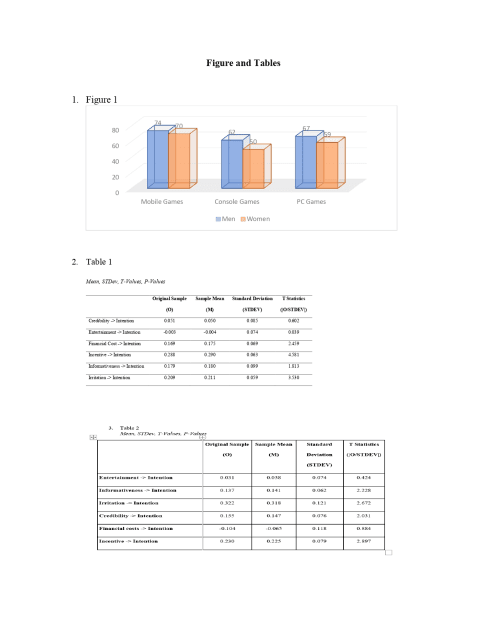
Indonesia possesses a substantial population comparable to China, India, and other developing nations; these countries are advancing their economies, attracting foreign investments from established nations (Haudi & Cahyono, 2020; Kim & Thuc, 2020). Investors cannot overlook Indonesia, which ranks as the fourth largest smartphone market globally, following China, India, and the United States. In 2017, around $1.1 billion was expended on video games in Indonesia, establishing it as one of the region's most profitable industries. Seventy-four percent of men and seventy percent of women engage in mobile gaming, whereas sixty-two percent of men and fifty percent of women participate in console gaming within the online demographic (Figure 1).
Figure 1. Type of Games Played by Gender (Percent), (Newzoo.com, 2019)
The foundation of mobile in-game advertising
While the promotion of products via mobile devices is not a recent innovation, mobile advertising frameworks continue to evolve swiftly. There are fundamental formats for advertising on devices. These encompass display advertising, search advertising, and messaging. Before the widespread adoption of PDAs, tablets, and smartphones, SMS (Short Message Service) and MMS (Multimedia Messaging Service) were the initial advertising mediums in mobile devices.
Considering the impact of advertising
In the early stages of Internet commerce, extensive research was conducted to assess the efficacy and impact of banner advertising. Subsequently, several methods have been employed. This encompasses trademark memory, brand knowledge following exposure to the advertisement, online purchasing expectations, desire to engage with the ad, and consumer attitudes towards various advertising attributes.
Comparable measures have been employed to assess the impact of portable advertisements in the previous study. Nonetheless, in relation to the IGBA performance research, the focus has been on brand recognition or advertising attention. Furthermore, the perception of many aspects has been essential in the previous research on IGBA. Currently, the research emphasizes the impact of IGBA on players' objectives. The video game industry has been growing rapidly; therefore, understanding marketing inside video games may be beneficial.
Population and Sample
The study examines a demographic of young adults living in India and Indonesia who own a minimum of one mobile game on their cellphones. Indonesia and India were selected for analysis since they are classified among the Big Five countries globally, demonstrating a substantial number of app downloads, especially in gaming, between 2021-2022 (Statista.com, 2023). The authors examined two prospective markets for game banner advertising: Indonesian (210) and Indian (202) young adults, with a total of 412 respondents.
Finding and Discussion
Indonesia
Table 1 indicates that Credibility, Entertainment, and Informativeness are insignificant with respect to purpose, as evidenced by t-statistic values less than 1.96. Financial cost, incentive, and irritation are highly significant to intention.
Table 1 Mean, STDev, T-Values, P-Values [Table 1 Here]
The recurrent advertisements that appear in gaming may indicate unsettling feelings while engaging with a mobile game. Indonesian clients encounter commercials while playing games; they do not perceive the adverts as intrusive. It denotes the organizations who invest in mobile games within the Indonesian region, notably in advertising, emphasizing customer demands and successfully mitigating annoyance in their marketing delivery. Ranganathan and Campbell (2002) stated that it is essential to execute all actions without bothering or disrupting current or prospective users.
India
Table 2 illustrates that the impact of inner weight estimation on entertainment (T-statistic score: 0.424) and financial costs (T-statistic score: 0.884) is negatively significant regarding intention, as both values are less than 1.96. Informativeness (T-statistic score: 2.228), annoyance (T-statistic score: 2.672), credibility (T-statistic score: 2.031), and incentive (T-statistic score: 2.897) shown positive significance regarding intention. The data indicate that Indian consumers do not regard amusement as a vital element when encountering advertisements in games. The absence of engaged consumers viewing advertisements may adversely affect brand perceptions. The advertising company should be motivated to enhance delight by providing aesthetic pleasure and emotional release during gameplay. Consumers require a respite from concentrated activity; hence, advertisements offer a means of brief escapism and diversion (Elliott & Speck, 1998; Shavitt et al., 1998).
Table 2 Mean, STDev, T-Values, P-Values [Table 2 here]
Indian mobile game advertisers are adept at achieving the objectives of informing customers about products or services and enhancing consumer awareness of those offerings. Petrovici and Marinov (2007) assert that obtaining information about products and services is essential. Consequently, advertising should predominantly focus on disseminating information. Moreover, the information relevant to the game promoted via banners is considered effective and capable of fostering consumer trust (Liu et al., 2012). Comparable findings in India and Indonesia indicated that irritation is highly relevant in relation to intention.
Conclusion
Indian mobile game advertisers are adept at achieving the objectives of informing customers about products or services and enhancing consumer awareness of those offerings. Petrovici and Marinov (2007) assert that obtaining information about products and services is essential. Consequently, advertising should predominantly focus on disseminating information. Moreover, the information relevant to the game promoted via banners is considered effective and capable of fostering consumer trust (Liu et al., 2012). Comparable findings in India and Indonesia indicated that irritation is highly relevant in relation to intention.
Application distribution platforms, such as the App Store and Play Store, provide a diverse selection of games available via either a free download model or a paid download model for mobile customers. Identifying a unique strategy among diverse developer games that effectively attracts customers and can impact their decision-making process is a challenging endeavor, as examined in this study.
References
Haudi, H. W., & Cahyono, Y. (2020). Analysis of Most Influential Factors to Attract Foreign Direct Investment. Journal of Critical Reviews, 7(13), 4128–4135
Newzoo.com. (2019). Insights into the Indonesian Games Market. https://newzoo.com/insights/infographics/insights-into-the-indonesian-games-market/
Statista.com. (2023). Number of mobile app downloads worldwide in 2021 and 2022, by country.
Ranganathan, A., & Campbell, R. H. (2002). Advertising in a pervasive computing environment. Proceedings of the 2nd International Workshop on Mobile Commerce, 10–14.
Elliott, M. T., & Speck, P. S. (1998). Consumer perceptions of advertising clutter and its impact across various media. Journal of Advertising Research, 38(1), 29–30.
Shavitt, S., Lowrey, P., & Haefner, J. (1998). Public attitudes toward advertising: More favorable than you might think. Journal of Advertising Research, 38(4), 7–22.
Petrovici, D., & Marinov, M. (2007). Determinants and antecedents of general attitudes towards advertising: A study of two EU accession countries. European Journal of Marketing, 41(3/4), 307–326
Liu, C.-L. ‘Eunice,’ Sinkovics, R. R., Pezderka, N., & Haghirian, P. (2012). Determinants of consumer perceptions toward mobile advertising—a comparison between Japan and Austria. Journal of Interactive Marketing, 26(1), 21–32.