The India-European Union Free Trade Agreement: A Historic Partnership
The India-EU Free Trade Agreement, concluded January 2026, is a landmark accord creating the world's largest free trade zone with 2 billion people and 25% global GDP. India gains duty-free access for 99% of exports while EU expects to double goods exports to India by 2032.
Introduction: Mother of All Deals
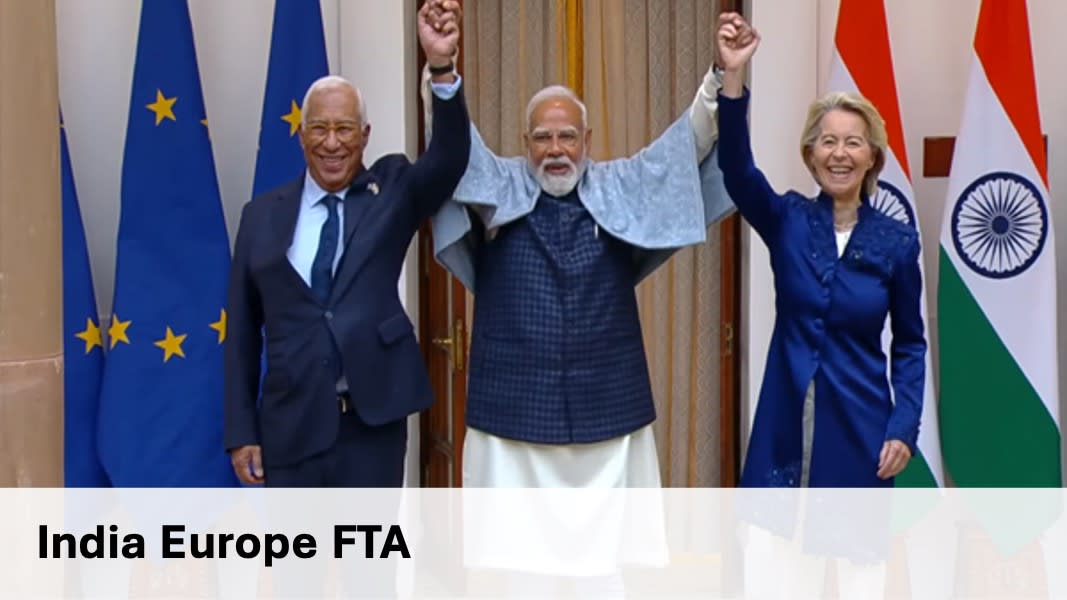
After two decades of negotiations, India and the European Union have concluded one of the most significant trade agreements in their respective histories. Concluded on January 27, 2026, the India-EU Free Trade Agreement (FTA) represents far more than a simple tariff reduction agreement. The India-EU FTA has the potential to offer wide-ranging benefits going beyond not only economic advantages but also reinforcing the broader strategic and political links between the EU and India. This landmark achievement creates the world’s largest free trade zone, bringing together two of the world’s largest democracies with a combined market estimated at over INR 2091.6 Lakh Crore (USD 24 trillion) and representing approximately 25% of global GDP. The agreement encompasses 2 billion people across both regions, signaling a commitment to open, rules-based trade in an era increasingly characterized by protectionism and unilateral tariff actions.
Bilateral merchandise trade between India and the EU has demonstrated sustained growth, valued approximately at INR 11.5 Lakh Crore (USD 136.54 billion) in 2024-25, with India exporting roughly INR 6.4 Lakh Crore (USD 75.85 billion) to the EU. India-EU trade in services reached INR 7.2 Lakh Crore (USD 83.10 billion) in 2024.
Despite healthy and growing trade, there is a significant untapped potential considering the size of each other’s market and trade. The FTA provides an unparalleled pathway and holds immense promise for both India and the EU to emerge as each other’s major economic partners.
This FTA of strategic significance evolves India-EU relations from a traditional into a modern, multifaceted partnership, providing a stable and predictable environment for exporters, enabling Indian businesses, including MSMEs, to plan long-term investments, integrate into European value chains, and ensure consistent favorable market access amid global economic uncertainties.
Unprecedented Benefits for India
For India, the FTA delivers unprecedented market access opportunities. The agreement provides preferential access to European markets across 97% of tariff lines and delivers unprecedented market access for more than 99% of India’s exports by trade value, while preserving policy space for sensitive sectors and reinforcing India’s developmental priorities. This level of market access is transformational for Indian exporters and businesses seeking to diversify beyond traditional markets.
The specific tariff concessions are particularly noteworthy for India’s key export sectors. Once operational, around 93% of India’s exports are set to gain duty-free entry into European markets, with full extension to 93% within seven years. Marine products and seafood—including shrimp and frozen fish currently levied at up to 26 percent—will now enjoy zero tariffs immediately, alongside chemicals, plastics, rubber, leather, footwear, textiles, and apparel. These reductions directly benefit India’s labor-intensive industries, where the country possesses significant comparative advantages.
Beyond merchandise trade, India has secured substantial openings in services sectors with the EU, an area traditionally protected in India’s trade policy. In addition to merchandise trade, the FTA secures substantial openings in services, supported by a mobility framework that facilitates the smooth movement of skilled Indian professionals. India’s services commitments under this FTA are the most ambitious it has ever undertaken, surpassing the concessions granted to partners such as the United Kingdom and Australia, with India opening 102 services subsectors to the EU in sectors including financial, maritime, and telecommunications industries.
Prime Minister Narendra Modi emphasized that the agreement would prove very helpful for Indian businesses and industry leaders in sectors such as textiles, gems and jewellery, noting that “it will not only boost manufacturing in India but will also expand India’s services sector”. This comprehensive approach positions India as an attractive investment destination and manufacturing hub.
Substantial Benefits for the European Union
The benefits flowing to the European Union are equally significant. The Commission expects the deal to double EU goods exports to India by 2032, supporting jobs across manufacturing, agriculture, and services. This projected doubling represents enormous potential for European businesses seeking access to one of the world’s fastest-growing major economies.
The tariff concessions granted by India to European exporters are substantial. By eliminating or reducing tariffs on 96.6% of EU exports, the agreement will save European companies 4 billion euros annually and is expected to double goods exports to India by 2032. European manufacturers gain unprecedented access to the world’s most populous market, with dramatic tariff cuts on automobiles, machinery, chemicals, and pharmaceuticals—sectors where the EU possesses technological leadership.
Wine and spirits manufacturers will see particular benefits. Current tariffs on spirits and wines imported to India from the EU, currently tariffed at 150 percent, will be cut to 20 to 30 percent for wines, 40 percent for spirits and 50 percent for beer. Additionally, tariffs on automobiles, aircraft, optical, medical and surgical equipment will be eliminated for almost all products, providing major opportunities for European exporters.
European SMEs (small and medium-sized enterprises) will receive dedicated support mechanisms to help them seize new opportunities in the Indian market, democratizing access to one of Asia’s most dynamic markets. The agreement also includes provisions for improved access in financial and maritime services for EU firms, areas where European companies possess substantial competitive advantages.
Strategic Impact and Geopolitical Significance
The strategic importance of this agreement transcends economics. India offers the EU benefits including access to a vast and growing consumer market, a diverse pool of skilled labor and talent, a strategic geopolitical partner in the Indo-Pacific region, a supplier of key goods like textiles and chemicals, and potential for investment in areas like digital technologies, green energy, and raw materials.
The two sides hope to increase bilateral trade from the current USD 136.5 billion (2024-25) to about USD 200 billion by 2030, demonstrating the growth potential both parties envision. This represents a substantial increase but remains realistic given the size of both markets and their complementary strengths. India and Europe stand at a pivotal juncture in their partnership, with the forthcoming India-EU Free Trade Agreement expected to serve as a cornerstone for deeper economic integration in emerging sectors, including manufacturing, renewable energy, digital technologies, pharmaceuticals, and services.
The geopolitical context cannot be overlooked. The agreement positions the EU-India partnership as a counterweight to growing protectionism globally, particularly in the context of changing US trade policies. This is a modern, rules-based trade partnership that responds to contemporary global challenges and represents a strategic bet on openness and growth driven by deeper economic ties between two of the world’s largest democracies. The EU and India are pluralistic democracies committed to strategic autonomy, economic resilience, and international stability, sharing interests in promoting trade diversification and reducing over-dependence on any single partner.
The India-EU FTA is expected to strengthen institutional frameworks and provide a stable environment for businesses, enabling Indian enterprises to integrate into European value chains and ensuring consistent favorable market access amid global economic uncertainties. With India’s dynamic market and Europe’s technological prowess, the partnership is well-positioned to achieve inclusive, sustainable, and mutually beneficial outcomes.
Conclusion
The India-EU Free Trade Agreement represents a watershed moment in global trade governance. By emerging from protectionist pressures to conclude an ambitious agreement, both sides have demonstrated commitment to an open, rules-based international order. The agreement would prove to be a game-changer for both economies, positioning India and the EU as strategic partners in reshaping global commerce and geopolitics. As negotiations now turn to the parallel Investment Protection Agreement and Geographical Indications Agreement, the broader architecture of EU-India cooperation continues to strengthen, offering hope that open trade and strategic partnership remain viable tools for mutual prosperity in an uncertain world.
References
2. https://www.pib.gov.in/PressReleasePage.aspx?PRID=2219146®=3&lang=2