Two Decades Adrift: Census 2027 as India’s Map Back to Reality
The Census of 2027 is a wake-up call, exposing nearly two decades of drift since 2011. It reveals how demographic shifts, policy inertia, and inequality have compounded, turning statistics into a ledger of accountability.
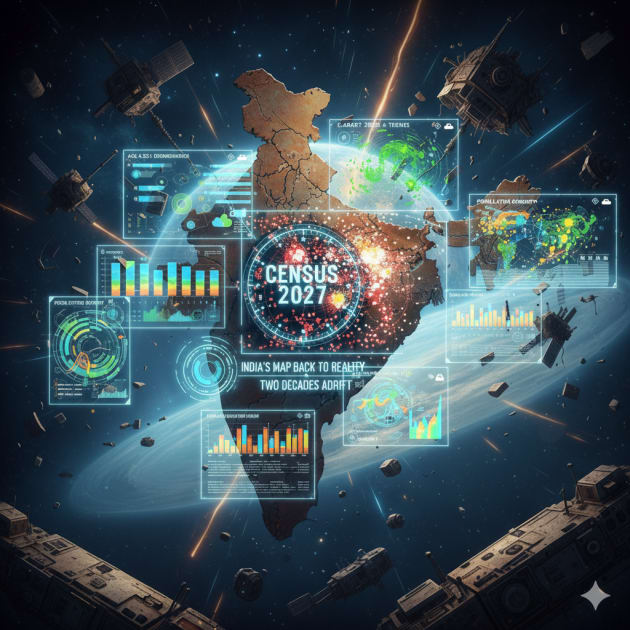
India has sailed for nearly twenty years without a fresh census the last enumeration was in 2011. In that long gap, policymakers and citizens alike have been forced to rely on projections and outdated assumptions. Welfare schemes, infrastructure planning, and debates on inequality have all been built on fragile foundations, leaving governance vulnerable to blind spots. Without a census, governance is a ship without a map. Leaders may steer with intent, but without coordinates, they risk drifting into uncertainty. The census provides those coordinates and charts the population’s size, age, gender, literacy, employment, migration, housing, and access to amenities. It is the compass that ensures resources reach where they are needed most, and the chart that reveals how inequality ripples across regions.
The analogy is clear: just as a captain cannot sail safely without a map of the seas, a government cannot govern wisely without a map of its people. The census is that map; it transforms leadership from guesswork into vision, and policy from projection into precision.
Between 2011 and 2027, India’s population has aged faster than anticipated, while urbanization has outpaced infrastructure. The youth bulge that was once heralded as an engine of growth now faces precarious employment, and rising dependency ratios are straining fiscal resources. Keynes’s reminder that “in the long run we are all dead”[1] feels particularly apt here: in the medium run, millions remain underemployed. Internal migration has created megacities that drive GDP but also magnify exclusion, with census data likely to confirm the widening gap between urban prosperity and rural stagnation.
The phrase nearly a “two decades adrift” captures the failure to translate census insights into coherent policy. Gunnar Myrdal’s warning that “statistics are the eyes of the policymaker, but blind eyes if unused” [2] rings true. Literacy gaps identified in 2011 remain unresolved, vocational skilling is underfunded, and female labor force participation continues to stagnate despite repeated evidence urging reform. Regional inequality persists, with fiscal transfers failing to correct structural imbalances.
Globally, the census will be read against the backdrop of climate change, digital disruption, and geopolitical realignments. Rising temperatures and water stress are reshaping settlement patterns, while the digital divide is evident even in the act of enumeration itself. Joseph Stiglitz’s insight “What we measure affects what we do. If we measure the wrong thing, we do the wrong thing”[3] is a reminder that census data is not just descriptive but prescriptive. It will influence India’s bargaining power in trade, labor, and climate negotiations.
Ultimately, the Census of 2027 is a ledger of accountability. Two decades adrift, India must decide whether to treat the data as a wake-up call or another missed opportunity. The numbers will speak, but whether policymakers listen is the decisive question. As T.S. Eliot lamented: “Where is the wisdom we have lost in knowledge? Where is the knowledge we have lost in information?” The census offers both knowledge and information; wisdom will depend on how it is used.
Numbers, as Amartya Sen once reminded us, are “not mere aggregates of lives, but indicators of freedoms and deprivations.”[4] The challenge is not only to count people, but to confront what those counts reveal about inequality, migration, and the sustainability of growth. Hence, the development of any economy, requires the removal of major sources of unfreedom and the Census is the first step in identifying those sources whether they lie in poverty, illiteracy, or lack of access to basic services. By counting honestly, a nation acknowledges its challenges and equips itself to remove them.
Therefore, the census is not bureaucracy, it is democracy in action. It is the heartbeat of governance, the architecture of justice, and the scaffolding of opportunity.
[1] Keynes, J. M. (1936). The general theory of employment, interest and money. London: Macmillan.
[2] Myrdal, G. (1944). An American dilemma: The Negro problem and modern democracy. New York: Harper & Brothers.
[3] Stiglitz, J. E. (2012). The price of inequality: How today’s divided society endangers our future. New York: W. W. Norton & Company.
[4] Sen, A. (1999). Development as freedom. New York, NY: Alfred A. Knopf.