When Warships Rewrite Balance Sheets: Accounting and Finance in an Age of Geopolitical Theatre
Geopolitical developments increasingly shape corporate financial outcomes and accounting judgments. This blog examines how the strategic positioning of the USS Abraham Lincoln near Iranian waters influences financial markets, corporate risk management, and accounting practices, highlighting the tran
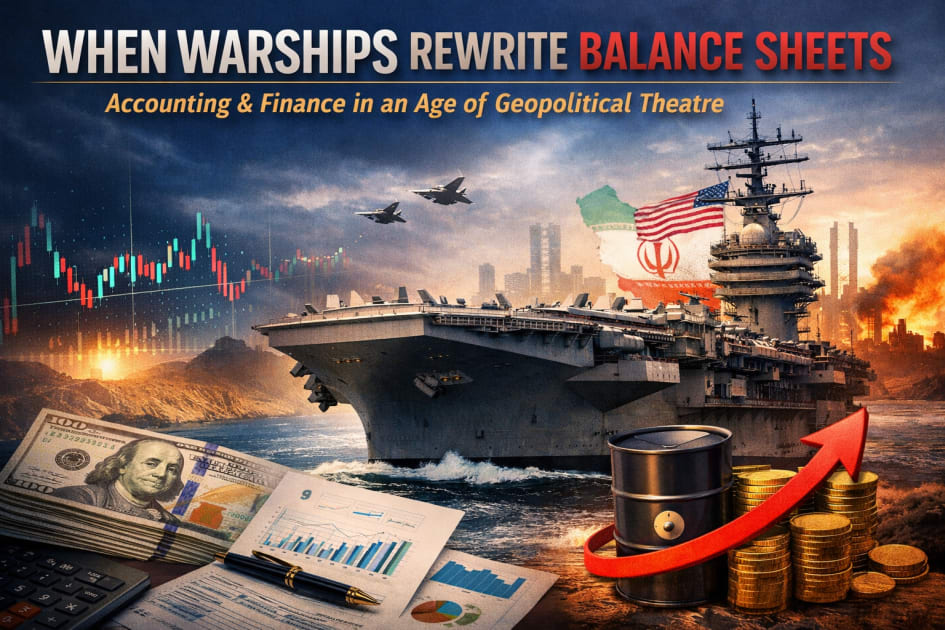
When a United States aircraft carrier such as the USS Abraham Lincoln enters geopolitically sensitive waters near Iran, it is often framed as a matter of defense and diplomacy. Yet, this movement is equally a financial event—one that quietly reshapes markets, corporate strategies, and accounting numbers long before any conflict materializes. In contemporary capitalism, warships no longer merely project power; they reprice risk.
Financial markets respond instantly to geopolitical signalling. The mere presence of a carrier group amplifies perceived instability, injecting risk premiums into energy prices, insurance contracts, and equity valuations. Crucially, these adjustments are driven not by realised disruption but by expectation and narrative. Oil prices move, shipping rates fluctuate, and investor sentiment pivots on probabilities rather than facts. This raises an uncomfortable question for finance professionals: are markets pricing fundamentals—or fear?
The consequences cascade into corporate finance decisions. Firms exposed to energy, logistics, or global supply chains face immediate increases in cost volatility, compelling managers to delay investment, revisit capital budgeting assumptions, or hoard liquidity. The cost of capital rises not because productivity has declined, but because uncertainty has intensified. In effect, geopolitical tension becomes an invisible tax on corporate growth.
Accounting, often assumed to be neutral and retrospective, is far from immune. Heightened geopolitical risk forces management to revisit fair value estimates, impairment tests, and going-concern assessments. Discount rates are adjusted upward, cash flow forecasts shortened, and risk disclosures expanded. These are not mechanical exercises; they are judgment-laden decisions where managerial interpretation plays a decisive role. The balance sheet thus becomes a silent witness to geopolitical anxiety.
Currency markets further complicate the picture. Movements in oil-linked and safe-haven currencies distort multinational earnings, testing the limits of hedge accounting and exposing firms to profit-and-loss volatility that is operationally unrelated. Accounting standards demand precision, yet the underlying risks are inherently political and unpredictable. This mismatch exposes a structural fragility in financial reporting frameworks designed for stable environments.
At the governance level, such events expose weaknesses in enterprise risk management. Boards and audit committees are compelled to confront whether geopolitical risk has been treated as a peripheral concern rather than a core strategic variable. Failure to integrate these risks raises questions not only of financial prudence but of fiduciary responsibility.
The stationing of the USS Abraham Lincoln near Iranian waters therefore reveals a deeper truth: modern accounting and finance do not merely record economic reality—they translate global power into numbers. Financial statements increasingly reflect strategic posturing, diplomatic signals, and military calculus. For scholars and practitioners alike, the implication is stark: in an era of geopolitical theatre, neutrality in accounting and finance is an illusion.