AI And Career Readiness: Why Business Schools Are At A Crossroads In 2026
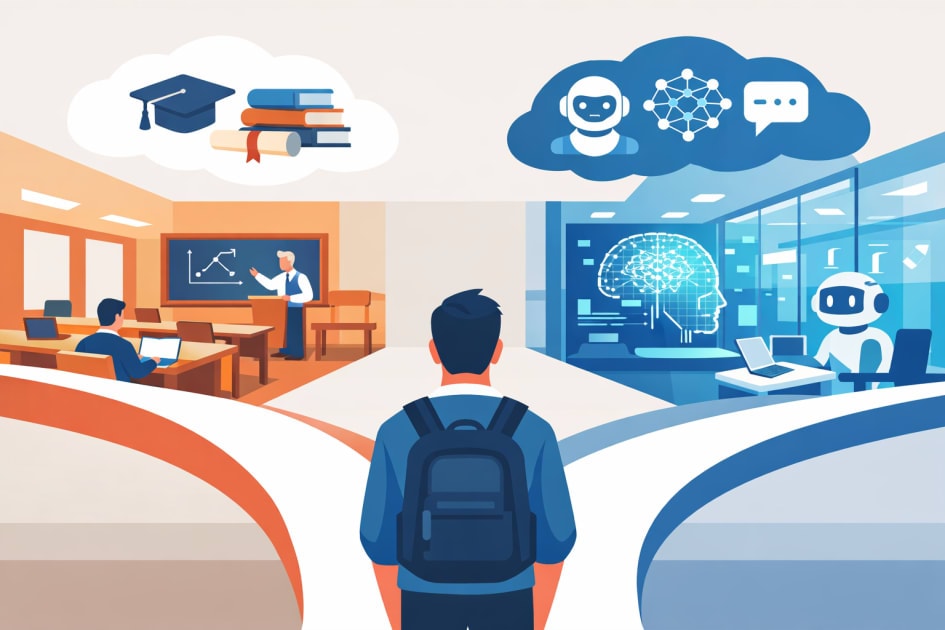
AI is reshaping every industry, yet many graduates still leave campus underprepared for an algorithm-driven workplace. In 2026, business schools must decide whether they will remain credential factories or become true skills labs for the AI economy.
The AI wake-up call for campuses
Across the world, employers are adopting generative AI for writing, coding, analytics, and customer interaction faster than universities are updating their syllabi. Surveys conducted in 2025 indicate that most students expect AI skills to be essential for their careers, yet a majority report having received little or no structured AI education during their degree.
Business schools in particular are under pressure: recruiters want graduates who can reason with, supervise, and question AI systems, not just talk about them abstractly. This puts management education at a crossroads in 2026 – either remain comfortable credential factories or evolve into hands-on skills labs for an algorithm-driven economy.
The widening AI skills gap
A global study of business schools found that while AI is widely discussed in classrooms, only a minority of programs require students to complete projects that involve using or auditing real AI tools. At the same time, companies across consulting, finance, marketing, and operations are redesigning workflows around generative AI, automation, and data-driven decision-making.
This mismatch is visible in three ways:
Surface familiarity, shallow competence – students may know brand names like ChatGPT or Claude but have not been trained to design prompts, evaluate outputs, or build simple workflows safely.
Limited understanding of risks – issues such as hallucinations, bias, IP leakage, and data privacy are often mentioned briefly, not explored through realistic case simulations.
Gaps in complementary human skills – critical thinking, questioning models, framing problems, and communicating trade-offs are not systematically linked to AI use in the curriculum.
If left unaddressed, this skills gap risks turning AI into another buzzword that appears on résumés but fails practical tests in the workplace.
What employers actually expect in 2026
Employer surveys and thought leadership from industry highlight a consistent pattern: companies are not asking every graduate to be a machine learning engineer, but they do expect AI-ready professionals. Typical expectations include:
Comfort using common AI tools for writing, analysis, and idea generation within corporate policies
Ability to check AI-generated content for factual accuracy, bias, and alignment with organisational values
Understanding of where AI should never be left fully autonomous, for example, in credit approvals, legal commitments or high-stakes HR decisions
Willingness to continuously learn new tools as platforms evolve
In short, employers want “AI-augmented humans” – graduates who can combine domain knowledge, ethics, and judgment with machine capabilities.
Why are many business schools still behind
Many institutions recognise the urgency but face structural hurdles when they try to respond. Common challenges include:
Siloed curriculum structures – AI topics are squeezed into a single elective instead of being woven across finance, marketing, HR, and operations courses.
Faculty capacity and incentives – not all faculty members are comfortable with AI tools, and few receive structured support or time to redesign courses.
Assessment design – fear that students will “cheat with AI” often leads to more closed-book, exam-heavy assessments rather than creative AI-enabled projects.
Infrastructure and policy gaps – many universities still lack clear guidelines on acceptable AI use, data privacy and academic integrity.
These constraints mean that even schools that talk about AI readiness may deliver only incremental change.
From credential factories to skills labs – what must change
For business schools to stay relevant and truly serve students and employers, several shifts are needed.
Treat AI as a horizontal capability, not a niche
Instead of parking AI in a standalone elective, schools should map AI learning outcomes across core subjects:
In finance, students can use AI tools to interrogate financial reports and then cross-check against primary data for hallucinations or misinterpretations.
In marketing, AI can be used to draft campaigns, followed by exercises that measure brand fit, ethical compliance, and long-term trust impact.
In operations and supply chain, learners can simulate AI-supported demand forecasting or routing, then stress test these models against realistic disruptions.
This integration helps students see AI as part of everyday decision-making, not a futuristic add-on.
Redesign assessments for AI-age integrity
Trying to ban AI outright is both unrealistic and counterproductive. Instead, assessment should be redesigned to reward process transparency and critical reflection:
Require students to log when and how they used AI tools, including prompts and iterations.
Grade not only the output but also the quality of problem framing, evaluation of AI responses, and final human judgment.
Use viva voce, group presentations, and in-class case defences to test conceptual understanding that cannot be fully outsourced.
Such designs teach responsible use rather than simple avoidance.
Build faculty capacity and communities of practice
Faculty development is as important as student training. Institutions that are moving faster typically:
Run internal workshops where faculty experiment with AI in their own research and teaching contexts.
Encourage cross-disciplinary teaching teams that mix technology expertise with domain depth.
Create small grants or time allowances for course redesign projects focused on AI integration.
When faculty feel safe to explore and fail, they are more likely to model the growth mindset students need.
Ethical and social questions that business schools cannot ignore
As engines of management education, business schools also have a duty to help future leaders think beyond efficiency. AI raises deep ethical and societal questions that belong in classrooms:
Bias and fairness – how should managers audit AI systems used in hiring, lending, policing, or healthcare, and who bears responsibility when harm occurs.
Labour displacement and reskilling – what is a responsible approach when automation threatens existing roles but also creates new categories of work.
Data governance and privacy – what principles should guide the collection and use of employee, customer, and citizen data in AI models.
Business schools that avoid these topics risk producing leaders who can deploy powerful tools but are unprepared for their long run human consequences.
What leading institutions are already doing
Early mover universities and business schools provide some encouraging examples:
Some have launched AI-infused core curricula where every student completes cross-functional projects using AI tools in marketing, HR, finance, and entrepreneurship.
Others are using immersive AI and VR environments to simulate boardroom debates, negotiations, and operational crises, improving both technical and soft skills.
Sector-wide surveys show a growing number of institutions developing formal AI policies, teaching resources, and centres for digital innovation.
These examples prove that transformation is possible when leadership provides clarity, resources, and a long-term vision.
What this means for students and faculty in 2026
For students, the message is clear: doing the bare minimum on AI is no longer enough. Graduates who proactively experiment with tools, seek interdisciplinary projects and reflect on ethical trade offs will enjoy a genuine edge in the job market.
For faculty and administrators, the responsibility is equally significant. Staying passive or defensive about AI effectively passes risk to students, who will have to learn on the job in higher stakes environments. By turning classrooms into safe spaces for experimentation and critical debate, educators can help future managers become thoughtful human supervisors of increasingly powerful machines.
Conclusion – choosing the road ahead
In 2026, AI is no longer on the horizon, it is already embedded in the tools and platforms that shape work in consulting, finance, marketing, supply chains, and entrepreneurship. Business schools that remain focused only on traditional content risk producing graduates who carry prestigious credentials but lack practical, ethical, and adaptive AI competence.
The alternative is more demanding but far more promising: to become true skills labs for an algorithm-driven economy, where students learn not only how to use AI but also when to distrust it, question it, and ultimately design better systems around it. The crossroads are here. The choice belongs to every dean, faculty member, and student who walks into a classroom this year.