AI Data Centers vs Climate: Can Clean Energy Keep Up in 2026
AI is driving a global data center boom that could sharply raise electricity demand just as climate impacts intensify. This article asks whether clean energy, grids, and policy can scale fast enough to power AI without derailing climate goals.
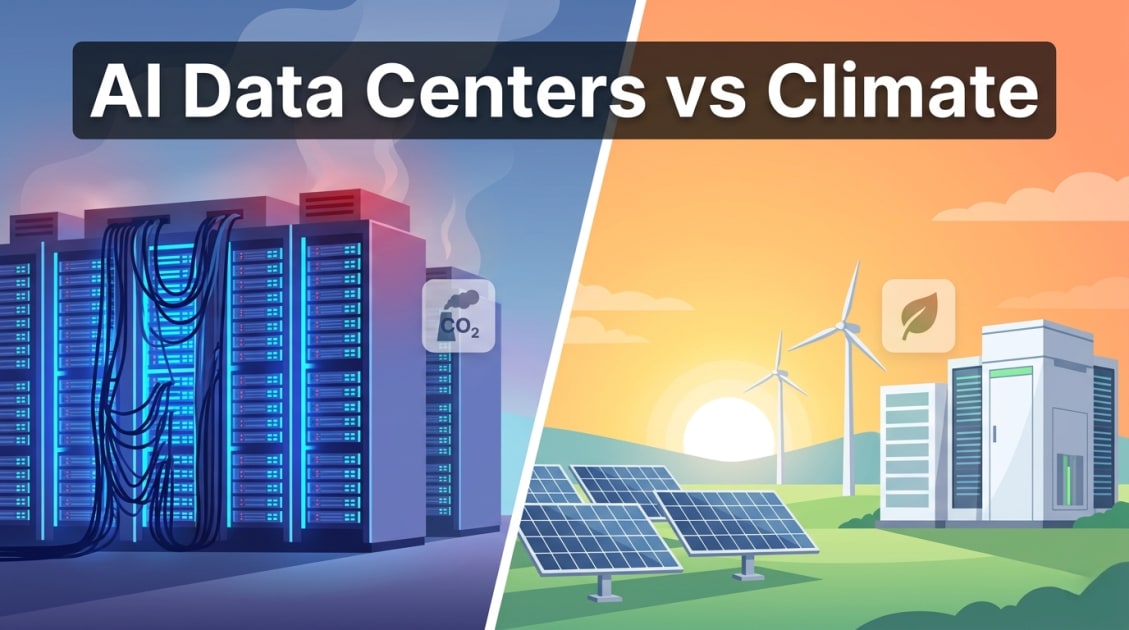
Artificial intelligence is no longer just a software story. In 2026, it is increasingly a concrete, steel, and megawatt story, as an unprecedented wave of data centers rises to power model training and AI agents across the economy. Behind the chat interfaces sit server farms that demand huge amounts of electricity and cooling, putting real pressure on grids already stressed by heatwaves and electrification of transport and buildings.
After two relatively flat decades, analysts now project a sharp surge in electricity demand in the United States largely due to data center growth for AI and cloud services. Modeling by independent researchers shows that meeting this new load primarily with clean energy is technically feasible, but only if policy and planning move fast enough on renewables, transmission, and storage. The investment required is enormous: one study estimates around 900 billion dollars in power sector spending between 2026 and 2050 just to accommodate data center demand, almost one fifth of wholesale power costs in that period.
At the same time, global climate risk is no longer abstract. United Nations and scientific assessments warn that temperatures in the late 2020s are likely to hover near or above the 1.5 degree threshold, making every additional fraction of warming matter for floods, heat stress, and economic losses. This creates a tension that sits at the heart of the AI debate in 2026. AI is marketed as a tool to optimize energy use, forecast climate risks, and accelerate materials discovery for clean tech, yet its own infrastructure threatens to lock in new fossil generation if left unmanaged.
The macroeconomic outlook complicates this picture further. The IMF now credits AI investment as a key factor behind stronger than expected growth projections for 2026, even as it flags AI as a downside risk if the boom proves overhyped or inflationary. Leading forecasters and chief economists argue that AI could add one to three percentage points to labor productivity growth over the coming decade, provided adoption and readiness keep pace. In other words, AI data centers may be both climate liability and growth engine.
So can clean energy keep up. Optimistic scenarios suggest that with robust policy, much of the new data center demand can be met by wind, solar, and storage, cutting air pollution and climate damages enough to outweigh higher power costs. Several regions are already experimenting with co‑locating data centers near renewables and signing long‑term clean power contracts, which can de‑risk projects and anchor new grid infrastructure. Yet these strategies face land constraints, permitting delays for transmission lines, community pushback, and competition with other sectors that also need low‑carbon electricity.
Self‑critically, it is not enough to assume that efficiency gains or “green PPAs” automatically make AI sustainable. Rebound effects, where cheaper AI services drive more usage and thus more compute, can erase efficiency improvements. Moreover, equity questions loom large: if grids are upgraded primarily to serve profitable data centers, who pays, and will households in less affluent regions face higher bills or more outages. There is also a risk that climate narratives are used mainly as branding, while real decarbonization is delayed.
The real test for 2026 and beyond is whether policymakers, utilities, and technology companies align incentives so that every new megawatt of AI demand accelerates, rather than undermines, the clean energy transition. That means tying approvals to verifiable clean supply, transparently tracking life‑cycle emissions, and planning grids for resilience in a hotter, more electric world. AI may help humanity respond to climate change, but only if its physical footprint is treated as a core part of climate strategy, not an afterthought.