AI Readiness of Indian IT Companies vis-à-vis Global Tech Majors (2026 Perspective)
In 2026, artificial intelligence (AI) readiness is defined by a blend of massive compute infrastructure, foundational model innovation, deep R&D investment, talent depth, enterprise adoption speed, and measurable revenue impact.
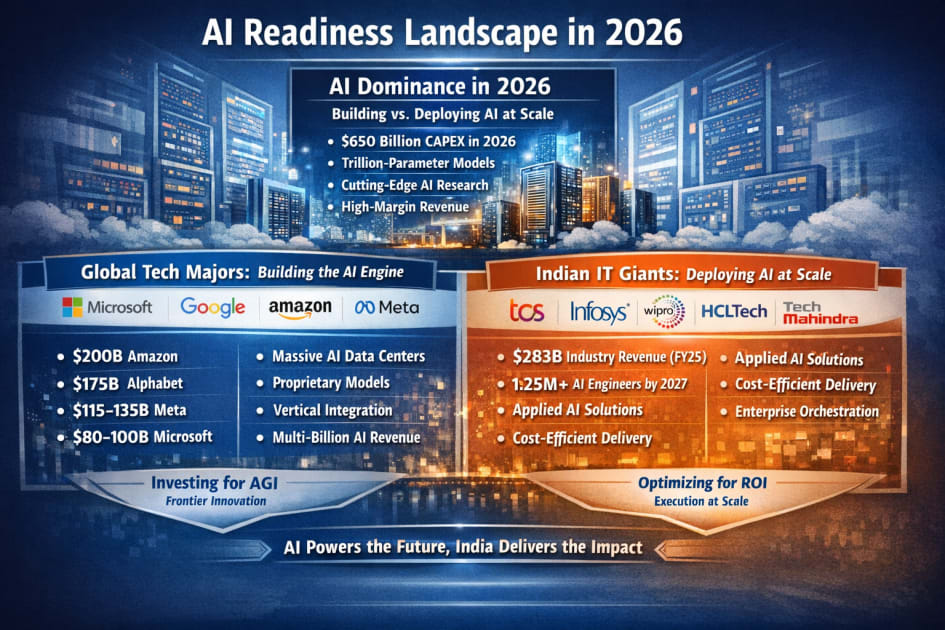
In 2026, artificial intelligence (AI) readiness is defined by a blend of massive compute infrastructure, foundational model innovation, deep R&D investment, talent depth, enterprise adoption speed, and measurable revenue impact. Global tech majors—Microsoft, Google (Alphabet), Amazon, and Meta—dominate the frontier through unprecedented capital expenditure. Indian IT giants—TCS, Infosys, Wipro, HCLTech, and Tech Mahindra—excel in applied AI, cost-effective implementation, and large-scale orchestration. While the former build the AI engine, the latter are rapidly becoming its most efficient operators for global enterprises.
Global majors are in a hyper-investment phase. In 2026, the four hyperscalers are projected to spend approximately $650 billion in capex, primarily on AI data centres, GPUs, and networking—nearly double 2025 levels. Amazon alone guides $200 billion, Alphabet $175–185 billion, Meta $115–135 billion, and Microsoft an estimated $80–100+ billion. This arms race funds proprietary models (Gemini, Copilot, Llama, Claude partnerships) and trillion-parameter training runs. Their strength lies in vertical integration: owning the stack from silicon to applications. Revenue from AI is surging—Microsoft’s Azure AI and OpenAI synergies, Google Cloud’s AI offerings, and AWS’s Bedrock are already multi-billion-dollar businesses with high margins. Readiness here is “offensive”: shaping the future of AI itself.
Indian IT companies operate on a different scale and model. The sector’s total revenue reached $283 billion in FY25 (NASSCOM), with exports at $224 billion. AI is the fastest-growing segment, but absolute investments remain modest compared to Big Tech. TCS, for instance, reported $1.8 billion in annualized AI services revenue as of January 2026, growing 17% quarter-on-quarter. This includes embedded AI across cloud, data, applications, and industry solutions. Infosys, Wipro, and HCLTech have similarly embedded GenAI into delivery platforms (Infosys Topaz, Wipro’s WEGA/WINGS), with hundreds of thousands of employees trained in GenAI. Wipro alone upskilled 180,000 staff.
Talent is India’s clearest advantage. According to Stanford University’s 2025 Global AI Vibrancy Index (data through 2024), India ranks third globally with a score of 21.59—leaping from seventh the previous year—behind only the US (78.6) and China (36.95). India leads in AI skill penetration and hiring growth, with the world’s largest pool of AI-proficient engineers (estimated 650,000–800,000 in 2025, projected to reach 1.25 million by 2027). EY’s 2026 “Aidea of India” survey of 200 enterprises reveals remarkable adoption maturity: 47% have multiple GenAI use cases in production, 76% expect significant business impact, and 64% rate organizational readiness as high. Speed of deployment is the top buying criterion (91%). Indian firms are pioneering agentic AI, small language models (SLMs) for Indic languages, and synthetic data solutions that comply with DPDP Act privacy rules.
Operationally, Indian IT is highly AI-ready in execution. They act as AI orchestrators for Fortune 500 clients—integrating hyperscaler models into enterprise workflows, building domain-specific agents, and delivering measurable ROI in operations (75% priority), customer experience (68%), and cost reduction. Partnerships with Microsoft, Google, and AWS are strategic: Indian firms run large Global Capability Centres (GCCs) that now own end-to-end AI production systems. The IndiaAI Mission (₹10,372 crore outlay, 34,000+ GPUs already provisioned) further bolsters sovereign compute access.
However, gaps remain stark. Indian IT capex and foundational R&D are orders of magnitude smaller. Big Tech spends in months what the entire Indian IT sector invests annually in AI infrastructure. Indian companies remain largely dependent on US hyperscalers for core models and high-end compute. Traditional service revenue (body-shopping, maintenance) faces disruption—evidenced by $50–56 billion combined market-cap erosion in early 2026 amid fears of automation replacing entry-level coding and back-office work. Fresher hiring has slowed 20–30% at majors, with consolidation of junior roles.
Despite this, Indian IT’s readiness is tailored to the “deployment era” of AI. While Big Tech races for AGI-level breakthroughs, Indian firms are winning the “last mile”—making AI work at enterprise scale, across languages, regulations, and cost constraints. EY notes India’s contrary-to-global optimism: unlike MIT-cited 95% pilot failure rates elsewhere, Indian enterprises are converting pilots to production rapidly and viewing AI as existential.
Looking ahead, Indian IT is pivoting aggressively: heavy M&A in AI startups (33% rise in 2025), platform plays, and upskilling mid-career talent. With global enterprises needing reliable, cost-effective AI integration, Indian firms are uniquely positioned to capture a disproportionate share of the $1.7 trillion economic value AI is projected to add to India by 2035—and a significant slice of global AI services spend.
In summary, global majors lead in AI creation and infrastructure; Indian IT leads in AI consumption and industrialization at scale. The former has deeper pockets and frontier innovation; the latter has unmatched execution velocity, talent density, and pragmatic readiness. As AI matures from experimentation to ubiquitous enterprise reality in 2026–2030, Indian IT companies are not just ready—they are indispensable partners in making AI deliver real-world value at global scale.