EU–India Free Trade Agreement: Problems and Prospects for India
The European Union (EU) and India are two of the world’s largest and most influential economic entities. Together, they account for a substantial share of global population (2 billion), output (24 trillion), trade, and investment flows.
EU–India Free Trade Agreement: Problems and Prospects for India
Prof Dr Ravinder Rena
Professor of Economics, School of Business
Woxsen University, India
Introduction
The European Union (EU) and India are two of the world’s largest and most influential economic entities. Together, they account for a substantial share of the global population (2 billion), output (24 trillion), trade, and investment flows. Despite this complementarity, economic relations between the two have remained below potential.
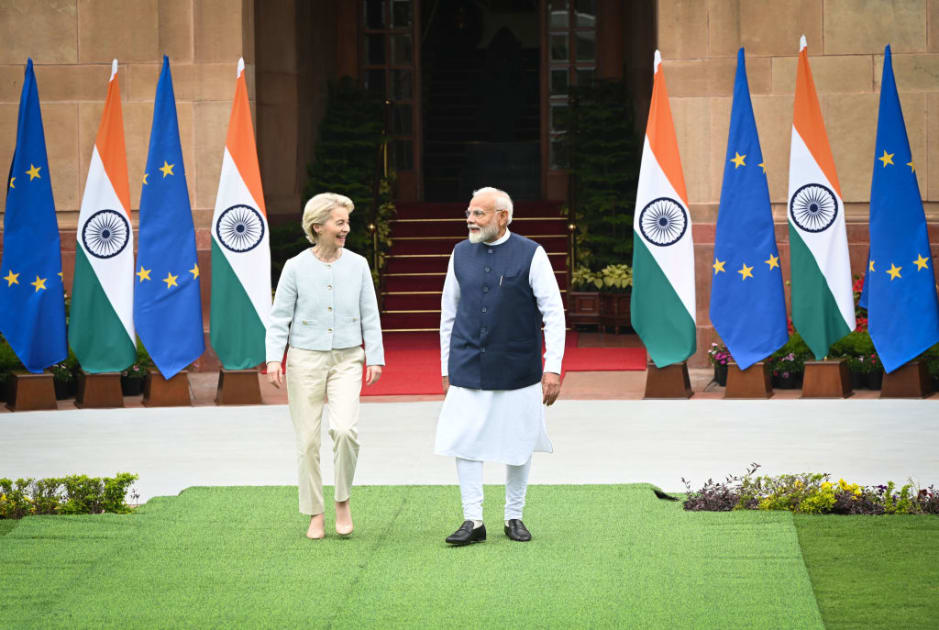
The proposed EU–India Free Trade Agreement (FTA), officially referred to as the Broad-based Trade and Investment Agreement (BTIA), represents an ambitious attempt to deepen bilateral economic integration, known as the “Mother of all trade”. Negotiations, first launched in 2007, stalled in 2013 due to deep-seated differences but were revived in the early 2020s amid changing global economic and geopolitical realities. The recent visit to India by Ursula von der Leyen, President of the European Commission, and Antonio Costa, President of the European Council, during the 77th Republic Day celebrations, concluded several trade deals that can strengthen economic and political ties between the two parties.
For India, the EU–India FTA presents a complex mix of opportunities and challenges. On the one hand, it promises improved market access, enhanced investment inflows, technology transfer, and integration into global value chains. On the other hand, concerns persist regarding domestic industry competitiveness, regulatory sovereignty, labour and environmental standards, and the distributional consequences of liberalisation. This article critically examines the problems and prospects of the EU–India FTA from India’s perspective, drawing on economic theory, empirical evidence, and policy experience.
Background and Economic Context
The EU is India’s largest trading partner in goods and services, accounting for roughly one-sixth of India’s total trade (with about $136 billion). India, however, represents a relatively smaller share of the EU’s global trade, highlighting an asymmetry in economic dependence. India’s exports to the EU are concentrated in sectors such as textiles and garments, pharmaceuticals, chemicals, engineering goods, and information technology services. EU exports to India include machinery, transport equipment, chemicals, and high-value manufactured goods.
From a theoretical standpoint, an FTA between economies at different levels of development can generate welfare gains through comparative advantage, economies of scale, and increased competition. However, such agreements also risk trade diversion, adjustment costs, and asymmetric benefits if domestic constraints are not adequately addressed. The EU–India FTA must therefore be assessed not only in terms of aggregate gains but also in terms of sectoral impacts and long-term development objectives.
Prospects for India
1. Enhanced Market Access
One of the most significant potential benefits for India lies in improved access to the EU market. The EU maintains relatively low average tariffs, but tariff peaks and non-tariff barriers remain in sensitive sectors such as textiles, agriculture, and processed foods. An FTA could reduce or eliminate tariffs on labour-intensive Indian exports, thereby enhancing competitiveness and export volumes.
For India’s services sector—particularly information technology, business process outsourcing, and professional services—the agreement could facilitate greater mobility of skilled professionals and recognition of qualifications. Given India’s comparative advantage in skill-intensive services, such provisions could yield substantial gains.
2. Increased Foreign Direct Investment and Technology Transfer
The EU is a major source of Foreign Direct Investment (FDI) with 140 billion euros for India. A comprehensive FTA that includes investment protection and regulatory transparency could further boost EU investment inflows. Increased FDI can contribute to capital formation, employment generation, and productivity growth.
Moreover, EU firms often operate at the technological frontier. Closer economic integration could promote technology transfer and innovation spillovers, particularly in manufacturing, renewable energy, pharmaceuticals, and advanced engineering. For India’s long-term growth strategy, such spillovers are arguably more valuable than short-term trade gains.
3. Integration into Global Value Chains
Participation in global and regional value chains has become a key driver of industrial development. The EU–India FTA could help Indian firms integrate more deeply into European value chains, especially in automotive components, electronics, and green technologies. This integration could enhance export diversification, improve quality standards, and strengthen India’s manufacturing base under initiatives such as “Make in India.”
4. Strategic and Geopolitical Benefits
Beyond economics, the FTA has strategic significance. In an era of rising protectionism and supply-chain reconfiguration, closer ties with the EU can help India reduce over-dependence on a narrow set of trading partners. From India’s perspective, the agreement aligns with its broader objective of positioning itself as a reliable economic partner in a multipolar global order.
Problems and Challenges for India
Despite these prospects, the EU–India FTA faces several structural and political challenges that are particularly salient for India.
1. Tariff Liberalization and Domestic Industry Concerns
One of India’s principal concerns relates to tariff reductions on industrial goods, especially automobiles, wines and spirits, and high-end manufactured products. The EU has consistently sought deep tariff cuts in these sectors, arguing that India’s applied tariffs are relatively high by global standards.
From India’s standpoint, rapid liberalization could expose domestic industries—many of which are still in a process of technological upgrading—to intense competition from European firms. Small and medium enterprises (SMEs), which form the backbone of Indian manufacturing and employment, may face adjustment pressures that could outweigh short-term consumer gains.
2. Agriculture and Livelihood Security
Agriculture remains a sensitive sector in India due to its role in employment and rural livelihoods. The EU’s demands for greater market access in agricultural and dairy products have raised concerns about the impact on small farmers. European agriculture benefits from substantial subsidies, creating an uneven playing field for Indian producers.
Economic theory suggests that while consumers may benefit from lower prices, the social cost of displacing vulnerable producers can be significant. For India, ensuring food security and rural stability remains a political and economic priority, limiting its willingness to make deep concessions in agriculture.
3. Non-Tariff Barriers and Standards
Non-tariff barriers (NTBs), including sanitary and phytosanitary standards, technical regulations, and conformity assessment procedures, constitute a major challenge for Indian exporters. While such standards are often justified on health, safety, and environmental grounds, they can function as de facto trade barriers.
Compliance with EU standards requires significant investment in quality infrastructure, certification, and regulatory capacity. For large firms, these costs may be manageable; for smaller exporters, they can be prohibitive. Without adequate domestic support mechanisms, the benefits of market access may remain unevenly distributed.
4. Intellectual Property Rights (IPR)
The EU has sought stronger intellectual property protection, particularly in pharmaceuticals, through provisions that go beyond the World Trade Organisation’s Agreement on Trade-Related Aspects of Intellectual Property Rights (TRIPS). India has resisted such “TRIPS-plus” provisions, arguing that they could undermine access to affordable medicines and weaken its generic pharmaceutical industry.
Given India’s role as a major supplier of low-cost medicines to developing countries, this issue carries both economic and ethical dimensions. Striking a balance between innovation incentives and public health objectives remains one of the most contentious aspects of the negotiations.
5. Labour, Environment, and Regulatory Sovereignty
The EU increasingly emphasises labour rights, environmental standards, and sustainable development in its trade agreements. While these objectives are normatively appealing, India has expressed concerns about their potential use as disguised protectionism or as constraints on domestic policy autonomy.
From a development economics perspective, imposing uniform standards across countries at different income levels may lead to unequal adjustment costs. India’s challenge lies in aligning sustainability goals with developmental priorities without accepting binding commitments that could limit future policy space.
Assessment and Way Forward
The EU–India FTA represents neither an unambiguous opportunity nor an inevitable threat for India. Its net impact will depend critically on the design of the agreement, the sequencing of liberalisation, and the availability of complementary domestic reforms.
For India, a pragmatic approach would involve:
Gradual and asymmetric liberalisation, allowing sensitive sectors time to adjust.
Strong safeguard mechanisms to address import surges and unfair trade practices.
Enhanced domestic capacity building, particularly for SMEs to meet EU standards.
Preservation of policy space in areas such as public health, agriculture, and industrial policy.
Linking trade liberalisation with structural reforms, including improvements in infrastructure, logistics, and regulatory efficiency.
Conclusion
The EU–India Free Trade Agreement has the potential to reshape bilateral economic relations and contribute to India’s long-term growth and diversification. At the same time, it poses significant challenges related to domestic competitiveness, regulatory autonomy, and social welfare. From an economic standpoint, the agreement should not be viewed merely as a trade-liberalisation exercise but as part of a broader development strategy.
If negotiated carefully and complemented by domestic reforms, the FTA could catalyze productivity growth, technological upgrading, and global integration. Conversely, a poorly designed agreement could exacerbate structural weaknesses and distributional inequalities. The central policy challenge for India, therefore, lies in maximising the developmental gains of engagement with the EU while safeguarding its economic and social priorities.
Prof Dr Ravinder Rena
Full Professor of Economics, School of Business, Woxsen University, India
Contributor at Woxsen University School of Business
Comments (3)
Dear Prof Madichie, thanks for your valuable comments, much appreciated.
Thanks for sharing this thought-provoking article --- well summed up too --- "The EU–India Free Trade Agreement has the potential to reshape bilateral economic relations and contribute to India’s long-term growth and diversification. At the same time, it poses significant challenges related to domestic competitiveness, regulatory autonomy, and social welfare. From an economic standpoint, the agreement should not be viewed merely as a trade-liberalisation exercise but as part of a broader development strategy." Even higher education has a place in the unfolding relationship/ partnership.
Thanks for this powerful post --- I really like the way it was all wrapped up --- "The EU–India Free Trade Agreement has the potential to reshape bilateral economic relations and contribute to India’s long-term growth and diversification. At the same time, it poses significant challenges related to domestic competitiveness, regulatory autonomy, and social welfare. From an economic standpoint, the agreement should not be viewed merely as a trade-liberalisation exercise but as part of a broader development strategy." Kudos!