From Burden to Business: Unlocking Opportunities in Legacy Waste Management
India’s waste crisis is no longer confined to overflowing bins or unsightly dumps—it has become an economic, social, and environmental challenge that demands business-led solutions.
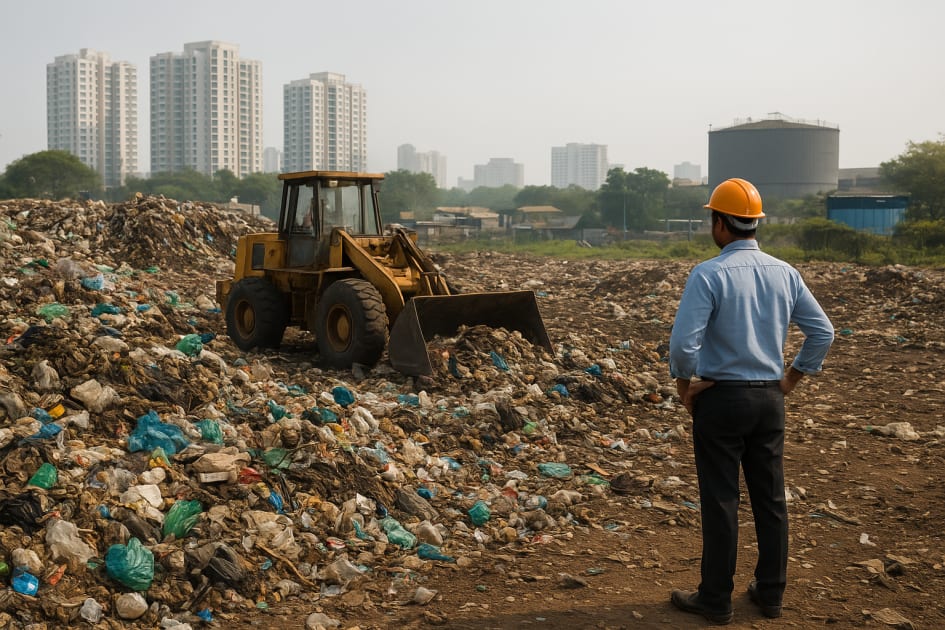
India’s waste crisis is no longer confined to overflowing bins or unsightly dumps—it has become an economic, social, and environmental challenge that demands business-led solutions. Across more than 3,000 dumpsites in the country, an estimated 1,300 million tonnes of legacy waste occupy valuable urban land. What was once dismissed as “garbage” is now increasingly recognized as a resource waiting to be tapped.
Why Legacy Waste Matters to Business
Legacy waste is not just an environmental concern—it is an underutilized asset. Prime land worth billions of dollars is locked beneath heaps of untreated trash. Unmanaged dumpsites contaminate soil, water, and air, creating liabilities for local governments and surrounding businesses. They also drive up healthcare costs, stifle urban development, and limit the competitiveness of cities that aim to attract global investment.
This is where businesses, entrepreneurs, and policymakers can step in—not just to solve a pressing problem but also to shape new markets, create jobs, and contribute to national sustainability goals.
Opportunities Hidden in the Waste
1. Land Reclamation and Real Estate Development
Clearing legacy dumpsites releases thousands of hectares of urban land. This reclaimed land can be repurposed for housing, industrial clusters, logistics hubs, or green infrastructure. For real estate and infrastructure players, it represents a once-in-a-generation opportunity.
2. Circular Economy Ventures
Legacy waste contains soil-like material, recyclables, construction debris, and even fuel-grade material. Businesses can invest in processes that turn this waste into usable products—soil improvers, construction aggregates, or refuse-derived fuel. Developing quality standards and reliable supply chains for these materials could open up profitable niche markets.
3. Green Infrastructure and Policy Alignment
With India pushing forward on the Swachh Bharat Mission (Urban) 2.0 and its climate commitments, legacy waste projects align neatly with policy priorities. Companies that can integrate their solutions with government schemes stand to benefit from incentives, regulatory support, and first-mover advantages in a rapidly growing sector.
4. Innovation and Start-Up Ecosystem
Start-ups focusing on waste analytics, digital monitoring, and sustainable product design can become key enablers in this ecosystem. From AI-powered monitoring of dumpsites to blockchain-enabled waste traceability, the innovation canvas is wide open for entrepreneurs.
5. Impact Investment and ESG Alignment
For investors, legacy waste management offers measurable environmental and social impact—cleaner cities, reduced carbon footprints, improved public health—making it a natural fit for ESG-focused funds. In fact, companies that can demonstrate successful waste-to-value models may find themselves well-positioned to attract green finance and international partnerships.
Policy and Governance Dimensions
Policymakers play a central role in making this sector investable. Stronger enforcement of compliance norms, creation of markets for waste-derived products, and partnerships with private operators can turn today’s compliance challenge into tomorrow’s growth story. Initiatives such as mandating the use of processed waste in road construction or creating incentives for waste-derived fuels can give businesses a stable revenue base.
At the same time, accountability and monitoring must improve to ensure projects deliver both environmental and economic outcomes. Public–private partnerships (PPPs) in this space will only succeed if transparency and quality standards are maintained.
Looking Ahead
The scale of India’s waste challenge may seem daunting, but it is precisely this scale that makes it a fertile ground for innovation and investment. Businesses that can position themselves at the intersection of environmental responsibility and economic opportunity will not only help clean India’s cities but also carve out leadership in a global market where sustainable urban solutions are in demand.
As the business world looks for the next wave of opportunities, legacy waste management offers a compelling case: it is socially necessary, environmentally urgent, and economically promising. For entrepreneurs, investors, and policymakers alike, the time is ripe to turn this burden into business.