Multilingualism and Communication in the MNCs: Addressing language issue in human resource management
The primary argument of this note is to situate language as a pivotal force within human resource management (HRM) research. The piece further underlines some organisational good practices that may work as a stepping stone for HRM professionals to plan languages in their organisation.
Multilingualism can be considered a valuable tool to guarantee mutual understanding. It is a complex phenomenon that can be studied both from an individual as well as a societal perspective. At the individual level, it focuses on how more than one language is represented and accessed in the mind of the individual. Such multilingualism may be acquired (i.e., learning a new language), or one may be exposed to two or more languages by birth. Societal multilingualism, on the other hand, refers to the linguistic diversity itself, where various languages are used by some or all members of a determined society. Reasons for societal multilingualism may be manifold, ranging from colonialism to the current transnational mobility of the population due to globalisation.
With the advent of globalisation, unceasing technological innovations and neoliberal discourses in international business, the multinational corporations are increasingly becoming “superdiverse” (Vertovec 2007, 2023) in terms of their workforce while operating across borders. They belong to different cultures and may use one or more languages other than English. So, knowing only English is never sufficient to conduct business internationally. As such, it can be argued that language management in MNCs should be seen as more than a communication tool, but rather should be perceived as a strategic lever that impacts inclusion, identity, coordination, and power. Nevertheless, Human Resource Management (hence, HRM) as a field of research continues to retain a stronger focus on traditional issues such as recruitment, performance appraisal, and training, often emphasising structural, behavioural, and strategic dimensions. This functionalist perspective often diminishes the significance of language as a constitutive force in organisational life (for more discussion on this, see Presbitero et al. 2023). In a world increasingly shaped by complex interpersonal, intercultural, and virtual interactions, understanding how languages operate within HRM practices is not only beneficial (e.g., in job interviews, appraisals, and training) but also a medium that shapes meanings, identities, and power relations within organisations (Karhunen et al., 2018). While addressing this research gap, the primary argument of this note is to situate language as a pivotal force within HRM research. As such, language plays a significant role through which HRM policies are designed, appropriated, and executed in multinationals.
Research on language management from a business perspective covers multiple levels of exploration, including individual, group or community and organisational. Whereas a large majority of studies researching the language management in the corporates would focus on English as the only global lingua franca for multinationals, little has been studied on the interaction between English and local languages in workplaces. European Commission, for instance, recognises the fact that around 11% of their small and medium-sized enterprises (SMEs) could not do business due to insufficient local language skills or one out of ten European SMEs that operate internationally come across language barriers and intercultural problems when they operate business abroad. On the other hand, the organisations invested in developing a range of language management activities such as hiring speakers of local languages, using professional interpreters and translators or putting a strategy in place to empower their employees with local language skills, and achieved an elevated export sales much higher than those not making any of such investments (van der Worp et al., 2018).
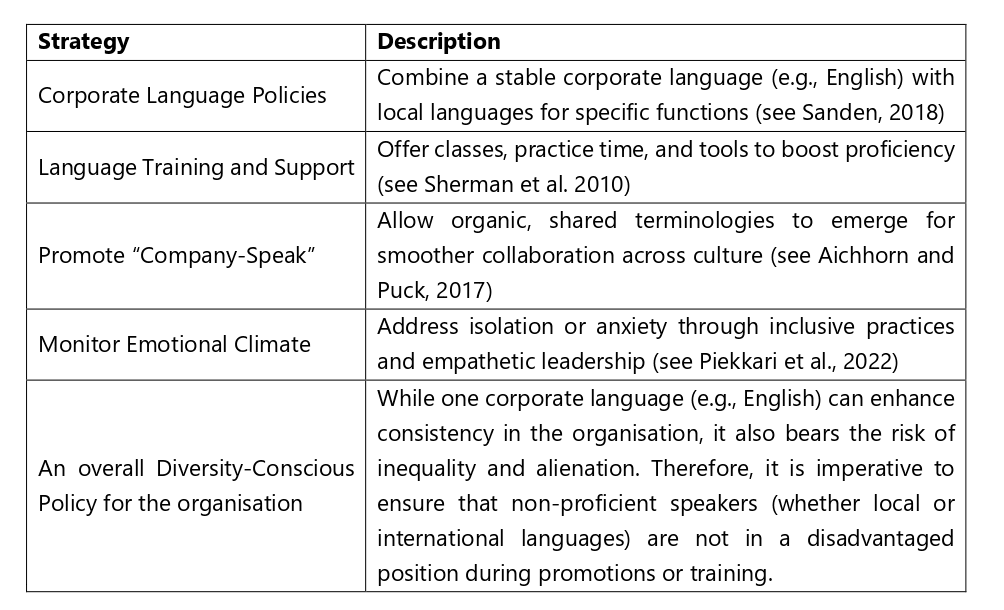
Hence, it can be argued that language management in MNCs should not be seen as a key factor for organisations to achieve continuous economic growth. The following chart, developed from an extensive survey of literature, underlines some organisational good practices that may work as a stepping stone for HRM professionals to plan languages in MNCs:
The chart should be attached here...
A rigorous implementation of these mandates can open promising avenues toward a more inclusive, dynamic, and cosmopolitan organisational culture in MNCs.
References:
Aichhorn, N. and Puck, J. 2017. Bridging the language gap in multinational companies: Language strategies and the notion of company-speak. Journal of World Business, Vol. 52(3), 386-403. https://doi.org/10.1016/j.jwb.2017.01.002
Karhunen, P., Kankaanranta, A., Louhiala-Salminen, L., & Piekkari, R. 2018. Let’s talk about language: A review of language-sensitive research in international management. Journal of Management Studies, 55(6), 980–1013. https://doi.org/10.1111/joms.12354
Piekkari, R., Gaibrois, C., & Johansson, M. 2022. A review of language-sensitive research in international business: A multi-paradigmatic reading. Journal of Comparative International Management, 25(1), 144–174. https://doi.org/10.55482/jcim.2022.32906
Presbitero, A., Froese, F. J., Peltokorpi, V., Pudelko, M., & Tenzer, H. 2023. Language in international human resource management: current state of research and future research directions. The International Journal of Human Resource Management, 34(21), 4027–4045. https://doi.org/10.1080/09585192.2023.2274659
Sanden, Guro R. 2018. Ten reasons why corporate language policies can create more problems than they solve, Current Issues in Language Planning, 21(1), 22–44. https://doi.org/10.1080/14664208.2018.1553914
Sherman, T.; Carl, J.; Engelhardt, O.; Balogh, E. and Balla, Á. 2010. The interaction of language schools and multinational companies in the management of multilingual practices. European Journal of Language Policy 2, 229-249.
van der Worp, K., Cenoz, J. and Gorter, D. (2018). Multilingual professionals in internationally operating companies: tensions in their linguistic repertoire? Multilingua, vol. 37(4), 353-375. https://doi.org/10.1515/multi-2017-0074
Vertovec, S. 2007. “Super-diversity and Its Implications.” Ethnic and Racial Studies 30(6): 1024–1054. https://doi.org/10.1080/01419870701599465.
Vertovec, S. 2023. Superdiversity: Migration and Social Complexity. London: Routledge.