Oil, Conflict, and Consequence: How the West Asia Crisis Threatens India’s Economy
The unfolding conflict in West Asia has once again underscored a recurring truth of global political economy: that regional instability in energy-rich geographies has far-reaching consequences, extending well beyond the immediate effects of conflict.
Prof Dr Ravinder Rena
Professor of Economics, Woxsen University
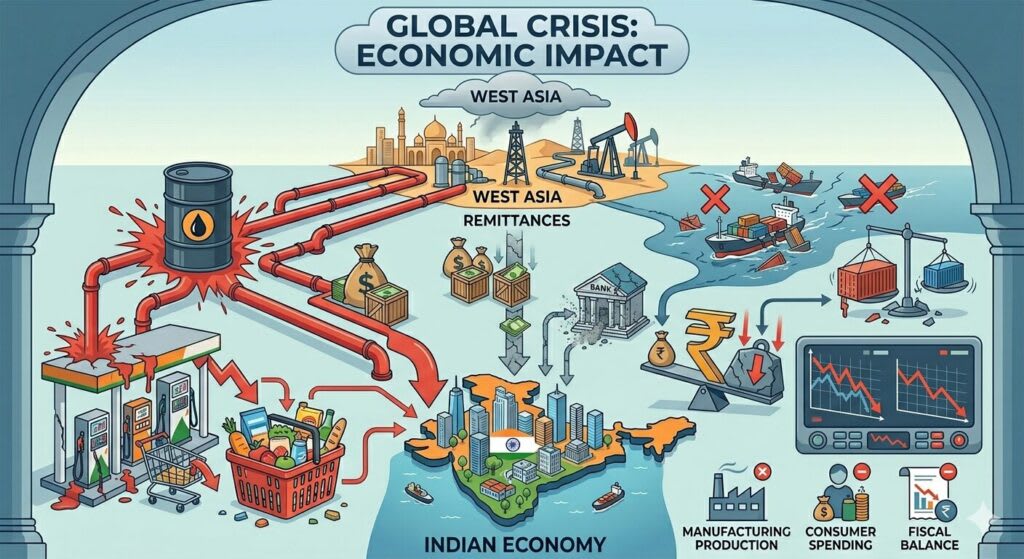
The unfolding conflict in West Asia has once again underscored a recurring truth of global political economy: that regional instability in energy-rich geographies has far-reaching consequences, extending well beyond the immediate effects of conflict. For a country like India, whose economic trajectory is deeply intertwined with imported energy, with 85% of its needed crude oil and gas (LPG and LNG), the ramifications are both immediate and structural. As the situation evolves from 28 February 2026, it is imperative to examine its potential impact on India’s energy security, inflation dynamics, fiscal balance, and broader economic resilience.
At the heart of the issue lies India’s heavy dependence on crude oil imports. India imports nearly 85 per cent of its crude oil requirements, a significant portion of which comes from West Asian countries. Any disruption—whether physical supply constraints or even anticipatory price spikes driven by uncertainty- translates almost instantly into higher import costs. Even in the absence of direct supply interruptions, geopolitical tensions tend to induce speculative pressures in global oil markets, pushing prices upward. For example, Brent Crude oil prices increased from $70 per barrel to $112 a barrel within 2 weeks (the highest price not seen since mid-2022.
The first-order effect of rising crude oil prices is a deterioration in India’s trade balance. Oil constitutes one of the largest components of India’s import basket. A sustained increase in prices widens the Current Account Deficit (CAD), putting downward pressure on the rupee, which fell to an all-time low of Rs 95 per dollar. Currency depreciation, in turn, makes imports more expensive, creating a feedback loop that exacerbates inflationary pressures.
Inflation, particularly in a country like India where food and fuel play a pivotal role in household expenditure, is highly sensitive to energy prices. Fuel is not merely a consumption good; it is a critical input across sectors—transportation, manufacturing, agriculture, and logistics. An increase in fuel costs raises production and distribution expenses, leading to cost-push inflation. This has a cascading effect on prices of essential commodities, disproportionately affecting lower-income households in India who earn less than Rs 10,000 per month.
From a policy perspective, the Reserve Bank of India (RBI) finds itself in a delicate position. On the one hand, rising inflation may necessitate tighter monetary policy to anchor inflation expectations. On the other hand, higher interest rates could dampen investment and consumption, potentially slowing economic growth. This trade-off becomes particularly challenging in an environment where growth recovery remains uneven and external uncertainties are mounting.
The fiscal implications are equally significant. Historically, the Indian government has often intervened to cushion consumers from sharp increases in fuel prices through excise duty cuts or subsidies. While such measures may provide short-term relief, they come at the cost of fiscal consolidation. A reduction in fuel taxes directly impacts government revenues, potentially widening the fiscal deficit. Given India’s ongoing commitment to fiscal discipline, balancing revenue considerations with political and social imperatives becomes increasingly complex.
Beyond macroeconomic indicators, the conflict also raises concerns about energy security in a more fundamental sense. India has made considerable progress in diversifying its sources of crude oil imports over the past decade, expanding procurement to regions such as the United States, Africa, and Latin America. However, West Asia remains a critical supplier due to geographical proximity and established trade relationships. India imports about 50% of its oil and gas via the Strait of Hormuz. Any prolonged instability in the region could disrupt supply chains, increase shipping insurance costs, and necessitate a reconfiguration of import strategies.
In this context, India’s strategic petroleum reserves (SPR) assume heightened importance. These reserves are designed to provide a buffer against short-term supply disruptions. However, their capacity is limited, covering only a few weeks of consumption. While the government has initiated efforts to expand these reserves, the current levels may not be sufficient to withstand prolonged geopolitical shocks. This underscores the need for a more robust and comprehensive energy security framework.
The situation also highlights the urgency of accelerating India’s transition towards renewable energy. Over the past decade, India has made significant strides in expanding its renewable energy capacity, particularly in solar and wind power, which increased by more than 200 GW in 2025. While these efforts are commendable, the pace of transition needs to be significantly scaled up to reduce dependence on imported fossil fuels. Investments in green hydrogen, battery storage technologies, and grid infrastructure will be critical in this regard.
However, it would be simplistic to view the crisis solely through the lens of vulnerability. There are also potential opportunities for India. For instance, shifts in global energy trade patterns could enable India to negotiate more favourable long-term contracts with alternative suppliers. Additionally, Indian refiners—known for their complexity and efficiency—may benefit from processing discounted crude from non-traditional sources, as seen in recent years.
Furthermore, the crisis could act as a catalyst for structural reforms in the energy sector. Rationalising fuel pricing mechanisms, enhancing the efficiency of public sector oil companies, and promoting energy conservation measures could yield long-term benefits. In the industrial sector, rising energy costs may incentivise firms to adopt more energy-efficient technologies, thereby improving overall productivity.
On the geopolitical front, India’s position is uniquely nuanced. Maintaining balanced relations with multiple stakeholders in West Asia has been a cornerstone of India’s foreign policy. In times of conflict, this strategic autonomy becomes even more valuable. India must continue to engage diplomatically with all parties to safeguard its economic interests while contributing to regional stability.
It is also worth noting that the conflict's impact is not confined to oil alone. Natural gas markets, shipping routes, and even global financial markets can be affected. Disruptions in key maritime chokepoints, such as the Strait of Hormuz, would have severe implications for global trade. For India, which relies heavily on maritime routes for both imports and exports, ensuring the security of these channels is of paramount importance.
In conclusion, the ongoing conflict in West Asia serves as a stark reminder of the interconnectedness of geopolitics and economics. For India, the immediate challenges lie in managing inflation, maintaining fiscal discipline, and ensuring energy security. Over the longer term, the crisis underscores the importance of reducing structural dependence on imported fossil fuels and building a more resilient and diversified energy ecosystem.
While the external environment remains uncertain, India’s policy response will play an active role in shaping outcomes. A calibrated mix of short-term mitigation measures and long-term structural reforms can not only cushion the impact of the current crisis but also strengthen the foundations of sustainable economic growth. As history has repeatedly shown, moments of crisis often carry within them the seeds of transformation—provided they are met with foresight, pragmatism, and decisive action that is good for India in the long run.
Prof Dr Ravinder Rena
Full Professor of Economics, School of Business, Woxsen University, India
Contributor at Woxsen University School of Business