The Quantum Impact on Cryptography Landscape
Organizations face an unprecedented cryptographic migration challenge as quantum computers mature. "Store-now, decrypt-later" attacks threaten historical data confidentiality. NIST-standardized post-quantum algorithms like CRYSTALS-Kyber and Dilithium provide quantum-safe encryption.
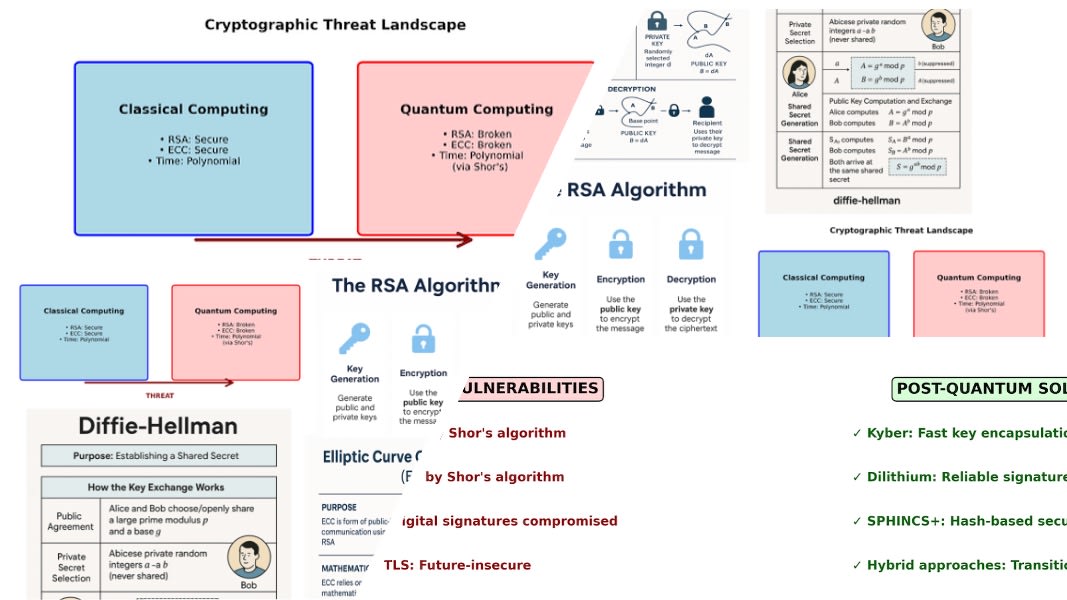
Introduction:
The emergence of quantum computing represents a watershed moment in cybersecurity history, heralding both unprecedented opportunities and existential threats to the cryptographic foundations upon which modern digital civilization rests. As quantum technologies mature from theoretical constructs into practical engineering challenges, the mathematical assumptions underpinning traditional public-key cryptography face an imminent obsolescence [1].
The rise of quantum computing fundamentally challenges the cryptographic landscape by enabling computational capabilities that render currently secure algorithms vulnerable within polynomial time, forcing a comprehensive reassessment of how we protect sensitive data in the post-quantum era [2].
Current Cryptographic Landscape:
1. RSA :
RSA is an acronym for the names of its inventors: Rivest, Shamir, and Adleman. They publicly described the algorithm in 1977. RSA is the most widely used public-key (or asymmetric) cryptographic algorithm. It uses a pair of mathematically linked keys:
Public Key: Used to encrypt data or verify a digital signature. This key can be shared openly.
Private Key: Used to decrypt the data or create a digital signature. This key must be kept secret.
RSA is foundational to online security, used globally for secure web connections (TLS/SSL handshakes), digital certificates, and digital signatures.
2. Elliptic Curve Cryptography (ECC):
ECC is a modern asymmetric encryption scheme that offers a significant advantage over RSA: comparable cryptographic strength with much shorter key lengths. For instance, a 256-bit ECC key offers security equivalent to a 3072-bit RSA key. This efficiency makes ECC ideal for constrained environments like mobile devices and IoT.
Unlike RSA, which is based on the difficulty of factoring large numbers, the security of ECC relies on the difficulty of solving the Elliptic Curve Discrete Logarithm Problem (ECDLP).
3. Diffie-Halman Protocol:
The Diffie-Hellman protocol is one of the most foundational concepts in modern cryptography, specifically for its role in enabling two parties to securely establish a shared secret key. The protocol is often referred to as Diffie-Hellman Key Exchange (DHKE),
The Diffie–Hellman protocol is designed not to encrypt messages directly, but to let two parties—commonly called Alice and Bob—securely agree on a shared secret key over an insecure channel like the internet.
Once established, this shared secret can be used with fast symmetric encryption algorithms (such as AES) to protect actual data exchange.
The Quantum Threat: Breaking Classical Cryptography
Shor's Algorithm and RSA Vulnerability
At the heart of the quantum threat lies Shor's algorithm, a elegant quantum procedure capable of efficiently factoring large integers and computing discrete logarithms—the mathematical problems underlying RSA and elliptic curve cryptography (ECC) [1].
Classical computers require exponential time to break RSA-2048, rendering brute-force attacks computationally infeasible with current technology. However, quantum computers equipped with sufficient qubits can solve these problems in polynomial time, fundamentally inverting the security assumptions that have protected digital communications for decades [3].
The implications are profound: RSA and ECC, which currently secure 80% of global cryptographic infrastructure, could be rendered obsolete within 8-10 years as quantum hardware matures [2]. This threat transcends theoretical concern—it represents a clear and present danger to long-lived data. Information encrypted today using classical algorithms can be preserved and decrypted retroactively once quantum computers become operational, a phenomenon termed "store-now, decrypt-later" attacks [1].
Defense Against Quantum Threat:
NIST Standardization Initiative
Recognizing the urgency of this threat, the National Institute of Standards and Technology (NIST) initiated a global competition in 2016 to identify and standardize quantum-resistant cryptographic algorithms [6]. After multiple rounds of rigorous evaluation involving cryptanalysis, performance benchmarking, and security validation, NIST announced its standardization decisions in 2024, selecting four foundational post-quantum cryptographic (PQC) algorithms [1]. This standardization process represents the most comprehensive cryptographic migration in modern history, establishing protocols designed to withstand attacks from both classical and quantum adversaries [3].
Lattice-Based Cryptography: The Leading Contender
Lattice-based cryptography has emerged as the leading paradigm for post-quantum security, underpinned by the computational difficulty of problems such as the Learning with Errors (LWE) and Shortest Vector Problem (SVP) [7]. These mathematical structures possess remarkable properties: they are believed resistant to both classical and quantum attacks, support efficient implementations, enable advanced functionalities like homomorphic encryption, and provide robust security proofs based on worst-case hardness assumptions [7].
Conclusion and Strategic Recommendations
The quantum threat to cryptographic security represents an unprecedented challenge requiring immediate, coordinated global response. Organizations cannot afford to delay migration to post-quantum cryptography—the window for strategic planning and gradual infrastructure modernization narrows with each passing year. While quantum computers capable of breaking RSA-2048 may not arrive within the next five years, the “store-now, decrypt-later” threat means adversaries are likely already collecting and archiving classified communications to decrypt retroactively [1].
Strategic recommendations include:
(1) Begin immediate evaluation and pilot deployment of NIST-standardized algorithms, particularly CRYSTALS-Kyber for key encapsulation and CRYSTALS-Dilithium for digital signatures;
(2) Implement hybrid cryptographic approaches combining classical and post-quantum primitives to balance immediate deployment feasibility with quantum resistance;
(3) Conduct comprehensive cryptographic audits identifying systems storing long-lived sensitive data requiring prioritized PQC adoption;
(4) Invest in workforce development, ensuring cryptographic engineers and system architects possess practical expertise with post-quantum algorithms;
(5) Establish organizational governance frameworks for managing the lengthy transition period while maintaining security against emerging threats.
References
[1] P. Vareta, H. Muzenda, T. Nyamupaguma, Y. Dube, and B. Ndlovu, “The rise of quantum computing and its impact on cybersecurity,” Indonesian Journal of Computer Science, 2025.
[2] B. R. Gadkari, “Quantum computing and cybersecurity: Navigating the next frontier of digital security,” International Journal of Scientific Research in Computer Science Engineering and Information Technology, 2025.
[3] C. K. Gitonga, “The Impact of Quantum Computing on Cryptographic Systems: Urgency of Quantum-Resistant Algorithms and Practical Applications in Cryptography,” None, Jan. 2025, doi: https://doi.org/10.24018/compute.2025.5.1.146.
[4] N. Safoev, “Security Challenges In The Era Of Cryptography And Quantum Technologies,” American Journal Of Applied Science And Technology, Nov. 2025, doi: 10.37547/ajast/volume05issue11-23.
[5] N. Prajapati, “Review of Quantum Computing Advances and their Impact on Modern Cryptographic Security,” International Journal of Innovative Science and Research Technology, May 2025, doi: 10.38124/ijisrt/25may501.
[6] C. Zong, “Some Mathematical Problems Behind Lattice-Based Cryptography,” Jun. 2025, [Online]. Available: https://www.semanticscholar.org/paper/70d5cd0fb3350dbec14275d36392d31900f78037
[7] I. Singh, “Lattice-Based Cryptography: A Post-Quantum Solution to Secure Digital Communications in the Age of Quantum Computing,” International Journal For Multidisciplinary Research, Mar. 2025, doi: 10.36948/ijfmr.2025.v07i02.38377.