Natural Language Processing (NLP): The Evolution from Rule-Based to Generative Models
Natural Language Processing (NLP) has experienced major changes since it began. NLP was primarily rule-based and used hand coded systems. The field progressed to statistical and machine learning, followed recently by deep learning and large-scale generative models, which reflected both, increases in
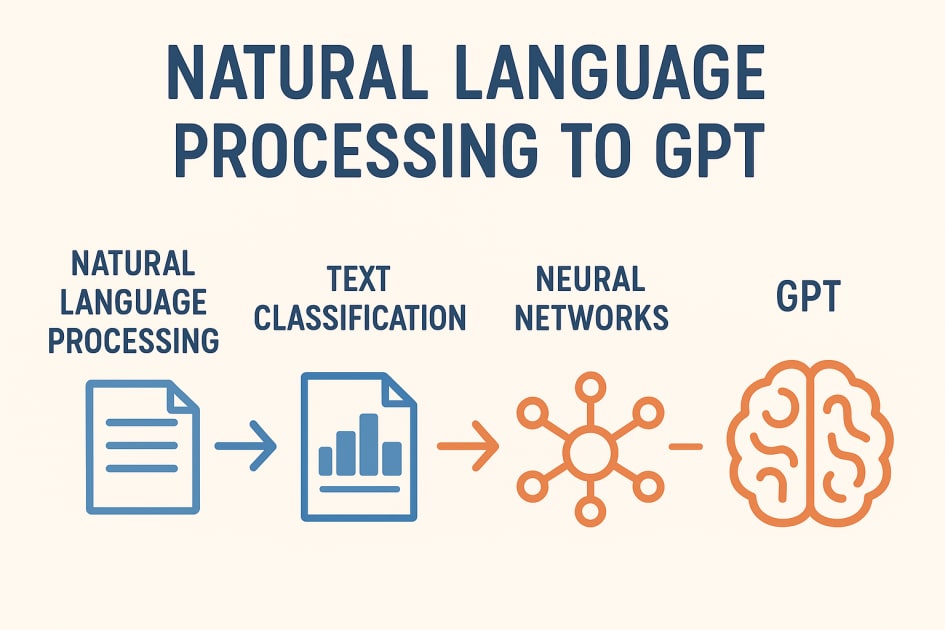
Natural Language Processing (NLP): The Evolution from Rule-Based to Generative Model
1. Introduction
Natural Language Processing (NLP) has experienced major changes since it began. NLP was primarily rule-based and used hand coded systems. The field progressed to statistical and machine learning, followed recently by deep learning and large-scale generative models, which reflected both, increases in computational power and shifts in theoretical and applied priorities—away from explicit linguistic knowledge that was formulated by experts to more data-driven models that learned from large corpora of text. This article will outline the key phases of that evolution, including important successes, shortcomings, and future directions.
1.1. Rule-Based / Symbolic NLP (1950s–1980s)
The first stages of study in NLP used symbolic rules and theories of linguistics. Investigators sought to encode grammars, lexicons, syntax, semantics, and sometimes pragmatics as formal rules that a computer could think and act on. Early NLP systems, including ELIZA (1966) a simple pattern-matching conversation agent, or SHRDLU (1970’s) and its limited "blocks world" were exemplars of rule-based or symbolic NLP, where meaning was created through the use of manually constructed syntax and semantics written in formal rules (eg, grammar trees, context-free grammars) (GeeksforGeeks, “History and Evolution of NLP”) GeeksforGeeks.
The advantages of rule-based approaches included their interpretability, as well as notable outperformance in confined, narrow domains and contexts. However, these rule-based systems had considerable limits, including their brittleness to linguistic variation Classic Examples by AI, Borderless. GeeksforGeeks+2aiworldinsights.com+2.
2. Statistical Natural Language Processing and Machine Learning (1990s–early 2010s)
With the advent of suitable computational resources and access to large text corpora, NLP began its transition into statistical methods of analysis. These statistical methods included n-gram language models, Hidden Markov Models (HMMs) for tasks such as part-of-speech tagging, and probabilistic parsing models such as Probabilistic Context-Free Grammars (PCFGs) (Medium / Preeti Kuntal) Medium+2aiworldinsights.com+2
Machine learning methods including Support Vector Machines (SVMs), Conditional Random Fields (CRFs), and traditional supervised classifiers gained acceptance for tasks such as named entity recognition, sentiment analysis, and text classification. EWADirect+2aiworldinsights.com+2.
Statistical models showed much greater flexibility and generalization than rule-based systems, but still required significant feature engineering, had difficulty modeling long-distance dependencies (e.g., modeling dependencies in discourse), and often required labeled datasets to be effective.
3. The Neural Deep Learning Era (mid 2010s – 2020)
The biggest shift was the introduction of neural networks. Word embeddings, like Word2Vec and GloVe, provided dense vector representations of words based on co-occurrence statistics which were able to encapsulate semantic similarity better than statistical feature-based systems. Recurrent neural networks (RNNs), Long Short-Term Memory (LSTM) networks, and Gated Recurrent Units (GRUs) started to be used to model sequential data and capture longer context (Preeti Kuntal; medium-blog sources). Medium+2Medium+2.
Sequence-to-sequence (seq2seq) models (for example, in machine translation) created a bolder application of this capacity; attention mechanisms allowed the model to focus on appropriate parts of the input sequence, improving performance (Medium outlines) DigitalRGS+2Medium+2.
4. Transformer Models and Pretrained Generative Models (2017 Onwards)
The invention of "Attention Is All You Need" (Vaswani et al., 2017) was a turning point with the transformation model, which replaced recurrence with attention mechanisms entirely, allowing parallelization and capturing long-range dependences much more effectively (blogs/medium sources) Medium+2Medium+2.
Then we saw the pretrained language models that have had massive unsupervised or self-supervised learning. BERT (Bidirectional Encoder Representations from Transformers) initiated bidirectional context modeling. Similarly, GPT-1, GPT-2, GPT-3 + successors, demonstrated generative capabilities - to produce fluent, meaningful text, and to allow zero-; few-; or many-shot learning of new tasks with minimal fine-tuning. arXiv+4Wikipedia+4Medium+4.
Other transformer-based pretrained models such as T5, RoBERTa, XLNet, ELECTRA, DeBERTa have all further pushed performance in tasks such as summarization, question answering, translation, etc (Review papers on generative AI architecture). Health Informatics Journal+2arXiv+2.
5. Generative Models:
The Strengths, Weaknesses, and Differences of Generative models in contemporary NLP (notably Large Language Models (LLMs) is a stark contrast to previous systems that excel in generating unique text. They learn context, transfer across a variety of tasks, and use limited task-specific supervision. Generative models are trained on a massive amount of larger unlabeled corpora using self-supervised objectives (predictions of the next token, masked tokens, span predictions) and then more recent adaptations include fine-tuning or prompting. They can generate text (generation), summaries, translations, dialogue, etc., often producing at what is near human fluency (MEGA Multilingual Evaluation; "Survey of Diffusion Models in NLP") arXiv+1.
However, generative models also have drawbacks: hallucinations (either plausible or false information), computational and environmental costs, biases inherited from training data, lack of interpretability, and difficulty in reliably controlling outputs. Sapien+3arXiv+3arXiv+3
6. Comparative Summary:
Aspect | Rule-based/Symbolic | Statistical/Traditional ML | Neural/Deep Learning | Generative Pretrained Models/LLMs |
Data dependency | Low (rules handcrafted) | Moderate (annotated corpora) | High (large corpora) | Very high (massive corpora, unsupervised/self-supervised) |
Feature engineering |
Heavy (manual) |
Moderate |
Less (learned embeddings etc.) |
Minimal for specific tasks |
Handling long-ranged context |
Poor |
Improved via smoothing etc. |
Much better via RNNs/LSTMs + attention |
Excellent; Transformer architectures with large context windows |
Flexibility/ transferability |
Low |
Moderate |
High | Very high (multitask, few/few-shot) |
Interpretability |
High |
Moderate |
Low to moderate
|
Low |
Computational cost |
Low-moderate |
Moderate |
High
|
Very high |
7. Latest Milestones & Case Studies:
· ELIZA (1966): a pattern recognition simulation that produced conversations based on scripted rules but had no real understanding (GeeksforGeeks).
· SHRDLU in the blocks world: algorithm that demonstrated very early symbolic understanding in a restricted domain (GeeksforGeeks) GeeksforGeeks.
· IBM's statistical machine translation in the 1990s: a predecessor to neural network based and pre-trained models, used probabilistic approaches with large bilingual corpora (Preeti Kuntal; “Evolution…” medium).
· Word2Vec (2013) & GloVe: shift in methods for generating word embeddings and representation learning (Medium sources)
· Transformer / Attention Is All You Need (2017): drove new architectures for many modern models, including AI models.
· BERT (2018) / GPT-1 (2018) / GPT-2 / GPT-3: represented a generative pretrained model that established new state-of-the-art benchmarks across many NLP tasks.
8. Future Research Directions:
Despite the current state of generative models, many avenues of research remain for potential future:
• Efficiency and size: building smaller, efficient models (e.g., model compression, distillation) that can function within low-resource paradigms.
• Interpretability: finding tools to understand decision making in LLMs (e.g., why certain generation occurred).
• Bias, Fairness, and Ethics: addressing harmful biases to ensure performance is equitable if models are deployed across languages or demographic groups.
• Control and Safety: making generation (e.g., prompts, instructions) more deterministic, preventing toxic, hallucinated or misleading content.
• Low-resource languages and multilingual systems: some generative modeling performs well across English or major languages, addressing their performance across many more definitions, (MEGA evaluation) arXiv.
• Multimodal models: generation combining text with images, audio, video, with the potential for richer understanding and generation.
Conclusion:
The trajectory of NLP progressed from explicit rule-based decision systems through statistical systems, to neural networks and deep learning models, and has now culminated in generative pre-trained large language models. Each step was accompanied by improvements in flexibility, performance, and the ability to manage complexity, while introducing new challenges, including the quantity of data required, computational cost, interpretability, and increased social and ethical risk. Going forward, it will be important to address an increasingly expansive and powerful toolkit against a framework of responsibility. Research that seeks to balance generative pre-trained models' efficiency, transparency, fairness and robustness will be paramount to the next phase of evolution.
References:
“History and Evolution of NLP”, GeeksforGeeks. GeeksforGeeks
“The Evolution of Machine Learning in Natural Language Processing: From Traditional Methods to Deep Learning”, EWADirect (ACE Proceedings). EWADirect
Medium: “Natural Language Processing: From Rule-Based Systems to Generative AI” by Rohit Thorat. Medium
Wikipedia: “Generative Pre-trained Transformer (GPT-1)” page. Wikipedia+1
Medium: “The Evolution of Natural Language Processing: From Rule-Based Systems to GPT Models — DigitalRGS”. DigitalRGS
Medium: “The Evolution of Natural Language Processing (NLP) and Its Applications in Real Life” (AI World Insights). aiworldinsights.com
“A Survey of Diffusion Models in Natural Language Processing”, Zou, Kim, Kang, arXiv (2023). arXiv
“MEGA: Multilingual Evaluation of Generative AI”, Ahuja et al., arXiv (2023). arXiv
“Diffusion Models in NLP: A Survey”, Zhu & Zhao, arXiv (2023). arXiv
“A Review of Hybrid and Ensemble in Deep Learning for Natural Language Processing”, Jia et al., arXiv (2023). arXiv
“From rule-based models to deep learning transformers architectures for natural language processing… sign language translation systems: survey, taxonomy and performance evaluation”, Artificial Intelligence Review (2024) SpringerLink
“Generative AI for Text Generation: Advances and Applications in Natural Language Processing”, Saha, JCAI. fringeglobal.com
“Generative AI in the Era of Transformers: Revolutionizing Natural Language Processing with LLMs”, Archna Balkrishna Yadav (2024) Bohrium
“A journey into the Generative AI and large language models: From NLP to BioInformatics”, Ahmed Elnaggar, PMLR (2023) Proceedings of Machine Learning Research
“Rule-Based vs. AI-Driven: Comparing PolyAQG Framework and Generative AI Models”, Proc. of IC on NLP & Info Retrieval (2024) ACM Digital Library
“Advancements and Challenges in Natural Language Processing: A Comprehensive Review”, Creative News. Creative News
LinkedIn: “The Evolution of NLP: From Rule-Based Systems to Cutting-Edge Models”, Khaleel Shaik. LinkedIn
Medium: “The Evolution of Natural Language Processing: From Rules to Neural Networks”, Shriya Shenoy. Medium
“Artificial Intelligence Methods in Natural Language Processing: A Comprehensive Review”, Chen, Wang, Yu, Zhou (2024) Bohrium
“A Review of Generative Adversarial Networks in Text Generation”, Jaden Cohen (Preprint).